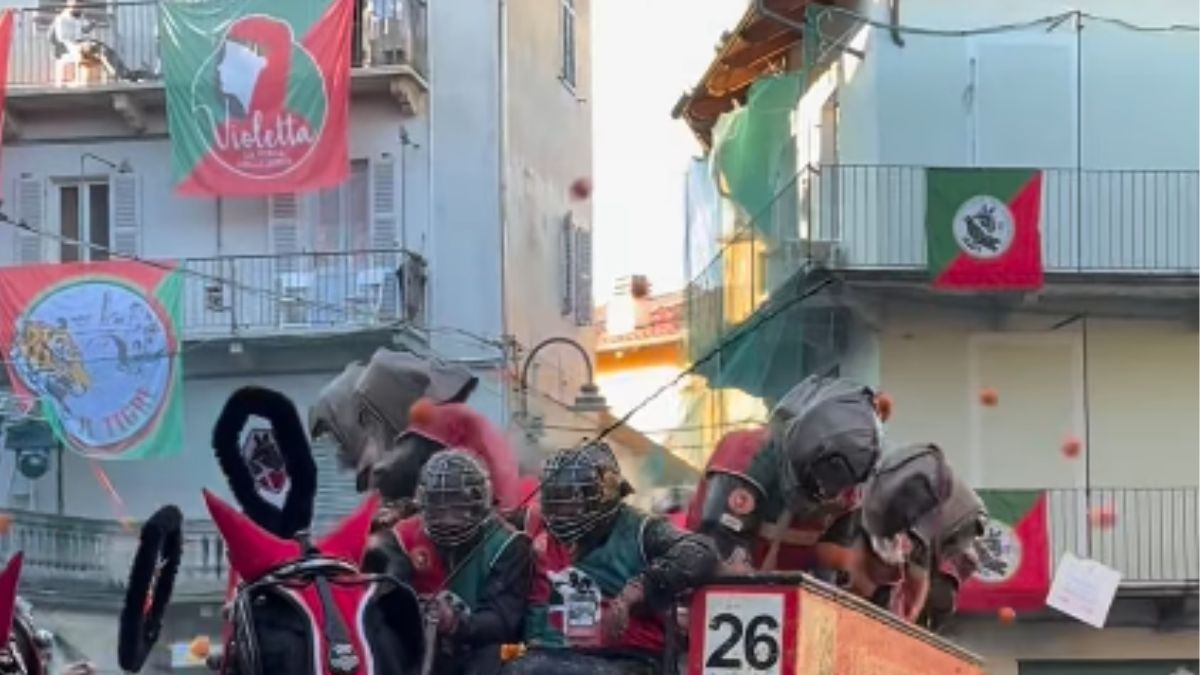
Every year, thousands of people descend on the small northern Italian city of Ivrea for one of the most spectacular and unusual festivals on the planet. The event, known as the Battle of Oranges, is a three-day carnival tradition that draws visitors and participants from across the globe. Set against the backdrop of a medieval city situated near Turin, the festival transforms the streets into a colorful, fruit-filled battlefield. As reported by Euronews, the most recent edition of the event once again brought massive crowds eager to take part in this living piece of history.
The origins of the Battle of Oranges stretch back to around the year 1200, rooted in a legend that has been passed down through generations. According to tradition, the city once lived under the oppressive rule of a feudal baron who held a cruel privilege over the local population. The law granted him the right to spend the first night of any marriage with a bride of his choosing, taking that right away from her husband. It was a practice that embodied the worst of medieval feudal tyranny, and the people of Ivrea eventually had enough.
The spark that ignited the rebellion was a young woman named Violetta, the daughter of a local miller. She refused to submit to the baron’s demand, and her defiance quickly inspired the entire community to rise up against him. The uprising that followed was swift and decisive. The tyrant was overthrown, his castle was destroyed, and Ivrea was declared a free municipality. Violetta’s act of courage became the founding story of a city that has never forgotten what it once fought for.
Today’s festival is a faithful and dramatic reenactment of that historic revolt. The fighters who take part in the battle are known as the “Aranceri,” or Orange Throwers, and they are divided into nine teams on foot, each representing the rebellious townspeople. Their opponents ride on horse-drawn carriages, symbolizing the feudal armies that once sought to maintain the baron’s iron grip on the city. The battle takes place on the final day of the carnival, and the intensity of the orange-throwing is as real as it gets. Participants are pelted with fruit at close range, making the event as physically demanding as it is theatrical.
One of the most common questions surrounding the festival concerns the sheer quantity of oranges involved and what ultimately happens to them all. Organizers have addressed this directly, explaining that the fruit used during the celebration is not suitable for retail or consumption in the first place. Once the battle concludes and the festivities wrap up, every last orange is carefully gathered from the streets and squares of Ivrea. Rather than going to waste, all of the collected fruit is repurposed as organic fertilizer, giving even the discarded ammunition a second life.
The Battle of Oranges is also notable for its visual spectacle and the genuine communal spirit it generates. Participants wear distinctive costumes and protective gear, and spectators who do not wish to be hit by stray oranges are advised to wear a red cap, which signals to the Aranceri that they are observers rather than targets. The event blends history, mythology, and sheer fun into a tradition that has kept Ivrea on the cultural map of Italy for centuries. The streets run orange with juice by the end of each day, and the smell of citrus hangs over the entire city.
Beyond just the battle itself, the carnival of Ivrea is a UNESCO-recognized event and one of Italy’s oldest and most culturally significant festivals. The city, formally known as Ivrea, is located in the Piedmont region of northwestern Italy, in the metropolitan area of Turin. Carnival in Italy traditionally takes place in the period leading up to Lent, meaning the festivities fall in February or early March depending on the year. The Battle of Oranges specifically takes place on the Sunday, Monday, and Tuesday before Ash Wednesday. Ivrea’s carnival is distinct from the more internationally famous Venice Carnival, though both are celebrated during the same season. The use of oranges as symbolic stand-ins for the cannonballs and stones of a medieval revolt is a uniquely inventive touch that has helped this tradition endure far beyond its origins. The Piedmont region itself is known for its rich history, alpine landscapes, and a deeply rooted sense of local identity, all of which find expression in events like this one.
If you’ve ever heard of the Battle of Oranges or would love to witness something like it in person, share your thoughts in the comments.




