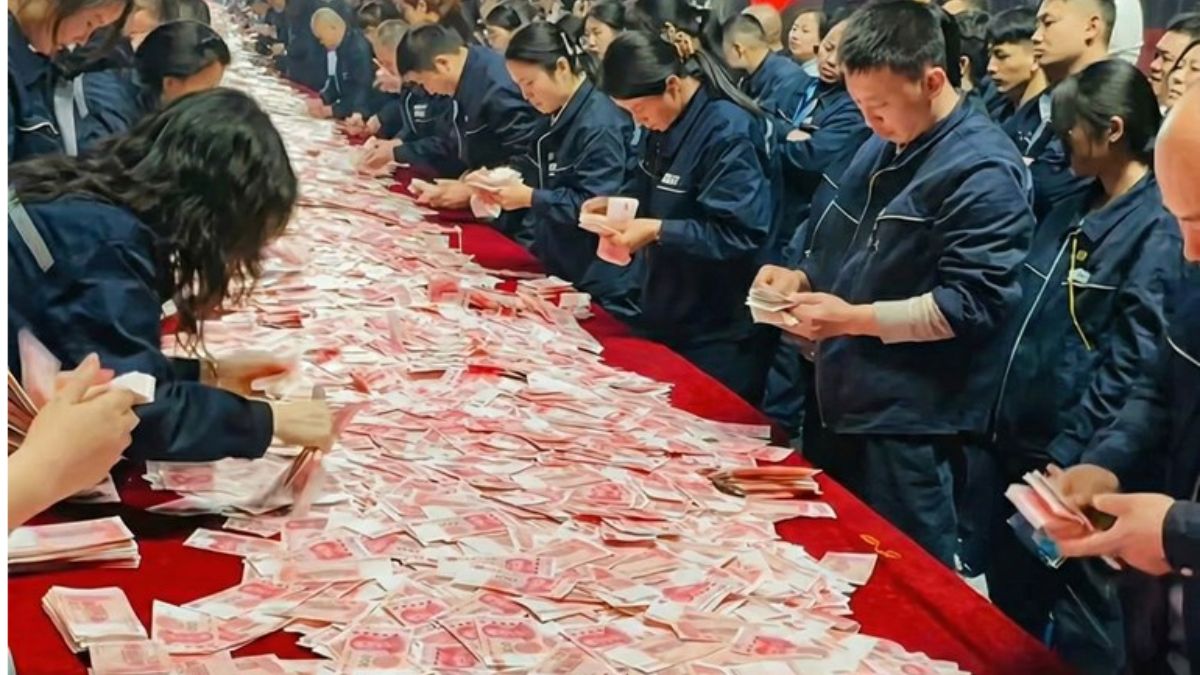
Most employees walk away from their company’s year-end celebration with a gift card or a branded mug. Workers at Henan Kuangshan Crane Co. Ltd. in China walked away with armfuls of cash. The manufacturing company held its annual banquet on February 13, spreading an estimated $26 million in physical banknotes across 800 tables and inviting roughly 7,000 attendees to take home as much as they could carry. According to Chinese media reports, at least one employee managed to pocket around $13,000 in a single night.
The spectacle was the deliberate vision of company director Cui Peijun, who wanted the bonus distribution to feel personal rather than transactional. When asked why he chose cold hard cash over a standard bank transfer, Peijun was characteristically blunt. “Some wonder why we don’t just transfer the money to their accounts, but that would just be cold numbers,” he explained. During the evening’s festivities, he reportedly also announced an on-the-spot addition to the celebration, telling the room: “Previous years we gave necklaces and rings. Why would we give washing machines? Bring cash and give everyone an extra 20,000 yuan.” That extra 20,000 yuan works out to roughly $2,200 per person, piled on top of the already staggering sum already laid out on the tables.
Peijun’s generosity is not a one-time headline grab. He holds a 98.88% stake in the company and has made it a consistent practice to funnel a significant portion of dividends back to his workforce. In 2024, the company posted a net profit of $38 million, and roughly $24 million of that was redistributed among employees. The year before, in 2023, the company set aside $8.5 million specifically for its top 40 performers, with the three highest-achieving salespeople each receiving $730,000. In March of that same year, nearly 2,000 female employees collectively received close to $230,000 in bonuses in honor of International Women’s Day.
A dream corporate party took place in China
— NEXTA (@nexta_tv) February 26, 2026
During a Chinese New Year celebration, Henan Kuangshan Crane piled up mountains of cash for 7,000 employees.
There were $26 million in cash laid out on the table. The only rule: take it with your hands and carry it away yourself.
The… pic.twitter.com/hH79ej7Bk6
The philosophy behind all of this generosity, according to Peijun himself, is rooted in a very practical understanding of financial pressure. “It’s not that I love giving money, but young people are burdened with car loans and mortgages, and any relief we can provide is welcome,” he said. His outlook extends well beyond the walls of his own company. In 2022, he donated $4.7 million to support more than 4,000 university students from low-income backgrounds. As reported by the South China Morning Post, Peijun’s motivation is deeply personal, having been forced to drop out of school himself because his family could not cover the costs. “Poverty must not be passed to the next generation,” he said. “They must not be denied education because of poor living conditions.”
Henan Kuangshan Crane Co. Ltd. was founded in 2002 and operates in the crane manufacturing and rental industry, with a presence spanning more than 130 countries. The company’s financial success mirrors broader trends in the Chinese economy. According to World Bank data, China has recorded faster GDP growth than the United States every year since 1977. In 2024, China’s economy grew at 5%, while the U.S. economy expanded at 2.8%. The International Monetary Fund’s January report projects China will grow at 4.5% in 2026. Despite this impressive macro-level growth, China’s GDP per capita, widely used as a measure of individual living standards, remains significantly lower than that of the U.S., sitting at around $13,303 compared to $84,534 in America.
Employee bonuses in China have a long cultural history tied to the Lunar New Year period, when companies traditionally reward staff before the holiday season. Cash gifting in Chinese business culture carries symbolic weight beyond its monetary value, representing respect and acknowledgment from leadership. The practice of distributing physical cash at large gatherings, while unusual by Western standards, is sometimes used by Chinese employers to create a sense of collective celebration and to make the reward feel more tangible and emotionally resonant than a quiet deposit into a bank account. Large-scale bonus events have become a form of employer branding in China, often going viral on social media platforms and helping companies attract talent in competitive markets.
Would you like to share what you think about Cui Peijun’s approach to rewarding his employees? Let us know in the comments.




