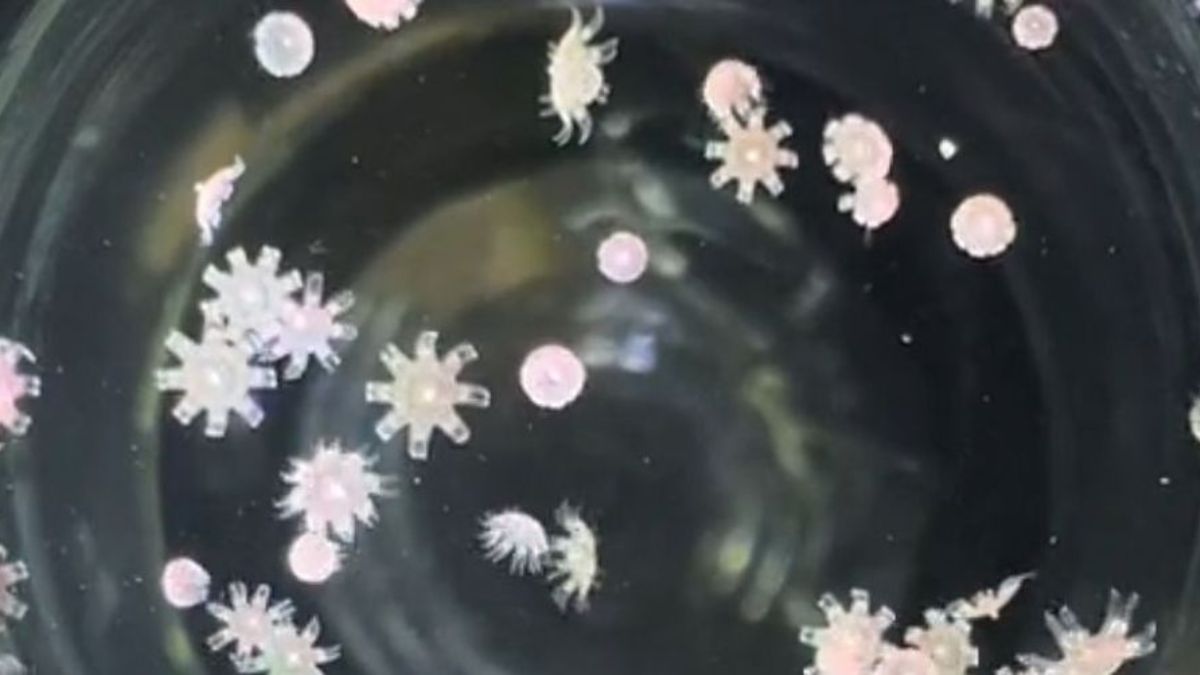
Most people’s first encounter with a jellyfish is not a pleasant one. You wade into the ocean on a warm summer day, and without any warning, something gelatinous brushes against your leg and suddenly your afternoon is ruined. It’s a deeply unglamorous introduction to one of the planet’s most ancient and fascinating creatures. But a series of videos posted by a TikTok account called JellyfishFarm has been quietly changing minds, showing the world what jellyfish look like before they grow up into the stinging nuisances we know and fear. The footage features tiny, translucent jellyfish babies drifting through the water in a controlled lab environment, and it has enchanted millions of people who had never imagined that jellyfish could be this adorable.
The JellyfishFarm account, which documents life inside an actual jellyfish breeding facility, has been posting close-up clips of baby jellyfish for some time, but the videos began accumulating massive viewership as they spread across social media platforms. In one clip, the caption reads simply “Jellyfish Babies in our lab!” and that modest description does not even begin to capture the reaction viewers have had. Comments flooded in from people expressing shock, wonder, and something close to affection for animals they previously associated only with pain and beach warnings. For many watching at home, these were genuinely the first baby jellyfish they had ever seen, and the experience was nothing short of transformative.
What makes the videos so compelling is how completely they reframe the jellyfish. In the ocean, these creatures are often spotted as pale blobs washing up on shore or drifting unpredictably close to swimmers. But in the lab footage, the tiny juveniles appear almost ethereal, moving with a gentle pulsing rhythm that looks more like a slow-motion ballet than anything threatening. Their bodies are nearly see-through, their movements hypnotic, and the scale of them compared to what they will eventually become makes the whole thing feel a little surreal. Viewers who spent years dreading jellyfish season at the beach found themselves commenting that they had never realized jellyfish could look this way.
@jellyfishfarm Jellyfish Babies in our lab! #jellyfish #jellyfishfarm #cute #jellytok ♬ Originalton – JellyfishFarm
Jellyfish farms like the one behind the TikTok account serve multiple purposes beyond generating viral content. These facilities raise jellyfish for scientific research, for aquariums, and sometimes for the restaurant industry, particularly in parts of Asia where jellyfish has been a culinary staple for centuries. Maintaining a controlled breeding environment requires significant expertise because jellyfish have a complex life cycle that involves multiple distinct stages. What most people think of as a jellyfish, the bell-shaped swimming form, is actually just one phase of a life that begins as a tiny polyp attached to a surface before eventually budding off into the free-swimming creatures we recognize.
The viral success of these baby jellyfish videos reflects a broader phenomenon happening across social media, where nature content filmed with care and patience consistently draws enormous audiences. Wildlife accounts documenting everything from octopus behavior to deep-sea creatures have built loyal followings by offering people a window into parts of the natural world they would never otherwise encounter. The JellyfishFarm clips fit perfectly into this tradition, combining genuinely unusual subject matter with footage that is calm, beautiful, and completely unlike anything that typically interrupts a social media scroll.
It also helps that the timing of these videos coincides with a growing general interest in marine biology and ocean conservation. As awareness of ocean health has increased, so has public curiosity about the creatures that live there, even the ones that tend to sting first and ask questions never. Jellyfish, it turns out, are not only beautiful in their infant stage but also remarkably important to marine ecosystems. They serve as food sources for sea turtles, certain fish species, and even some seabirds, and their populations are closely watched by scientists as indicators of broader environmental changes in ocean temperatures and chemistry.
Here is something that tends to stop people mid-conversation: jellyfish have been around for at least 500 million years, which means they survived every major mass extinction event on Earth, including the one that wiped out the dinosaurs. Also, one species called Turritopsis dohrnii is technically considered biologically immortal because it can revert to its juvenile polyp stage after reaching maturity and start the whole cycle over again, essentially cheating death on a loop. And if you ever wondered why jellyfish sting you even after they wash up dead on the beach, it is because their nematocysts, the tiny stinging cells, remain active for hours after the animal has died.
If these videos have shifted your feelings about jellyfish even slightly, share your thoughts in the comments.




