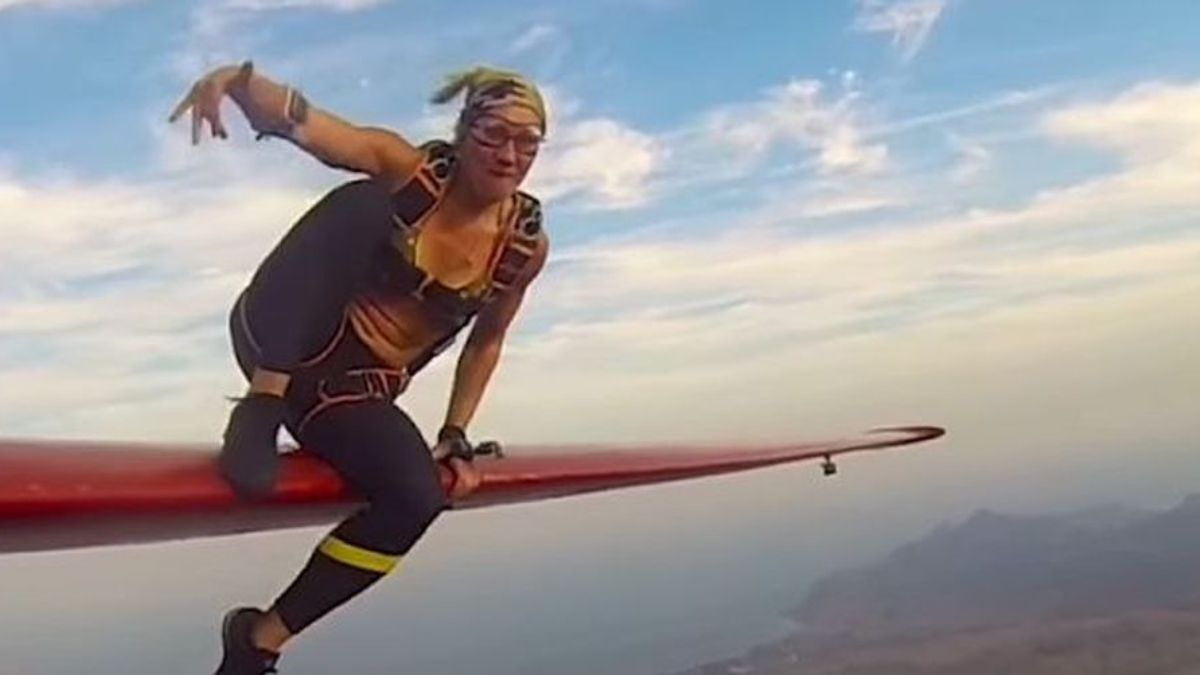
There is something almost magnetic about watching extreme athletes push themselves beyond what most people would dare to attempt. Skateboarding down near-vertical ramps, launching off mountain cliffs on wingsuits, surfing waves that could swallow a house whole — these pursuits attract a breed of person for whom ordinary life simply does not offer enough stimulation. Clips of their adventures have flooded social media for years, racking up millions of views and sparking both admiration and wide-eyed disbelief. But lately, it is the compilations of things going spectacularly wrong that seem to be generating the most conversation online.
A video collection currently making the rounds across various social platforms has captured exactly that phenomenon. Gathered together are footage of daring feats gone sideways — stunts that started with confidence and ended with a crash landing, a wipeout, or a moment of pure chaos that no amount of training could have predicted. The clips span disciplines ranging from mountain biking and parkour to base jumping and snowboarding, offering an unfiltered look at just how quickly adrenaline-fueled ambition can turn into a humbling reality check. What makes these compilations so hard to look away from is not the spectacle of failure itself, but the very human quality of it — the gap between what someone believed they could do and what physics ultimately decided.
Extreme sports have always carried a built-in acceptance of risk. Athletes who pursue disciplines like free solo climbing, big wave surfing, or motocross understand that falls and injuries are not just possible but practically inevitable over the course of a career. What has changed is the omnipresence of cameras. Action cameras mounted on helmets, drones hovering overhead, and smartphones in the hands of spectators mean that nearly every wipeout, every miscalculated jump, and every unplanned landing is now documented in high definition. This has created an entirely new kind of content economy, where the most gripping failures can travel around the world within hours.
Research into the psychology of risk-taking has shed some light on why these athletes keep pushing despite the obvious dangers. Studies have found that extreme sport participants tend to score higher on sensation-seeking scales than the general population, and many describe the experience of fear itself as part of the draw rather than a deterrent. For some, the calculation is simple: the reward of mastering something terrifying outweighs the possibility of getting hurt. For others, the presence of a camera adds its own layer of motivation, making the performance feel larger and more meaningful. That combination of genuine passion and the desire to be witnessed is what fills these compilations with moments that feel simultaneously reckless and deeply earnest.
The social media reaction to these videos tends to follow a familiar pattern. Comments pour in from people who are incredulous that anyone would attempt such things, alongside others who have tried the same activity and can pinpoint exactly where the athlete made their mistake. Veteran practitioners often use the footage as a teaching moment, pointing out the technical errors while also expressing genuine sympathy for what comes next. There is a kind of community that forms around extreme sports content online, one that is unusually candid about the realities of the lifestyle compared to the more polished images associated with other athletic pursuits.
Safety culture within extreme sports has actually evolved considerably over the past two decades, even as the activities themselves have become more spectacular and more widely shared. Helmets, impact-absorbing suits, avalanche airbags, and improved rescue protocols have made many disciplines meaningfully safer than they once were. Organizations dedicated to specific sports have implemented training certifications and location-specific rules to reduce preventable accidents. None of this eliminates the risk, of course — that would defeat the entire purpose — but it does mean that the crashes captured in viral compilations are often far less catastrophic than they appear in the moment.
That said, the footage does not lie about the fundamental nature of what these athletes are doing. Every clip in a compilation like this represents a real person who walked away with scrapes, bruises, or worse, and who in many cases climbed back up and tried again. That persistence, perhaps more than the daring itself, is what draws so many viewers back to this kind of content again and again.
The term “extreme sports” was not widely used until the early 1990s, when ESPN coined it to market the first X Games in 1995 — before that, activities like skateboarding and BMX were simply called “action sports” or just given their individual names. Base jumping, widely considered one of the most dangerous activities on earth, has a fatality rate estimated at around one death per 500 to 2,300 jumps depending on the discipline, making it statistically far more dangerous than skydiving. And wingsuit flying, which looks like something out of a superhero film, requires jumpers to sometimes have over 200 conventional skydives under their belt before they are even allowed to attempt it for the first time.
What is your relationship with extreme sports — do you watch, participate, or just enjoy seeing what happens when things go sideways? Share your thoughts in the comments.




