The Vanity Fair Oscars afterparty has long been considered the night’s most watched second act, a gathering where the fashion choices are studied just as closely as what happened on the main stage hours earlier. On March 15, 2026, Naomi Watts arrived at the event and immediately commanded attention. The 57-year-old actress wore a black sequined gown from Balenciaga’s Fall/Winter 2026 collection, designed by Pierpaolo Piccioli, and the result was the kind of red carpet moment that photographers circle around rather than simply capture in passing. The dress shimmered under the lights with a liquid-like quality, its surface catching and releasing light with every movement.
The design itself was architecturally considered. An off-the-shoulder asymmetrical neckline gave the gown a sculptural quality, while a dramatically high thigh slit introduced an element of bold confidence that contrasted beautifully with the overall refinement of the look. Watts wore the dress with simple classic black heels and kept her jewelry deliberately minimal, choosing only a few delicate silver rings. Her styling decisions spoke to a clear and assured aesthetic vision: nothing unnecessary, nothing competing with the gown itself. Her hair, a sleek chin-length blonde bob, framed her face with precision, and a bold red lip provided the single point of vivid color in an otherwise darkly glamorous composition. The effect was widely described as a fusion of modern sculpture and old Hollywood glamour, two sensibilities that rarely coexist this comfortably on the same person.
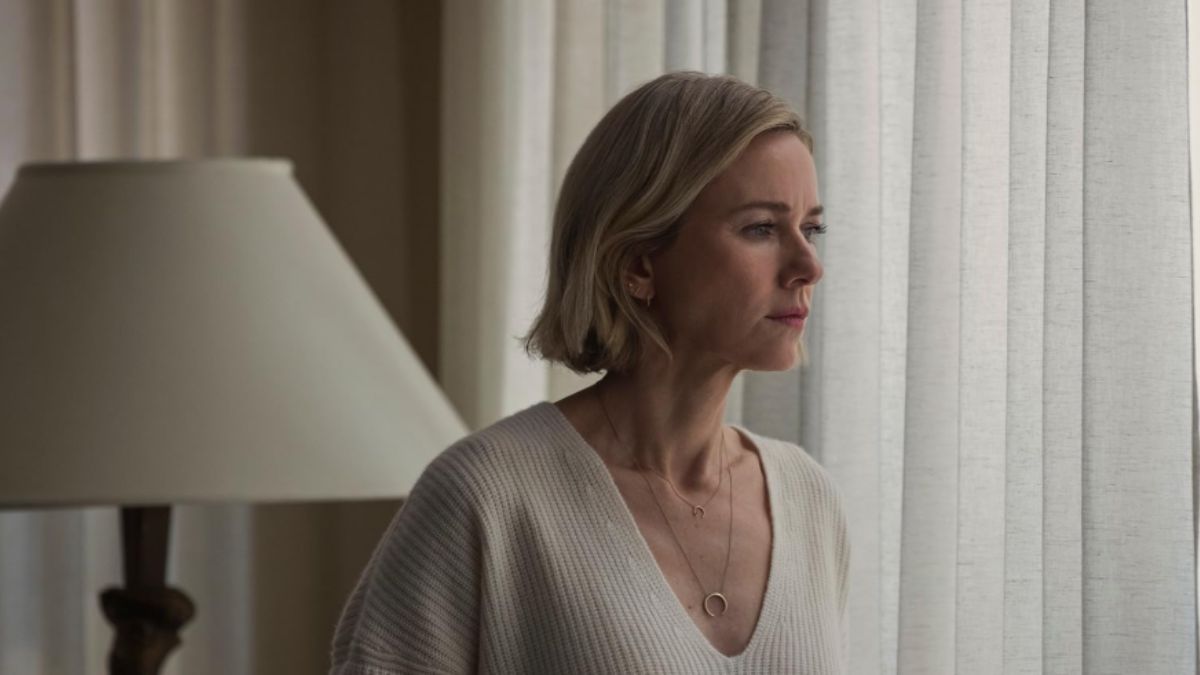
The appearance came at a moment when Watts is receiving some of the most enthusiastic professional attention of her career. She has been earning significant praise for her portrayal of Jacqueline Kennedy Onassis in the FX series ‘Love Story,’ which premiered in February 2026. The show centers on the lives of John F. Kennedy Jr. and Carolyn Bessette-Kennedy, with Watts inhabiting one of the most scrutinized and mythologized figures in American cultural history. Playing Jackie Kennedy is a role that invites relentless comparison and carries enormous pressure, given how deeply the public image of that woman is embedded in the collective imagination. By most critical accounts, Watts has delivered a performance of real nuance and emotional intelligence, neither mimicking nor overwhelming the role with imitation.
Naomi Watts arrives to the Vanity Fair #Oscar party pic.twitter.com/FcCc4mdcdg
— Variety (@Variety) March 16, 2026
It is a career trajectory that rewards closer attention. Watts was born in England and raised in Australia, and she spent years working in television and smaller film roles before her international breakthrough in David Lynch’s ‘Mulholland Drive’ in 2001. That performance was disorienting in the best possible way, a dual role that demanded radical tonal shifts and left audiences genuinely unsettled. It announced her as an actress willing to operate in deeply uncomfortable psychological territory, and it set the tone for a career defined by ambition rather than commercial calculation. Her subsequent Oscar nominations for ’21 Grams’ in 2003 and her acclaimed work in ‘The Impossible’ in 2012 confirmed that the Lynch breakthrough was not a fluke but a genuine declaration of intent.
What makes Watts particularly interesting as a public figure is how she has engaged with the subject of aging and visibility in an industry that has historically been unforgiving to women who are not in their twenties and thirties. She has spoken candidly about menopause, about the social pressures women face around appearance, and about the way Hollywood tends to sideline actresses at precisely the moment when they have accumulated the most depth and craft. Appearing at one of the most photographed events of the entertainment year in a daring, sequined Balenciaga gown with a high slit and a fierce red lip is, in that context, not just a fashion choice but something closer to a statement. The effortlessness of it is part of the point.
Pierpaolo Piccioli, who designed the gown Watts wore, was most recently the longtime creative director of Valentino before joining Balenciaga, and his appointment brought with it a great deal of industry anticipation around how he would translate his reputation for romantic, color-saturated drama into Balenciaga’s more severe and conceptual house language. The Fall/Winter 2026 collection that produced Watts’s gown has been among the most discussed of the recent season, and seeing it worn at the Vanity Fair party by someone who wore it with such conviction only amplified that conversation.
The Vanity Fair Oscars afterparty has been held annually since 1994, when Graydon Carter relaunched it after a three-year hiatus, and it has become so embedded in awards season culture that many in the industry consider the guest list and fashion arrivals nearly as newsworthy as the ceremony itself. Jacqueline Kennedy Onassis, the character Watts is currently playing in ‘Love Story,’ was so influential on fashion history that designers still cite her as a reference point today, which means Watts is currently inhabiting one of the most style-defining figures of the 20th century on screen while simultaneously delivering looks on the red carpet that are generating their own conversation. And Balenciaga, the house that made Watts’s gown, was founded by Cristóbal Balenciaga, whom Coco Chanel once described as the only true couturier among her contemporaries, a compliment so pointed it became one of the most repeated lines in fashion history.
What did you think of Naomi Watts’s look at the Vanity Fair party, and are you following her work in ‘Love Story’? Share your thoughts in the comments.




