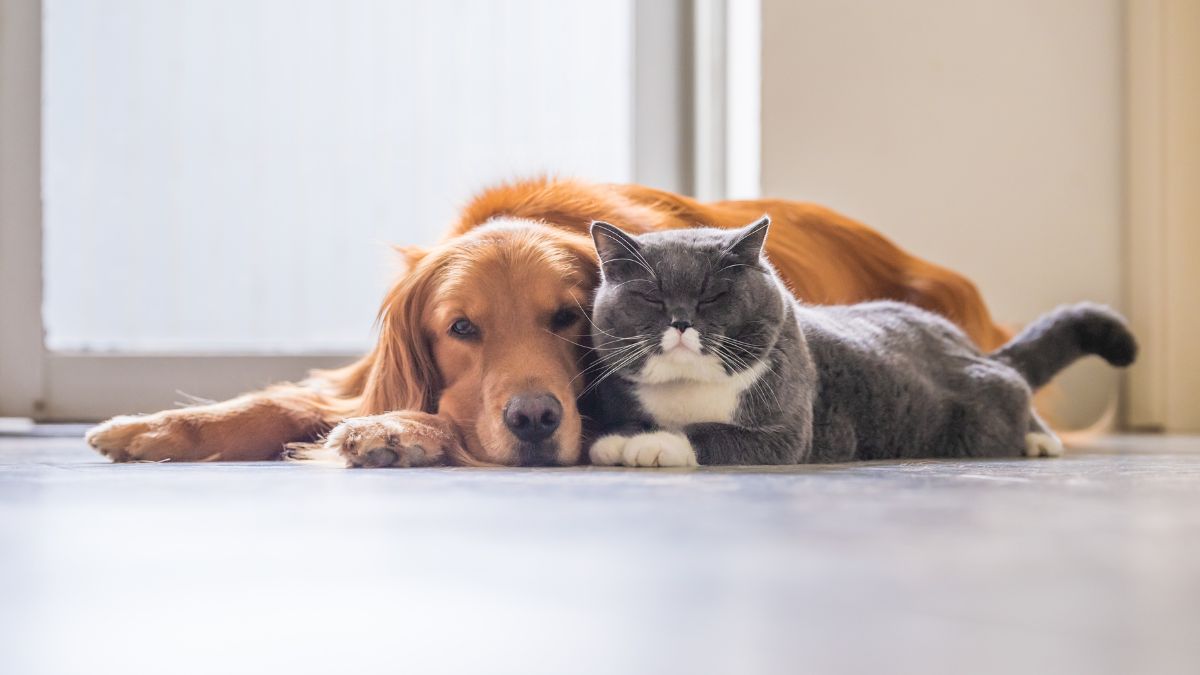
If you have ever scrambled around the house searching for your keys while your dog watched you intently and your cat remained completely unmoved on the couch, a new study suggests that dynamic is not coincidental. Research published in the journal Animal Behaviour has found that dogs behave in ways that more closely resemble young children than they do cats when it comes to spontaneous helping, and the explanation reaches deep into the evolutionary history of both species. The findings are being widely discussed among animal behavior researchers for what they reveal not just about pets, but about the nature of prosocial behavior across species that have developed close bonds with humans.
The study was conducted by scientists at Eötvös Loránd University in Hungary, a research institution with a long-standing reputation for rigorous comparative animal cognition work. The experimental setup was deliberately simple. Researchers observed whether untrained dogs, cats, and toddlers between the ages of 16 and 24 months would spontaneously help a caregiver locate a hidden object, in this case an ordinary kitchen sponge with no inherent appeal or value to any of the participants. Critically, the caregiver never directly asked for help, and no rewards were offered at any point during the experiment. This design was intentional: it allowed researchers to determine whether any helping behavior that emerged was genuinely self-motivated rather than a response to a command, a learned trick, or the anticipation of a treat.
The results were striking. More than 75 percent of the dogs and toddlers either physically retrieved the hidden object and brought it to the caregiver, or used clear communicative gestures to indicate its location, such as looking back and forth between the caregiver and the object in a way that was unmistakably intentional. The toddler results aligned neatly with existing developmental research showing that children at that age are already naturally disposed toward spontaneous prosocial behavior, which made the dogs’ matching performance all the more significant. Because no instruction was ever given, the researchers concluded that the dogs’ helpful responses were driven by genuine internal social motivation rather than by obedience or training.
Cats responded to the same situation in an almost entirely different way. They frequently paid attention to what was happening, demonstrating that they were aware of the scenario, but very few made any move to help. The only notable exceptions occurred in control tests where the hidden object was something the cat personally wanted, such as a favorite toy or food. Even then, the behavior appeared to be motivated by self-interest rather than by any concern for the caregiver’s need. The researchers are careful to note that this does not mean cats are indifferent to their owners or lack emotional depth. The more accurate interpretation, they suggest, is that cats operate with a higher degree of independence and tend to act selectively based on their own interests, which is a distinct cognitive and social strategy rather than a moral failing.
The evolutionary explanation for this divide is compelling. Dogs are descended from wolves, animals that evolved as highly cooperative pack hunters where reading social cues and coordinating with others was essential for survival. Over thousands of years of domestication, humans then selectively reinforced these tendencies even further, breeding dogs for attentiveness to human signals, responsiveness to human communication, and willingness to work alongside people toward shared goals. The result is an animal whose social wiring is, in certain meaningful respects, calibrated specifically for human partnership. Cats, by contrast, evolved from more solitary ancestors and are widely believed to have largely domesticated themselves, gravitating toward human settlements because of the food sources that agricultural communities created, without facing the same evolutionary pressure to develop cooperative or communicative behaviors directed at humans.
What makes this research particularly valuable is its methodology. By placing domestic pets and human children in the same experimental framework and using an object with no personal relevance to anyone involved, the researchers were able to isolate something genuine about the social orientation of each species. The study suggests that simply living alongside humans and forming close bonds with them is not automatically enough to produce the kind of spontaneous helping behavior observed in dogs and young children. Something deeper in the evolutionary and developmental history of the species appears to be required. For dogs, that something has been shaped over millennia of active partnership with humans in ways that may be genuinely unique among domesticated animals.
Eötvös Loránd University in Budapest, where this research was conducted, is also home to the Family Dog Project, one of the most influential long-running research programs in the world dedicated to studying the cognitive and social abilities of domestic dogs, and it has been publishing landmark studies on dog behavior and dog-human communication since the late 1990s. The domestic cat, for its part, has only been formally classified as a separate species from its nearest wild relative, the African wildcat, within the last few decades, with genetic research confirming that the split between tame and wild populations is surprisingly recent and incomplete by evolutionary standards. And here is the detail that keeps coming up in animal cognition circles: dogs are one of the only non-human animals known to follow a human’s pointing gesture to find a hidden object, a skill that even our closest primate relatives, chimpanzees, struggle significantly to learn.
Does your dog or cat surprise you with helpful or empathetic behavior? Share your stories in the comments.




