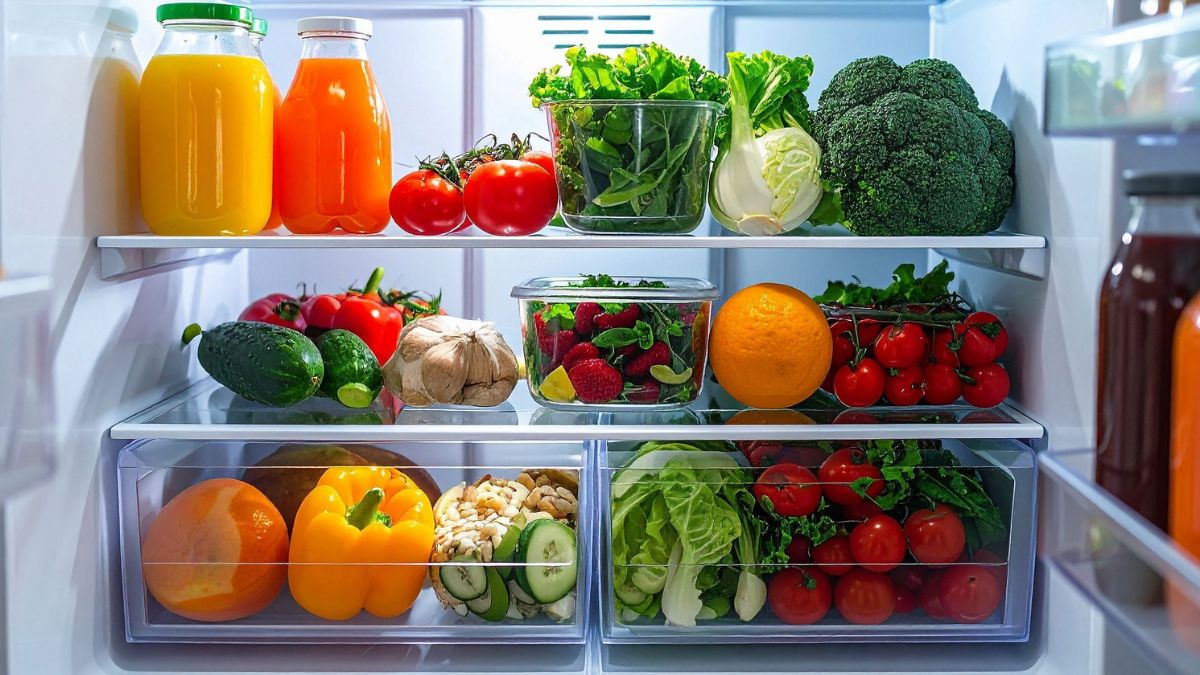
Coming home from the grocery store and finding somewhere to fit everything in the fridge is a task most people approach on autopilot. Produce goes wherever there is space, which is often in the crisper drawers at the bottom because that is what they seem to be there for. The problem is that while most people know crisper drawers exist for fruits and vegetables, very few actually understand how they work or how to use them correctly, and that gap in knowledge is costing households both money and food quality on a regular basis. Three appliance experts, speaking to Martha Stewart, explained exactly why this matters and what most people are getting wrong.
The core function of crisper drawers is to maintain the humidity levels that fresh produce needs to stay at its best. Mattia Sala, a product manager at SMEG USA, explains the logic clearly: the main refrigerator compartment is designed to circulate cold, dry air, which works well for most foods but is not ideal for produce. “The main refrigerator space is designed to circulate cold air and maintain low humidity, which are ideal conditions for preserving the freshness of many foods,” Sala says. “However, some fresh foods, especially fruits and vegetables, require more moisture and lower temperatures than those found in the rest of the refrigerator, and that is where the drawers come in.” When produce does not get that moisture, it wilts and dries out faster, which is the exact problem crisper drawers are engineered to prevent.
The way produce is arranged within the drawers also matters. Sala recommends laying leafy greens flat rather than stacking them upright, which helps prevent moisture loss through the cut or damaged edges. Lighter, softer items should sit on top of denser, heavier ones to avoid bruising, a simple principle that most people understand in theory but tend to abandon in practice when the drawer is already half full and they are trying to fit in a bag of spinach.
Food safety is an equally important consideration that gets less attention than freshness. Amy Chernoff, an appliance expert, notes that placing fresh produce near raw meat or leaking containers on the main shelves creates real contamination risk, and misusing the crisper drawers compounds that problem. “When drawers are used incorrectly, excess moisture and contact with other food can create perfect conditions for mold and bacteria growth,” Chernoff explains. “Using the drawers correctly creates a cleaner, more stable environment that preserves both freshness and food safety.” In other words, the drawers are not just about keeping lettuce crisp; they are part of the refrigerator’s overall system for preventing food-borne illness.
Not all produce wants the same humidity, and this is where the adjustable humidity sliders found on most crisper drawers become genuinely useful rather than decorative. If the fridge has two drawers, the split is fairly intuitive. Leafy greens, thin-skinned vegetables, and fresh herbs do best in high-humidity conditions. Most fruits, on the other hand, benefit from lower humidity settings. Sala specifically names apples, avocados, pears, melons, and stone fruits as items that should be kept away from high moisture. “These foods are more prone to rotting and release ethylene gas as they ripen, which in a high-humidity environment could cause them to spoil too quickly,” he explains. The ethylene point is particularly worth noting because fruits that produce this gas can actually accelerate ripening in neighboring produce, which means mixing the wrong items together has consequences beyond just humidity.
Chernoff identifies three common mistakes that shorten produce life even when people are generally trying to use the drawers correctly. The first is treating the crisper as a general overflow storage zone, tossing in whatever does not fit elsewhere. Leafy greens and berries lose their ideal conditions when the drawer fills up with unrelated items, and the risk of cross-contamination rises with the clutter. The second mistake is ignoring the humidity sliders entirely, leaving them in whatever position they came in from the factory. Different produce requires different settings, and failing to adjust them means either trapping too much moisture, which promotes rot, or allowing too much airflow, which causes dehydration. The third and most practically overlooked issue is overpacking. Even if the drawer contains only fruits and vegetables, Chernoff warns that an overcrowded crisper leads to uneven cooling, and uneven cooling means faster spoilage.
Americans throw away roughly 30 to 40 percent of the food supply, and the USDA has identified poor refrigerator storage as one of the leading contributors to household food waste, meaning the crisper drawer mistake is costing the average family real money every week. Ethylene gas, the ripening compound that Sala warns about, was first identified as a plant hormone in 1901 when a scientist noticed that leaking gas street lamps were causing trees to lose their leaves prematurely, which is one of those facts about everyday chemistry that sounds too specific to be true but absolutely is. The crisper drawer itself was first introduced as a standard refrigerator feature in the 1940s, making it one of the oldest unchanged design elements in modern kitchen appliances.
Do you actually use your crisper drawers correctly, or has this changed how you think about storing your produce? Share your thoughts in the comments.




