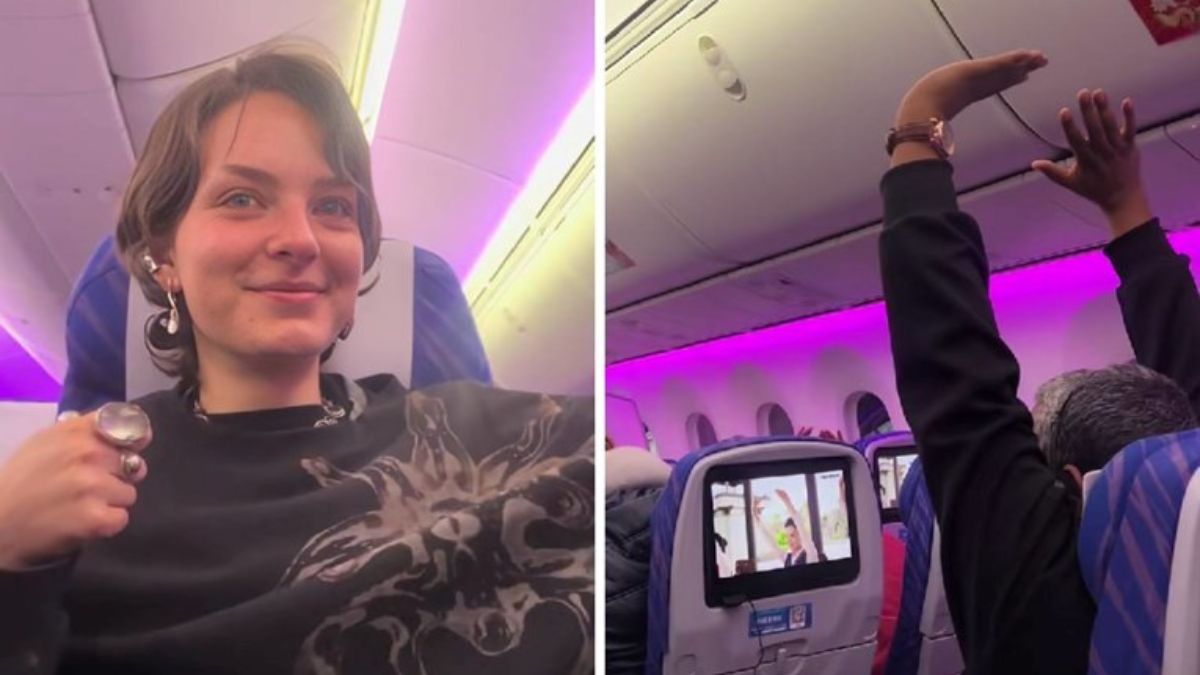
Waking up on a long-haul flight can be a disorienting experience under the best of circumstances, but the scene that greeted traveler Maite Bouzas after nine and a half hours in the air took things to a level she was clearly not prepared for. Bouzas woke up mid-flight on a Chinese airline to find that almost every other passenger in the cabin had joined a guided group exercise session, performing tai chi in their seats. She reached for her phone, captured the moment on TikTok, and gave it the only rating it deserved: “10/10.”
The video spread quickly after she posted it, and it is easy to see why. The footage shows rows of passengers in a cabin that is simultaneously tranquil and surreal, with travelers slowly extending their arms to the side and upward in gentle, synchronized movements. The whole thing is unhurried and quiet, the kind of collective calm that feels genuinely foreign to anyone accustomed to long-haul flights filled with scattered screens, neck pillows at odd angles, and the occasional snoring neighbor. Bouzas’s initial reaction on camera captures the exact feeling of waking up to something that takes several seconds to fully process.
Tai chi originated in China as a martial art and has evolved over centuries into a practice that people pursue primarily for its health and wellness benefits. The American National Center for Complementary and Integrative Health describes it as a combination of slow, gentle movements and postures, meditative focus, and controlled breathing. Its low-impact nature makes it particularly well-suited to situations where space is limited and energy is in short supply, which is exactly the situation of a cabin full of people who have been seated for the better part of a day.
@maite.bouzas Experiencia 10/10 🫶✨🇨🇳 #fyp #chinesebaddie #parati #travel ♬ original sound – EpicGamingMusic
The physical case for in-flight movement is straightforward. Hours of sustained sitting cause muscles to tighten and circulation to slow, with discomfort most commonly concentrated in the back, neck, and legs. Gentle stretching helps address all three by improving flexibility, encouraging blood flow, and releasing the muscular tension that builds up over a long journey. The genius of the in-cabin tai chi session, from a practical standpoint, is that it achieves all of this without requiring anyone to leave their seat or navigate a cramped aisle.
The TikTok comment section reflected a response that went beyond simple appreciation for the health benefits. Many viewers were drawn to the social dimension of the moment, noting that the shared nature of the activity transformed something that would normally feel awkward in public into something entirely comfortable. “They really nailed that sense of community, smart,” wrote one commenter. “Everyone participating is so wholesome,” agreed another. One person put it particularly well: “I love this because when everyone is doing it, it doesn’t feel weird. I always want to stretch properly on a plane without looking strange.” That observation cuts right to something true about public exercise: the embarrassment threshold drops sharply when everyone is in it together.
Tai chi has been practiced in China for at least four centuries, with some scholars tracing its origins back even further, though its historical documentation becomes thinner the further back one goes. What is well established is that it was originally a combat system before gradually shifting toward its modern reputation as a health practice, making the airplane cabin version something of an unlikely endpoint for a martial tradition. There are now more than 250 million people worldwide who practice tai chi regularly, making it one of the most widely practiced physical disciplines on the planet, even if most of them have not done it at 35,000 feet.
Have you ever seen something unexpected on a flight? Share your stories in the comments.




