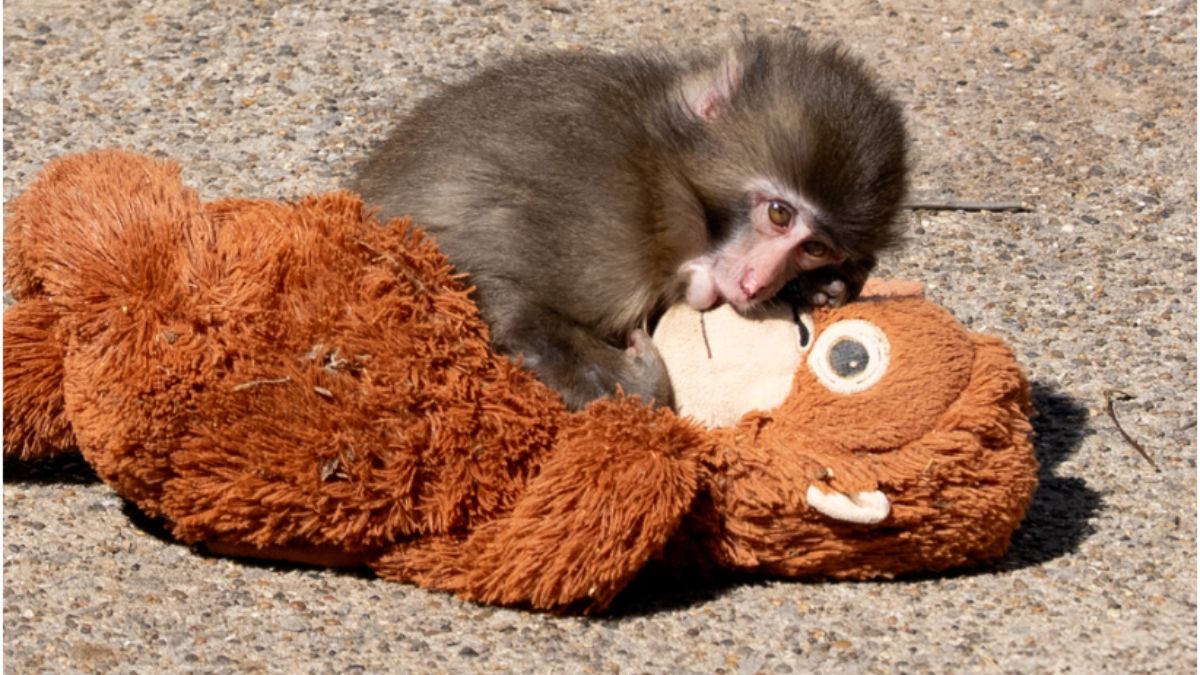
Punch, the tiny Japanese macaque who has captured hearts around the world, is back in the spotlight and giving the internet exactly what it needs right now. The little monkey, who lives at the Ichikawa Zoological and Botanical Garden in Japan, has already won over millions with his remarkable resilience and endearing personality. His latest viral moment, in which he appears to have learned how to wave at onlookers, has sent social media into a fresh wave of collective adoration.
Punch first came to widespread public attention when it was revealed that his mother had abandoned him shortly after birth, leaving zoo staff to step in and raise him. His story took on an even more emotional dimension when footage emerged of an older monkey attacking him, while the little one sought comfort in a stuffed orangutan toy that fans affectionately nicknamed “Ora-mama.” The image of Punch clinging to his plush companion while navigating the complexities of social life in his group became one of the most talked-about animal stories online in recent memory.
The Ichikawa Zoological and Botanical Garden responded to the public concern surrounding Punch with a heartfelt statement that struck a chord with many. “Although he is scolded by other monkeys, Punch shows resilience and mental strength,” the zoo wrote, urging supporters to root for his efforts rather than simply feel sorry for him. “When you watch members of the group discipline him as he tries to socialize with them, we would like you to support his efforts.” That message resonated deeply, and a devoted online fanbase has been following his journey ever since.
Punch learned how to wave 🥹 pic.twitter.com/z7uQXxL59g
— Complex (@Complex) March 3, 2026
His path to social acceptance has been a slow and touching one. Earlier milestones, including footage of Punch walking upright on two legs, drew enormous attention and affection from viewers around the world. Each new development in his story has felt like a small victory worth celebrating, and his latest trick is no different. The new clip appears to show the little macaque waving at the people watching him, a gesture so unexpectedly charming that it prompted an immediate outpouring of comments and reactions across social media platforms.
The responses from fans were as enthusiastic as ever. “My princess Diana,” one person wrote, while another simply pleaded, “Can he please stop being so damn cute.” A third commenter joked about Punch’s growing confidence, writing, “Punch’s revenge arc is about to begin,” while a fourth cut straight to the point with what may be the most relatable summary of the whole phenomenon: “Currently the greatest hope for humanity.”
It is not difficult to understand why Punch resonates with so many people. His story touches on themes of abandonment, resilience, the search for belonging, and the small daily victories that make survival meaningful. In a media landscape that can feel overwhelming, the sight of a small monkey waving cheerfully at strangers offers something genuinely uncomplicated to feel good about.
Japanese macaques, also known as snow monkeys, are native to Japan and are the northernmost-living non-human primates in the world. They are well known for their intelligence and their ability to learn and pass on new behaviors, including the famous hot spring bathing behavior first observed in Nagano Prefecture in the 1960s. Macaques live in complex social groups with strict hierarchies, which helps explain the challenges Punch has faced in winning acceptance from his group. Maternal bonding is critically important in macaque social development, and infants who are separated from their mothers often face significant difficulties integrating into the group dynamic. The Ichikawa Zoological and Botanical Garden, located in Chiba Prefecture near Tokyo, is a well-regarded facility that has been home to a wide variety of animals since its establishment.
Are you following Punch’s journey, and what do you think his next milestone will be? Share your thoughts in the comments.




