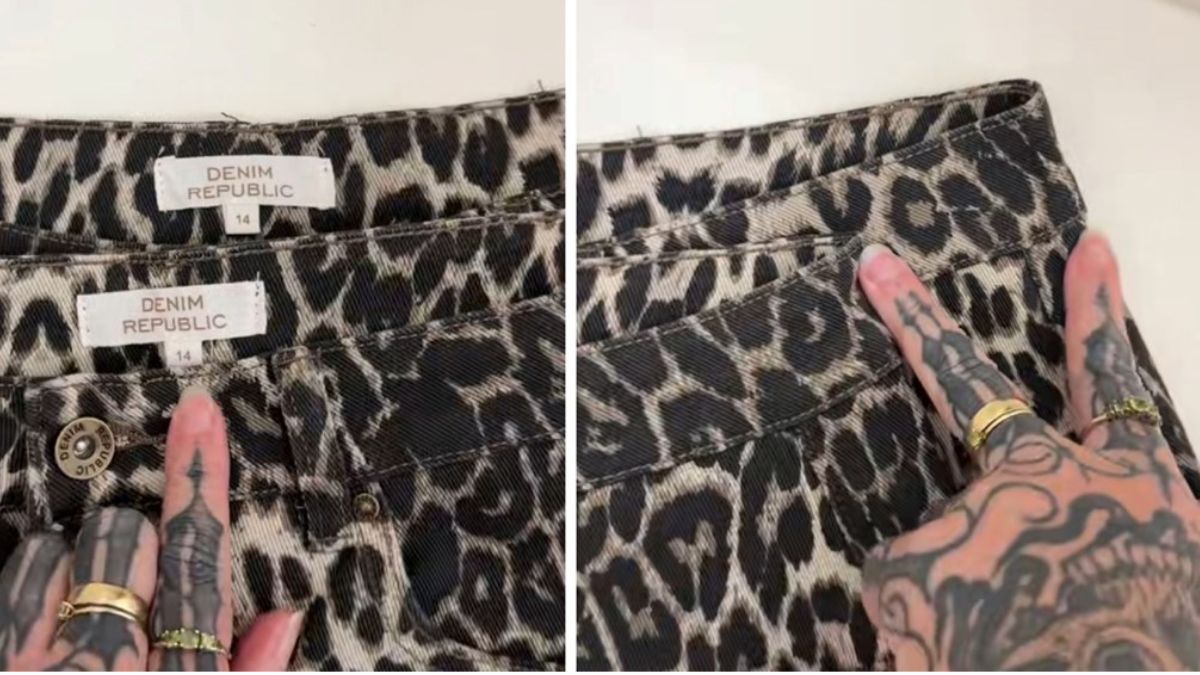
If you have ever tried on two pairs of supposedly identical jeans and found that one fits perfectly while the other will not get past your hips, you are not imagining things and you are definitely not alone. A TikTok video posted by creator Taylor Compain recently brought this frustratingly common experience into sharp focus, racking up more than 350,000 views in just a few days and igniting a comment section full of people who have clearly been waiting for permission to vent about this exact issue. The video is simple: two pairs of Denim Republic jeans in the same animal print, the same style, and the same size, held up side by side to reveal that one is visibly several inches narrower than the other. “Same size, same style, same brand, same label! That’s why you always need to check when something seems off,” Compain wrote in the caption.
The response in the comments was immediate and deeply relatable. Hundreds of people jumped in to share their own nearly identical frustrations, confirming that the problem is neither rare nor specific to any single brand or retailer. One commenter described purchasing the same pair of jeans in both a regular and black wash, only to find that the black version would not fit at all despite sharing the exact same label. “Completely the same size, same brand, and same model. I don’t understand,” she wrote, adding that the same inconsistency had played out across four dresses in different colors, all supposedly the same size, that somehow all fit her differently. Another commenter took a more sardonic approach: “So that’s why the same size in the same model in the same brand fits me anywhere from a 00 to an 8.”
Some stories were more painful than funny. One shopper shared a dressing room experience that had reduced her to tears: she had grabbed two pairs of work trousers in the same size, style, and brand, different only in color, and found that the first pair would not pull past the middle of her thighs while the second pair was loose enough to fall. She had been wearing a size smaller than the jeans she could not get on. The emotional impact of that kind of inconsistency on someone’s sense of their own body is something the comment section took seriously, with many people noting that sizing confusion had affected how they felt about themselves in fitting rooms over the years.
@taylorcompain Same size, same style, same brand, same tag!!!! This is why you always need to sense check when something seems off…
♬ how i love being a woman – editdiaary
People who had worked in retail or the garment industry stepped in with explanations, and the responses offered a revealing look at how clothing is actually produced at scale. One former retail worker described the core mechanical issue: in factories, fabric is cut by stacking many layers on top of each other and running a blade through all of them at once to produce multiple pieces simultaneously. As the blade moves through the layers, the actual dimensions of the cut pieces can drift slightly, meaning the top layers and the bottom layers of the stack may not come out perfectly identical. Even a small variance multiplied across a large batch of garments produces pairs that share a label but not a measurement. “At least that’s how it was explained to me when I worked in retail selling a lot of jeans,” the commenter noted.
A more troubling explanation came from shoppers who had heard directly from family members who worked in garment factories, particularly in accounts from the 1990s and early 2000s. One person described a grandmother who worked in a facility producing women’s dresses, where production staff were apparently instructed to attach size 10 labels to size 8 and size 12 garments when they ran short of items in the correct size to fulfill an order. Another shared an almost identical account involving a mother who worked at a labeling station, where size tags were applied to whatever garments were available when a particular size ran low. Both commenters acknowledged they were describing practices from decades ago, but neither was confident that the industry had fundamentally changed. “I honestly don’t feel like it has,” one wrote.
A smaller group of commenters offered a more forgiving interpretation, suggesting that in many cases the mislabeling is simply a production error rather than an intentional practice. Some noted that if you bring a clearly mislabeled item to the register, certain stores will relabel it correctly rather than charging you for the wrong size, treating it as a manufacturing mistake that fell through quality control rather than a deliberate deception.
The lack of standardized clothing sizes across the global apparel industry has been documented for decades, with researchers noting that what constitutes a size 10 or a size 14 varies significantly not only between brands but even between production runs within the same brand. Studies have found that women’s clothing sizing in the United States has shifted dramatically since the 1950s, when the federal government first attempted to standardize women’s sizing using data from a single military study that was not representative of the broader population. That original flawed foundation has never been fully corrected, which is part of why the experience of clothing sizes feeling arbitrary is not a perception problem but a structural one baked into how the industry developed.
Have you ever experienced dramatic size inconsistencies while shopping for clothing? Share your thoughts in the comments.




