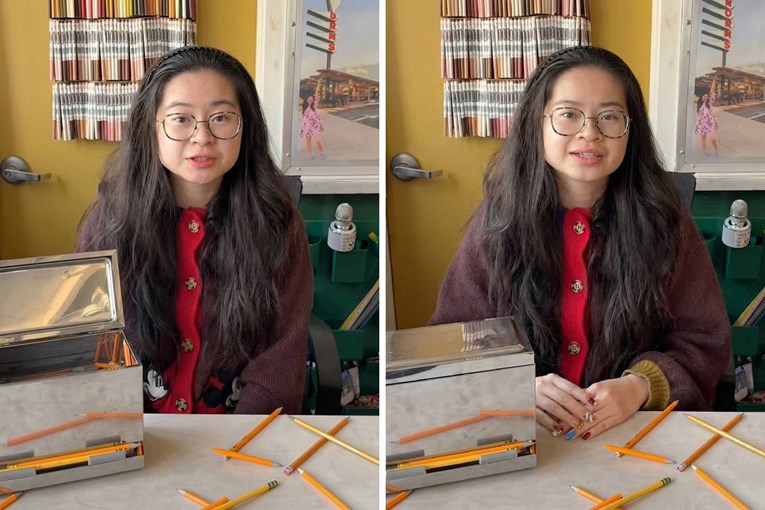
Modern teachers are increasingly vocal about the challenges of working with Generation Z and Alpha students, who are often described as distracted, unmotivated, and careless with shared materials. One high school teacher named Jess reached her breaking point when she realized just how much classroom supply was disappearing and being damaged at a staggering rate. Rather than giving up or punishing her students, she came up with a surprisingly simple yet deeply effective idea that would soon capture the attention of millions of people online. Her story quickly spread across TikTok and sparked a wide conversation about responsibility, respect, and what good teaching actually looks like.
In a video she posted on TikTok, Jess revealed the scale of the problem she had been dealing with. “My students destroyed 2,000 pencils in four months,” she said, noting that this was the highest rate of supply consumption she had ever seen during her teaching career. A large portion of those pencils were lost or ruined not by accident but through intentional breaking and throwing. What made the situation even more frustrating was that these were not cheap, throwaway pencils — Jess had been purchasing quality supplies out of her own paycheck because she wanted her students to have good tools to work with, knowing the school system would not provide them.
Her frustration was not just about the money. “It’s simply a lack of respect for other people’s things,” she pointed out, and that attitude is what she decided to address head-on. At the start of the new semester in 2026, she introduced a new system where each student received exactly one pencil for the entire month. The twist was that every pencil had the student’s name engraved on it and came in their favorite color, along with a small pencil case to keep it protected. If a student lost or broke their pencil before the month was up, they would not receive a replacement and would have to use an old, borrowed one instead.
The results went far beyond what Jess had anticipated. Students who now had a personalized item they felt ownership over began treating their pencils with noticeable care and pride. They carried their pencil cases, kept track of their supplies, and started developing a sense of responsibility that carried over into other areas of the classroom. The engraved name turned a generic school tool into something personal and worth protecting, and that shift in perception made all the difference.
What made the initiative even more meaningful was how it evolved into a community effort. Jess taught several students how to operate the engraving machine, and those students took on the role of preparing personalized pencils for the new month for their classmates. The dynamic in the classroom shifted noticeably as students began looking out for one another, picking up pencils from the floor after class and returning them to their owners or leaving them in a lost-and-found box. While a handful of students still struggled with the new rules, the overwhelming majority embraced the system and took collective ownership of it.
@inspo_by_jess new year, new pencil policy ✏️ the problem has gotten to the point where I’m now engraving students’ names into @Ticonderoga pencils to teach them about respect & accountability✨ Would you try this pencil policy? #teachers #asmr #diy @xtoolofficial ♬ original sound – inspo_by_jess
The TikTok video documenting the experiment was viewed more than 8 million times and flooded with positive comments from teachers and parents alike. Many educators recognized themselves in Jess’s story, acknowledging that it is nearly universal for teachers to spend their own money on classroom supplies despite already being underpaid. The easiest solution would have been to tell students to bring their own pencils and wash her hands of the problem, but Jess chose a different path — one rooted in empathy, creativity, and a genuine belief that students can learn to do better when given the right conditions and a reason to care.
It is worth noting that the broader issue Jess encountered is one that educators across the country have been raising for years. Studies and surveys consistently show that American teachers spend an average of several hundred dollars of their own money on classroom supplies each year. The National Education Association and various teacher advocacy groups have long pushed for better public funding of school materials, arguing that placing this financial burden on individual teachers is unsustainable and inequitable. Classroom management research also widely supports the idea that giving students a sense of ownership and personal investment in their environment leads to better behavior and stronger academic engagement. Approaches that build intrinsic motivation, as opposed to purely punitive systems, tend to produce longer-lasting changes in student conduct.
If you have thoughts on Jess’s approach or have experienced something similar in a classroom, share them in the comments.




