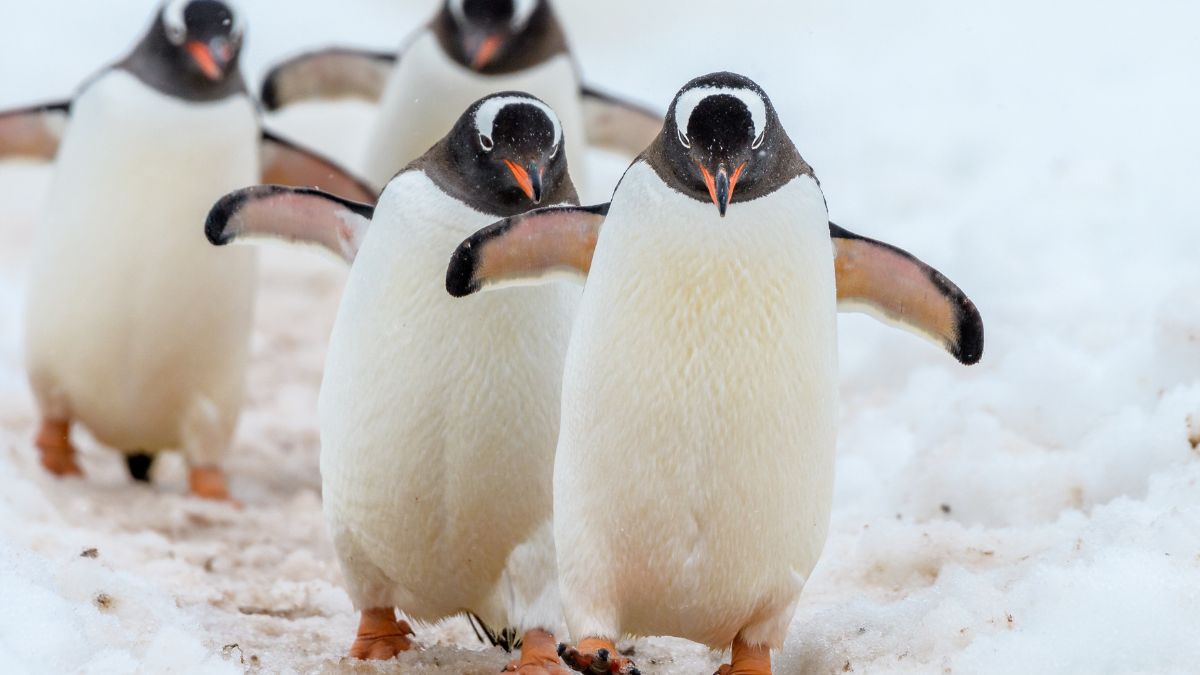
While most people exchange chocolates or flowers as tokens of affection, gentoo penguins have an entirely different idea of the perfect gift. For these charismatic birds native to Antarctica and its surrounding islands, nothing says “I love you” quite like a carefully selected pebble. Male gentoo penguins painstakingly gather stones using their beaks and present them to their partners, who then use the offerings as building blocks for a shared nest. It is one of the animal kingdom’s most endearing courtship rituals, and Edinburgh Zoo recently found a way to make it even more special.
To mark the beginning of the gentoo penguin mating season, Edinburgh Zoo organized a heartwarming creative event inviting children to paint pebbles that would later be gifted to the birds. The initiative was dreamed up as a way to bring young people closer to the natural world and to give them a hands-on connection with the animals living there. The workshops were organized by the Royal Zoological Society of Scotland, a wildlife conservation charity dedicated to protecting animals and educating the public about the importance of biodiversity. The event turned an already remarkable animal behavior into a shared celebration between humans and penguins.
The children who took part in the pebble-painting workshops were youngsters under the care of Edinburgh Children’s Hospital Charity, a charitable organization supporting children and families going through difficult times at the Royal Hospital for Children and Young People. For many of these kids, the activity offered not only a creative outlet but also a joyful way to engage with something bigger than themselves. Tiny brushes in hand, they decorated the stones with colorful patterns and designs, each pebble destined to become part of a real penguin nest.
Some of the finished pebbles were introduced to the penguin enclosure shortly after the workshops wrapped up. Thanks to live cameras streaming footage directly from the habitat, the children were able to watch in real time as the penguins discovered their new treasures and began incorporating them into their nests. Seeing their painted creations accepted and used by the birds added a layer of magic to the experience that no classroom lesson could replicate.
Gentoo penguins take their pebble selection extremely seriously, and the gifting process is central to how they form and reinforce pair bonds. A male who presents high-quality stones is signaling to his potential mate that he is a capable provider and a worthy partner. Nests built from many pebbles are also better at keeping eggs elevated above the cold, wet ground, meaning the quality of a penguin’s pebble collection can have a real impact on the survival of its chicks. By giving hand-decorated stones, these children unknowingly participated in one of nature’s most practical and poetic rituals.
The Royal Zoological Society of Scotland’s decision to involve children from the hospital charity added a particularly meaningful dimension to the occasion. Conservation organizations increasingly recognize that inspiring the next generation requires more than simply telling young people that animals matter. Experiences like this one, where a child can paint a stone and later watch a penguin carry it home, create lasting emotional connections to the natural world. Those early moments of wonder have a way of shaping how people think about wildlife and environmental responsibility for years to come.
Gentoo penguins are the fastest swimming penguins on earth, capable of reaching speeds of up to 22 miles per hour underwater, which is faster than most humans can sprint on land. Penguin pairs have been known to steal pebbles from neighboring nests when their partners are not looking, which scientists have observed and documented with remarkable straight-faced seriousness. The Edinburgh Zoo penguin colony is one of the most closely monitored in Europe, with researchers tracking individual birds and their nesting behavior across multiple breeding seasons.
Have you ever witnessed an animal behavior that completely changed how you think about the natural world? Share your thoughts in the comments.




