Few social environments compress human irritation into a smaller physical space than the elevator. What is functionally a brief and unremarkable vertical journey becomes, in the hands of certain passengers, a masterclass in inconsiderate behavior that manages to offend, inconvenience, or genuinely disturb everyone present. The rules of elevator etiquette are unwritten but almost universally understood, which makes violations feel less like accidents and more like deliberate provocations. The confined space, the forced proximity, and the inability to exit on demand create a uniquely charged social atmosphere where minor infractions land with outsized weight. Here are 26 petty elevator habits that reliably push fellow passengers to the edge of their patience.
Door Blocking
Positioning oneself directly in the center of the elevator doorway upon arrival and proceeding to assess the interior at leisure before deciding whether to enter is a behavior that manages to inconvenience every person both inside and waiting behind simultaneously. The doors are held open by a human obstacle while the blocker conducts what appears to be a thorough architectural survey of a space measuring approximately six square feet. People inside are delayed, people behind are delayed, and the blocker appears entirely unconscious of having created a human traffic incident out of a routine boarding process. The correct procedure of stepping fully inside before pausing to orient oneself is apparently not universally intuitive. This habit is particularly maddening because the solution requires approximately zero additional effort.
Button Mashing
Pressing the already-illuminated floor button repeatedly with the apparent belief that additional presses will accelerate the elevator’s arrival or motivate the doors to close faster is a habit that combines futility with mild aggression in a single gesture. The button is lit. The request has been registered. The elevator’s computer is not recalculating its priorities based on enthusiasm. The rapid jabbing continues regardless, creating a small percussion performance that serves exclusively to broadcast impatience to everyone present. The close-door button receives similar treatment despite research suggesting that in most modern elevators this button is either disabled entirely or produces a negligible reduction in door-open time.
Phone Speakerphone
Conducting a phone call on speakerphone in an elevator forces an entire captive audience to participate involuntarily in a conversation they have no interest in and no ability to escape from. The acoustics of an elevator car amplify and reverberate audio in a way that makes speakerphone calls significantly louder than they would be in an open environment. Fellow passengers receive both sides of a conversation covering topics ranging from lunch orders to medical results to domestic disputes, none of which they requested. The speakerphone user invariably raises their own voice to compensate for the ambient noise they are simultaneously creating. The existence of an earpiece option on every smartphone makes this behavior entirely elective.
Perfume Clouds

Applying a quantity of fragrance sufficient to establish a detectable presence in the elevator for a meaningful period after departure is an olfactory imposition that the enclosed and poorly ventilated environment transforms from a personal preference into a collective experience. What might pass unnoticed outdoors becomes an enveloping sensory event in a small sealed box, triggering headaches, allergic responses, and involuntary facial expressions from fellow passengers. The lingering nature of elevator fragrance means that people who enter minutes after the offender has departed still inherit the full aromatic experience without any of the context. Heavy fragrance application before entering confined shared spaces represents one of the more consistently resented forms of olfactory inconsideration in daily public life. The concentration of scent in a small unventilated space multiplies the impact of even a moderate application to something approaching overwhelming.
Floor Zero Urgency
Boarding an elevator on the ground floor, pressing a button, and then exhibiting visible distress when the elevator stops at intervening floors to collect or discharge other passengers reflects a fundamental misunderstanding of how shared vertical transportation infrastructure operates. The elevator stopping at other floors is not a malfunction, a personal affront, or an unexpected development. It is the precise function the elevator was designed and installed to perform for multiple users simultaneously. The sighing, the ostentatious watch-checking, and the ceiling-gazing that accompany each additional stop communicate a belief that one’s own journey should supersede the legitimate transportation needs of every other occupant. This reaction is particularly puzzling when it occurs on the ground floor stop of a building with thirty floors.
Rushing Entry
Sprinting toward elevator doors that are clearly in the process of closing and forcing entry through the narrowing gap rather than simply waiting for the next car is a habit that startles existing passengers, strains door mechanisms, and occasionally results in a collision between a human being and approximately two hundred pounds of closing metal. The person who forces entry typically arrives breathless, slightly disheveled, and radiating the energy of someone who has narrowly survived a significant event, when in reality they have saved themselves a wait of approximately ninety seconds. The passengers already inside experience the brief alarm of watching someone attempt to defeat a closing door at speed before they are rewarded with a confined space now containing the physical and energetic aftermath of the sprint. Waiting for the next elevator is almost always the more rational calculation.
Unsolicited Floor Pressing
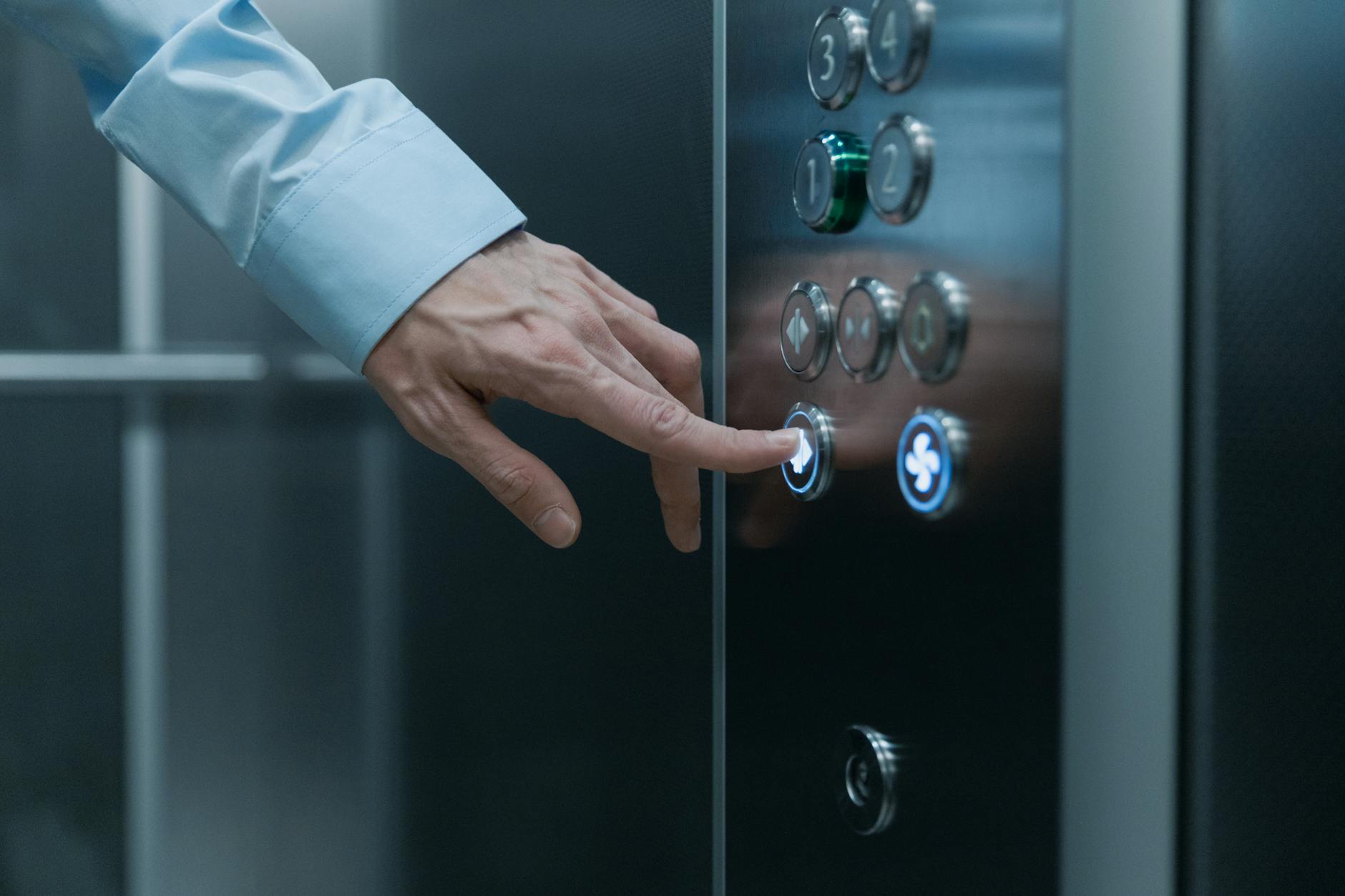
Positioning oneself next to the elevator control panel and appointing oneself unofficial floor attendant, pressing buttons for other passengers without being asked and occasionally pressing incorrect floors due to anticipatory enthusiasm, is a habit that merges presumption with inconvenience in a memorable way. The self-appointed attendant reaches across or around other passengers, sometimes making physical contact in the process, to perform a service that was neither requested nor necessary. When the wrong floor is pressed the attendant rarely acknowledges the error, leaving the incorrectly routed passenger to cancel the selection while the attendant maintains the satisfied expression of someone who has contributed meaningfully to the journey. Most adults are entirely capable of pressing their own floor button without assistance.
Loud Music
Playing music through phone speakers in an elevator subjects fellow passengers to audio content chosen entirely by one person and adjusted to a volume level optimized for that person’s listening experience in the open air rather than a reverberant enclosed space. The musical preferences of the broadcasting passenger are rarely universally shared, and the elevator environment ensures that escape is not an option for the duration of the journey. Bass frequencies in particular behave in small enclosed spaces in a way that makes the physical sensation of the music unavoidable regardless of where other passengers position themselves. The option to use earphones or headphones is universally available to smartphone owners and represents a straightforward solution to a problem that should not require solving. The persistence of elevator speaker use suggests a genuine unawareness of the shared acoustic environment rather than deliberate inconsideration, which somehow makes it more frustrating.
Hovering Outside
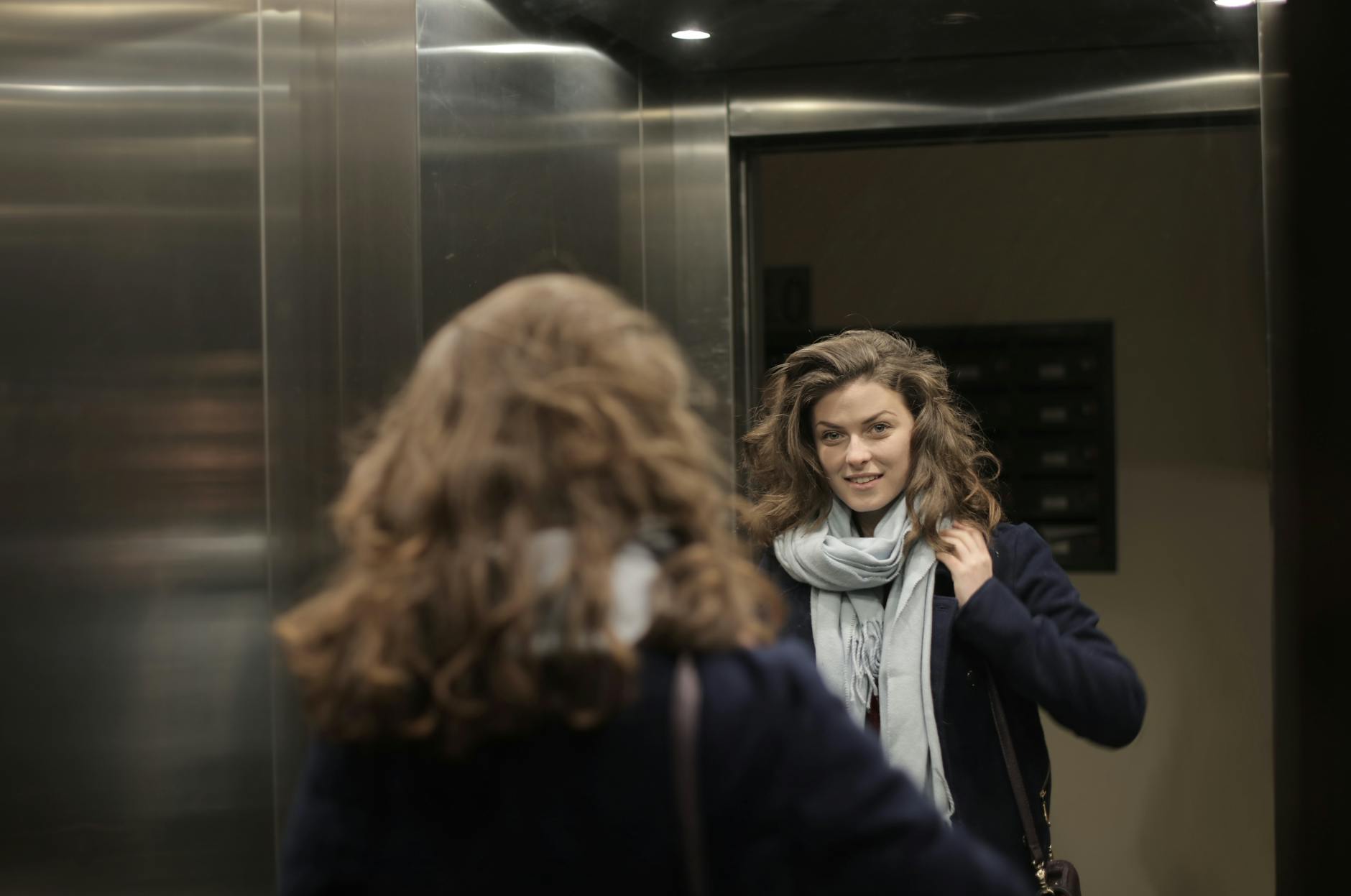
Standing directly in front of the elevator doors while waiting, positioned so close that passengers attempting to exit must navigate around or through the waiting person, is a spatial miscalculation that occurs with remarkable frequency across elevator environments worldwide. The doors open to reveal a person standing approximately eight inches from the threshold, requiring exiting passengers to execute an improvised lateral maneuver while carrying bags, strollers, or coffee cups. The waiting person appears genuinely surprised by the presence of people emerging from the elevator they are about to board, as though the concept of existing passengers had not previously occurred to them. The simple act of standing to the side of the doors rather than directly in front of them would eliminate this collision dynamic entirely.
Conversation Forcing
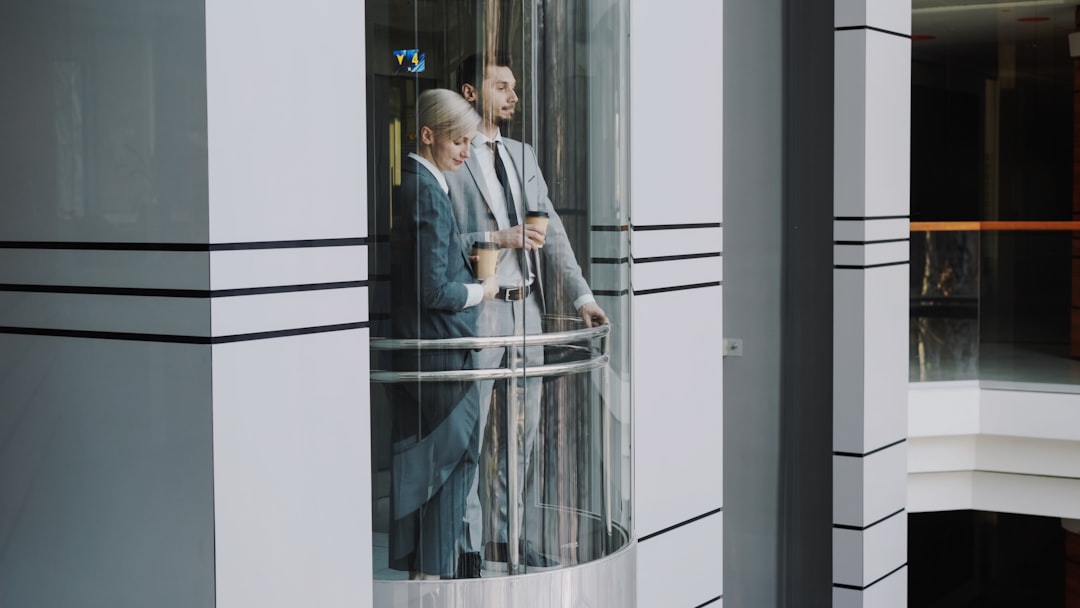
Initiating sustained unsolicited conversation with strangers in an elevator and continuing past the clear non-verbal signals of disengagement represents one of the more socially aggressive habits on this list precisely because it exploits the inability of fellow passengers to leave. The elevator is one of very few social environments where the target of unwanted conversation has no polite exit available for the duration of the journey. Short polite acknowledgment is the socially accepted transaction in elevator interactions, with silence being equally appropriate and widely preferred. Extending beyond this into questions about destination, observations about the building, or commentary on fellow passengers’ appearance or luggage produces a specific social discomfort that is disproportionate to the setting. The captive audience dynamic is what transforms this from minor social misjudgment into something more genuinely irritating.
Leaning Behavior
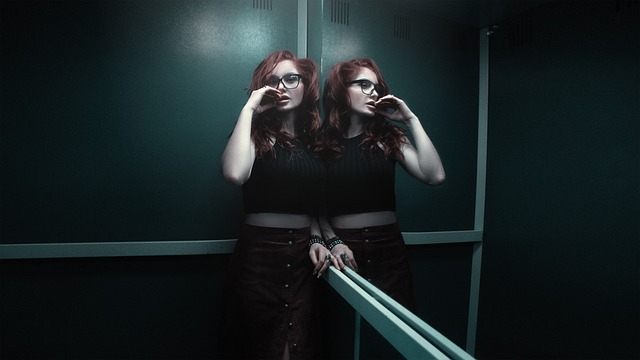
Leaning against the elevator wall in a manner that occupies substantially more horizontal and vertical space than a standing human body requires, particularly in a crowded car where other passengers are managing their own physical boundaries carefully, is a posture choice that communicates indifference to the spatial constraints affecting everyone present. The leaner’s extended elbows, spread feet, and backward-tilted posture collectively reduce the usable floor space for other passengers while the leaner projects an attitude of complete spatial ownership in a shared environment. This behavior intensifies in crowded elevators where the space being claimed through casual leaning is space another passenger genuinely needs. The posture communicates relaxation at the precise moment when consideration for others would be most appropriate.
Eating Smells

Consuming strongly aromatic food in an elevator, a behavior that the duration of an elevator journey renders both unnecessary and inexplicable, creates an olfactory situation that lingers in the enclosed space well beyond the departure of the person responsible for it. The person who boards an elevator mid-journey through a bag of fast food or an uncovered container of something involving onions has made a decision that the forty-five seconds between floors was insufficient time to pause their meal. The smell fills the space immediately and thoroughly in a way that outdoor eating never produces. Subsequent passengers encounter the aromatic legacy of a dining decision they were never part of and cannot escape until the doors next open. That this behavior occurs at all in a shared enclosed space suggests a remarkable degree of appetite prioritization over social awareness.
Staring

Maintaining direct, sustained eye contact with another elevator passenger rather than observing the conventional social protocol of facing the doors and finding a neutral gaze point is an interpersonal behavior that the enclosed environment renders significantly more uncomfortable than it would be in open space. The elevator is one of the few social situations where an established behavioral norm exists specifically to manage the discomfort of forced proximity with strangers, and that norm involves directing one’s gaze forward rather than at other people. The person who stares is usually not aware of how their behavior registers because they are absorbed in their own observations. The person being stared at is acutely aware of it and has no polite mechanism for addressing it in the confined situation. The discomfort compounds with each floor.
Bag Space
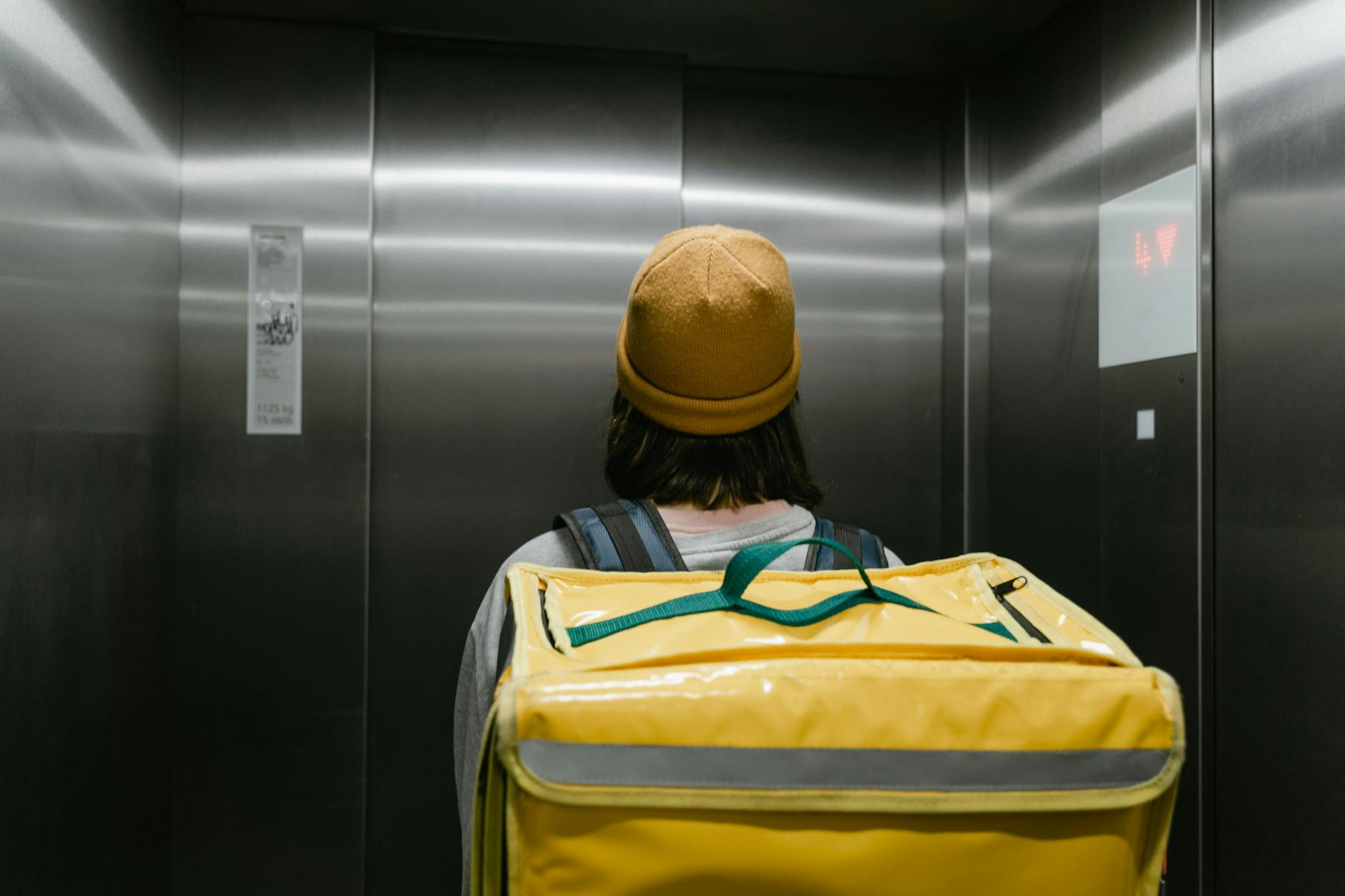
Allowing a large bag, backpack, or piece of luggage to occupy floor space and peripheral space without adjustment when the elevator fills with additional passengers is a habit that prioritizes the comfort of an inanimate object over the practical spatial needs of other human beings. The bag owner often remains unaware that their belongings have claimed a disproportionate share of shared floor space because their attention is directed upward at the floor indicator rather than downward at the actual space configuration. A brief repositioning of the bag to a more compact arrangement would recover meaningful usable space in a crowded car. The failure to make this adjustment is less about selfishness than about the widespread human tendency not to perceive our own objects as occupying shared space.
Door Hold Expectations
Pressing and holding the door-open button to wait for a colleague, acquaintance, or family member who is visibly some distance away and making no particular effort to accelerate their approach subjects the entire elevator population to an indefinite wait whose duration is determined by the unhurried pace of the person being awaited. The held elevator becomes a collective detention whose sentence length is set by how casually the approaching person chooses to walk, how thoroughly they need to finish their phone interaction, or how completely they must gather their belongings before beginning to move. The people inside the elevator have no say in this decision and no information about how long the wait will continue. A brief hold for someone clearly rushing is universally understood as courteous. An indefinite hold for someone clearly not rushing is an imposition dressed as consideration.
Corner Claiming
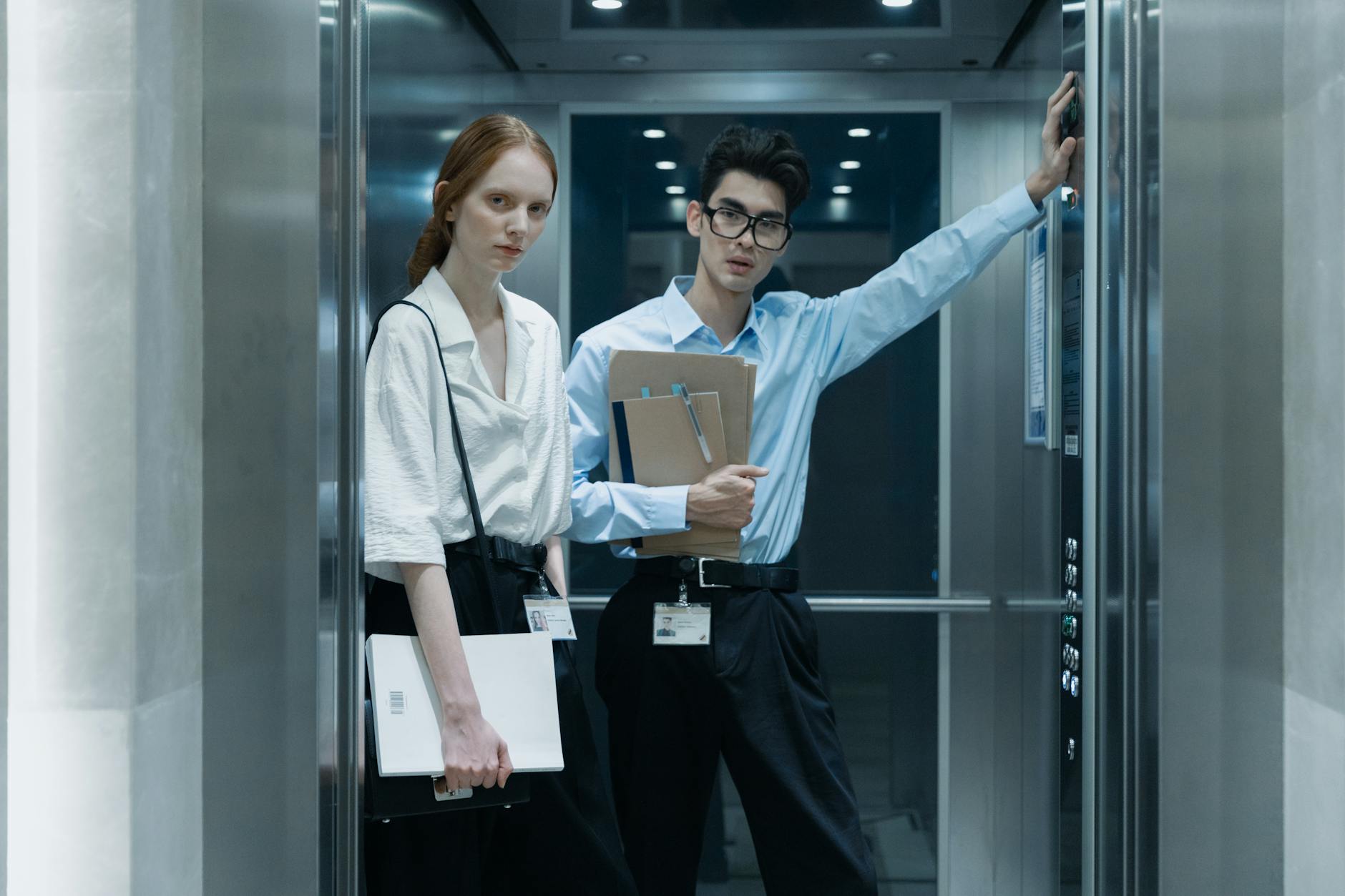
Boarding an elevator and immediately moving to a back corner, then refusing to shift position as the elevator fills, forcing subsequent passengers into increasingly awkward spatial arrangements around an immovable corner occupant, is a territorial behavior that prioritizes personal comfort over functional space management. The corner is widely coveted in elevator culture as the position of maximum personal space and minimum stranger proximity, which is precisely why claiming it and defending it against all redistributive pressure as the car fills becomes an act of spatial selfishness. A willingness to adjust position as occupancy increases is the basic cooperative norm that allows elevators to function at reasonable capacity. The corner defender typically signals their position through a studied forward gaze that communicates both awareness of the situation and a firm intention to do nothing about it.
Sighing Audibly

Producing loud, theatrical sighs at each elevator delay, each additional stop, or each moment of routine operational behavior communicates displeasure in a format that is impossible for fellow passengers to ignore and impossible to address without engaging the sigher directly. The sigh is carefully calibrated to be audible without being directly confrontational, occupying the passive-aggressive middle ground between silence and actual complaint. It invites sympathy it does not receive, communicates impatience to people who share that impatience but are managing it privately, and adds an emotional texture to the journey that nobody requested. Multiple sighs across a single elevator journey create a running emotional commentary on a trip whose total duration rarely exceeds two minutes. The theatrical quality of the sigh is what elevates it from an involuntary stress response to a genuine social infraction.
Phone Screen Brightness
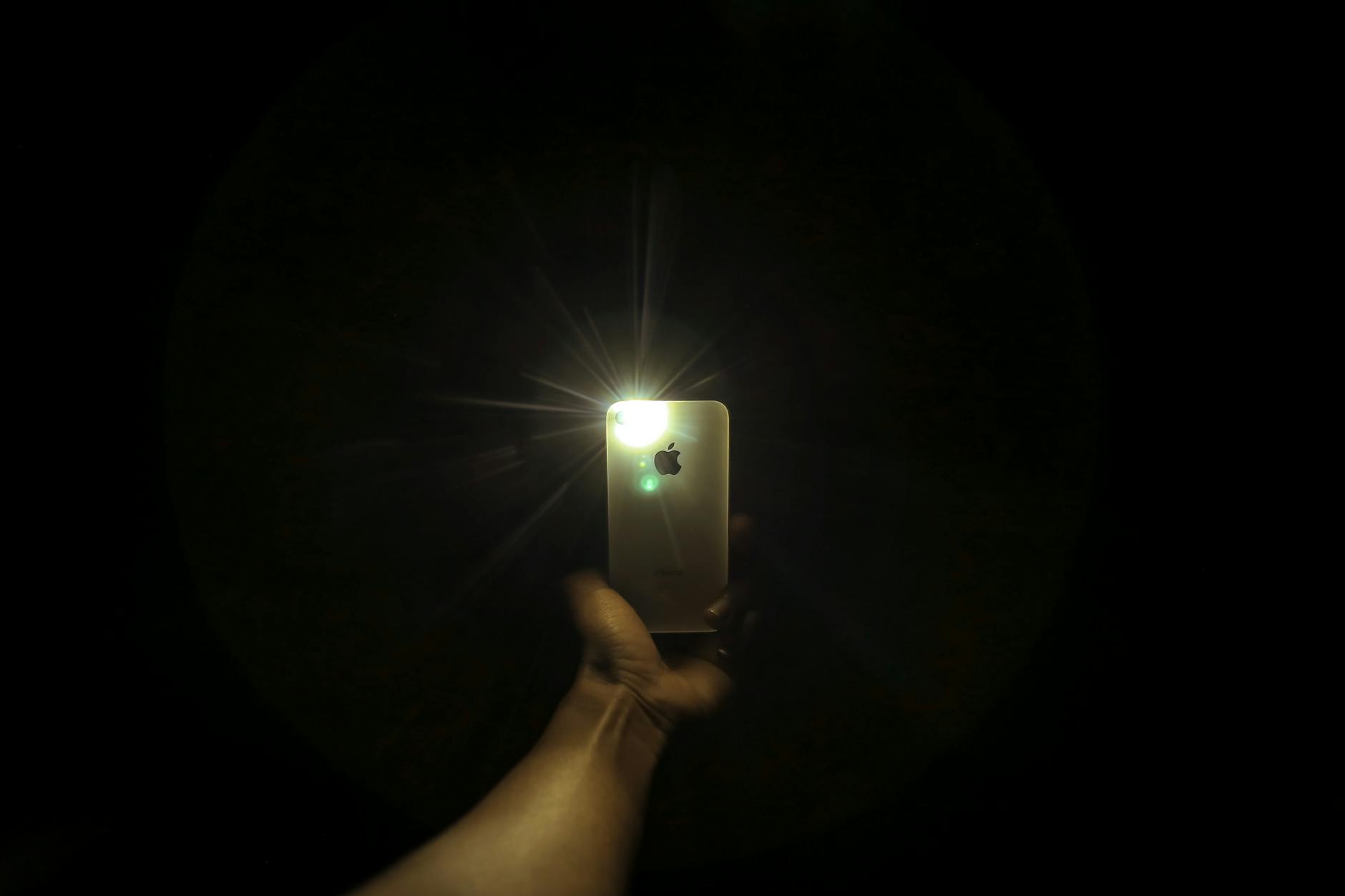
Operating a phone at maximum screen brightness in a dimly lit elevator, or simply holding a blindingly lit screen at an angle that projects directly into the peripheral vision of adjacent passengers, is a minor but genuinely irritating light imposition in a small shared space. The human visual system responds involuntarily to bright light sources in the peripheral field, meaning that adjacent passengers cannot simply choose not to notice the brightness regardless of how determinedly they stare at the floor indicator. Automatic brightness adjustment handles most of this in normal conditions but the elevator environment sometimes defeats it, and the phone owner rarely considers the directional projection of their screen as something requiring management. This habit sits at the very petty end of the elevator infraction spectrum, which is why it belongs here.
Middle Positioning

Boarding an elevator that currently contains one or two other passengers and positioning oneself in the exact geometric center of the available floor space rather than against one of the walls is a spatial decision that creates the most complicated social geometry possible from the simplest available layout. The center position places the new arrival in closest proximity to all existing passengers simultaneously, eliminates the natural flow paths to the control panel and the doors, and makes every subsequent boarding interaction more physically awkward than it needed to be. Wall positioning is the intuitive spatial norm in elevator culture because it maximizes available floor space and minimizes involuntary physical proximity. The center-stander is usually absorbed in their phone and entirely unaware of the spatial disruption their positioning has created.
Complaint Broadcasting

Using the elevator journey as an opportunity to deliver a loud running monologue of grievances about the building, the wait time, the elevator’s speed, or other passengers to a companion while those other passengers stand within two feet of the commentary is a social behavior whose rudeness is somehow rendered invisible to the person producing it by the presence of an intended audience. The conversation is conducted at full conversational volume in a space where full conversational volume reaches everyone present. The subjects of the commentary are present and audible but are treated as set dressing rather than as people. The companion typically provides minimal encouragement while the broadcaster continues, apparently operating under the assumption that the targets of the complaint have either not heard it or have no feelings about having heard it.
Umbrella Dripping

Boarding a shared elevator with a thoroughly wet open or semi-open umbrella and allowing it to drain freely onto the floor, creating a spreading puddle that other passengers must manage their footing around for the remainder of the journey, is a consideration failure with immediate physical consequences for everyone present. The umbrella owner is typically aware that their umbrella is wet in the abstract but has not translated this awareness into any action regarding where the water is going and who else is sharing the floor it is going onto. Closing the umbrella reduces dripping significantly. Holding it at an angle that directs drainage toward one’s own feet rather than the shared floor space is a further refinement that most people manage without thinking. The version that produces a shared puddle involves neither adaptation.
Sneezing Freely

Sneezing without covering the mouth and nose in a sealed elevator car, an enclosed environment with limited air circulation and mandatory close proximity to other human beings, is a hygiene failure whose consequences are uniquely concentrated by the setting. The aerosol distribution of an uncovered sneeze in a small sealed space achieves a coverage radius that would be diluted to insignificance outdoors but which functions very efficiently within elevator dimensions. Fellow passengers have no ventilation, no distance, and no exit available to them during the event or immediately after. The post-sneeze social atmosphere in an elevator following an uncovered sneeze has a particular quality of collective discomfort that is difficult to describe and impossible to mistake. A sleeve, an elbow, or a tissue transforms this from a shared biological event into a private one.
Name Calling
Calling loudly across an elevator car to a person at the opposite end, or shouting across the threshold to someone outside the elevator while passengers inside wait, transforms a shared quiet space into the incidental setting for someone else’s interpersonal interaction at a volume inappropriate for the dimensions involved. The elevator is not an auditorium, and voices calibrated for distance communication in an open environment produce a physically uncomfortable volume in an enclosed car of standard dimensions. The person being called to typically responds at matching volume, establishing a brief shouted exchange that the remaining passengers absorb from close range. The interaction is invariably brief, making its volume all the more difficult to justify against the alternative of simply walking toward the person before speaking.
Space Invading
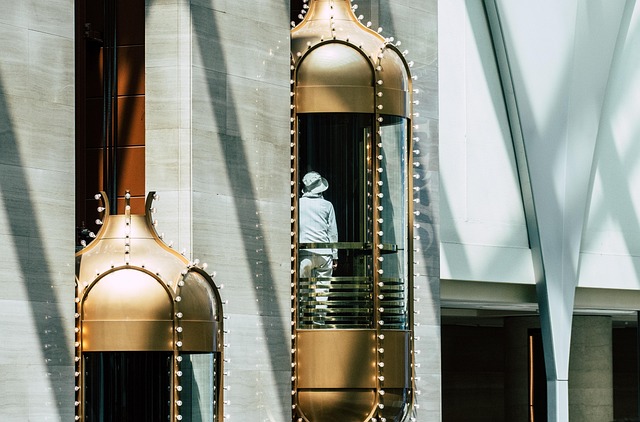
Moving progressively closer to another passenger during an elevator journey in a way that cannot be explained by the arrival of new passengers or any change in available space is an interpersonal intrusion that registers immediately and uncomfortably with the person on the receiving end. Most people maintain an acute awareness of the proxemic boundaries in elevator situations and track any violations of those boundaries with a precision they would not apply in open social environments. The gradual encroachment is particularly unsettling because it cannot be addressed through the normal social mechanism of moving away when the space is fixed and already at capacity. Fellow passengers resort to subtle postural adjustments and weight shifts that communicate discomfort through body language when direct verbal address feels disproportionate to the confined setting.
Ground Floor Indecision
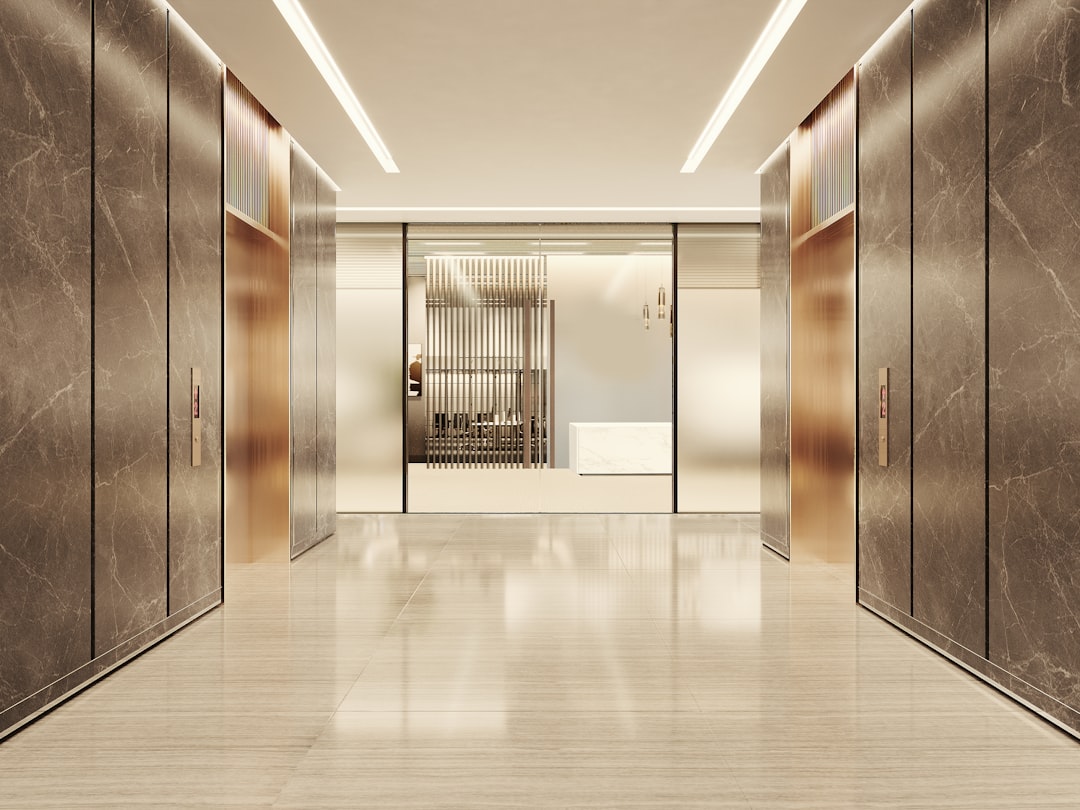
Boarding an elevator, allowing the doors to close, and then realizing or announcing that one has actually pressed the wrong floor or boarded an elevator traveling in the wrong direction, then requiring the entire car to stop at the next available floor to discharge one confused passenger before continuing, is a sequence of events whose brevity conceals the disproportionate disruption it creates for everyone else’s journey. The indecisive boarder is often apologetic, which partially mitigates the irritation but does not eliminate the additional stop, the additional wait, and the moment of collective realization that the journey has been extended by a navigational error that a brief pause before boarding would have prevented. Reading the elevator direction indicator before boarding is a simple practice whose adoption would eliminate this category of incident entirely.
Loud Notifications
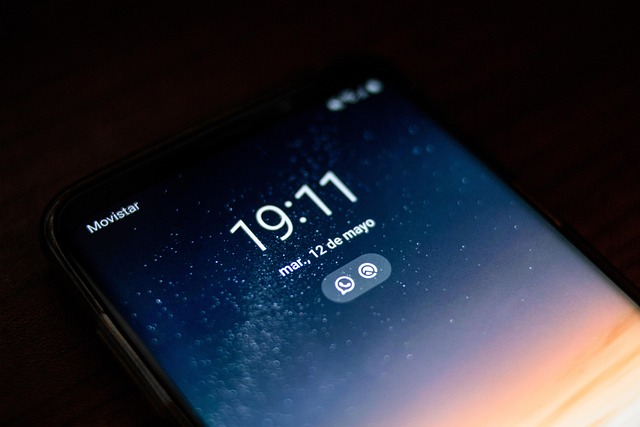
Allowing a phone to produce full-volume notification sounds, message alerts, and application audio throughout an elevator journey is an acoustic imposition that the enclosed environment amplifies and distributes to every passenger with complete efficiency. The notification sound that is mildly noticeable in an open office environment bounces off elevator walls in a way that makes it physically impossible to not process. Multiple notifications across a brief journey create a rhythmic interruption that fellow passengers experience as a shared soundtrack they did not choose. The silent or vibrate mode available on every smartphone provides a complete solution to this problem with a single settings adjustment that most people make instinctively in meeting rooms, cinemas, and libraries but somehow forget to apply in elevator contexts.
Holding Doors Repeatedly
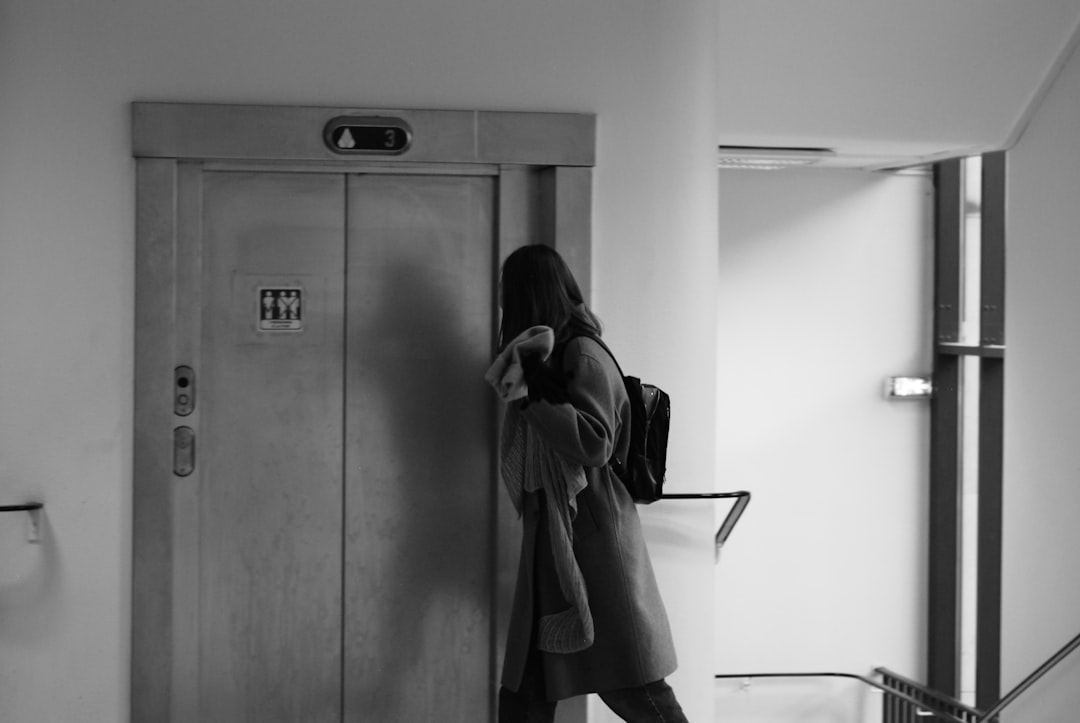
Pressing the door-open button to admit one additional person, and then continuing to hold it as that person gestures to another person, who in turn gestures to a third, creating a cascading chain of door-holding that extends the boarding process by thirty seconds or more, is a sequence that begins as courtesy and quietly transforms into an imposition on everyone already inside. The original hold was considerate. The continuation of the hold for an expanding circle of acquaintances who could have taken the next elevator tests the patience of existing passengers who had no say in the decision to extend the boarding window indefinitely. The passengers inside experience the accumulation of these holds as a collective sentence served on behalf of a social group they are not part of and have no connection to.
Next time you step into an elevator, share your most memorable or maddening elevator encounter in the comments.




