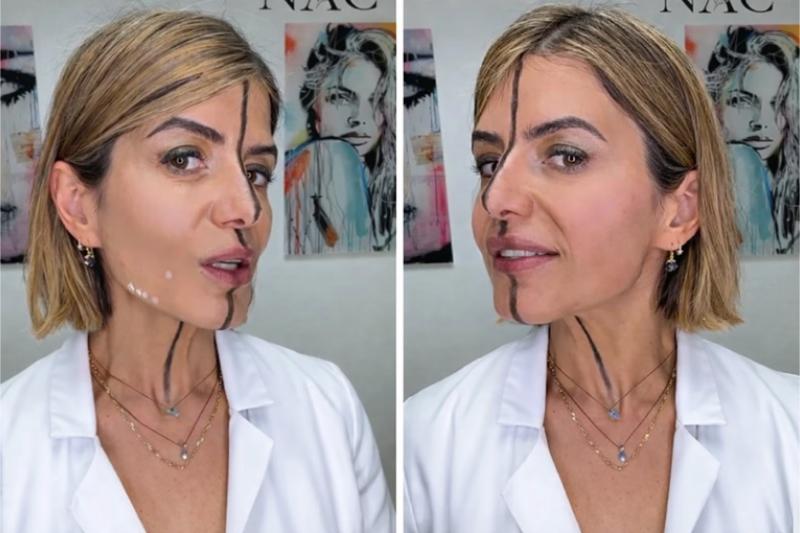
A California-based aesthetic physician decided to turn herself into a living demonstration by injecting Botox into only one side of her face. Dr. Bita Farrell, who brings over 20 years of professional experience to her practice, carried out the experiment with a clear educational goal in mind. She wanted her social media audience to see an unfiltered, side-by-side comparison of what the treatment actually does to facial muscles and skin appearance. The self-experiment quickly drew widespread attention, as reported by LADbible, and gave her 141,000 Instagram followers a rare look at the science behind a procedure millions of people undergo every year.
Dr. Farrell chose to inject the right side of her face exclusively, targeting two specific muscles responsible for pulling the lower face downward. The first was the DAO, or depressor anguli oris, which is the muscle that tugs the corners of the mouth toward the ground. The second was the platysma, a broad, flat muscle running along the neck and lower face that plays a role in facial expressions and jaw movement. By limiting the treatment to just one side, she was able to create a natural before-and-after comparison without waiting or using editing tools.
Two weeks after the injections, Dr. Farrell posted a video on Instagram to reveal the outcome. In the footage, originally recorded in June 2024, she demonstrated what happens when she attempts to engage the muscles in her lower face on each side. When she focused on the untreated left side, the platysma muscle visibly pulled her jaw downward, and the DAO clearly dragged the corner of her mouth lower. Switching attention to the injected right side, she noted that even when she tried to make the same movements, the muscular activity was noticeably weaker and less pronounced.
Beyond just reduced muscle movement, Dr. Farrell pointed out additional visible differences on the treated side. She observed that the right side looked mildly lifted compared to the left, and that both the nasolabial fold and the marionette line appeared less defined on the Botox-treated side. These are two of the most common cosmetic concerns people seek to address through facial treatments, making the visual contrast particularly striking. The difference offered a compelling real-world look at what targeted neuromodulator injections can accomplish when applied strategically.
In the post’s caption, Dr. Farrell went into greater detail about the mechanics behind the lifting effect. She explained that certain facial muscles pull features upward while others pull them downward, and that Botox works by interrupting the nerve signals that tell muscles to contract. When the downward-pulling muscles like the platysma and DAO are relaxed through injections, the upward-pulling zygomatic muscle becomes more dominant and takes over. This shift in muscular balance is what creates the appearance of a lifted, more youthful face without surgical intervention.
She also outlined a broader range of improvements that this approach can potentially deliver for patients. According to Dr. Farrell, strategic injections in these areas can soften marionette lines, reduce skin laxity beneath the jawline, counteract a perpetually downturned facial expression, and diminish the appearance of nasolabial folds. On top of that, she mentioned that the treatment may contribute to a more defined jawline, a modestly lifted neck, and cheeks that look slightly fuller. She noted that the effects of such treatments generally last between three and four months, and that various approved neuromodulator products can be used to achieve them. In a lighthearted closing remark, she acknowledged that she would now need to treat the left side of her face to restore a balanced appearance.
It is worth noting that Dr. Farrell emphasized throughout her post that procedures like these should only be performed by trained and properly qualified medical professionals. Botox, the brand name for botulinum toxin type A, is a neurotoxic protein derived from the bacterium Clostridium botulinum. In cosmetic medicine it is used in tiny, controlled doses to temporarily paralyze targeted muscles, with effects typically appearing within days and peaking around two weeks after injection. The FDA first approved botulinum toxin for cosmetic use in 2002, specifically for the treatment of frown lines between the eyebrows, and its applications have expanded significantly since then. Beyond aesthetics, botulinum toxin is also used medically to treat conditions such as chronic migraine, excessive sweating, muscle spasms, and certain bladder disorders. The global cosmetic injectable market, which includes Botox and similar products, is one of the fastest-growing segments in aesthetic medicine, reflecting the surging popularity of non-surgical facial treatments worldwide.
If you have thoughts or experiences with Botox treatments, feel free to share them in the comments.