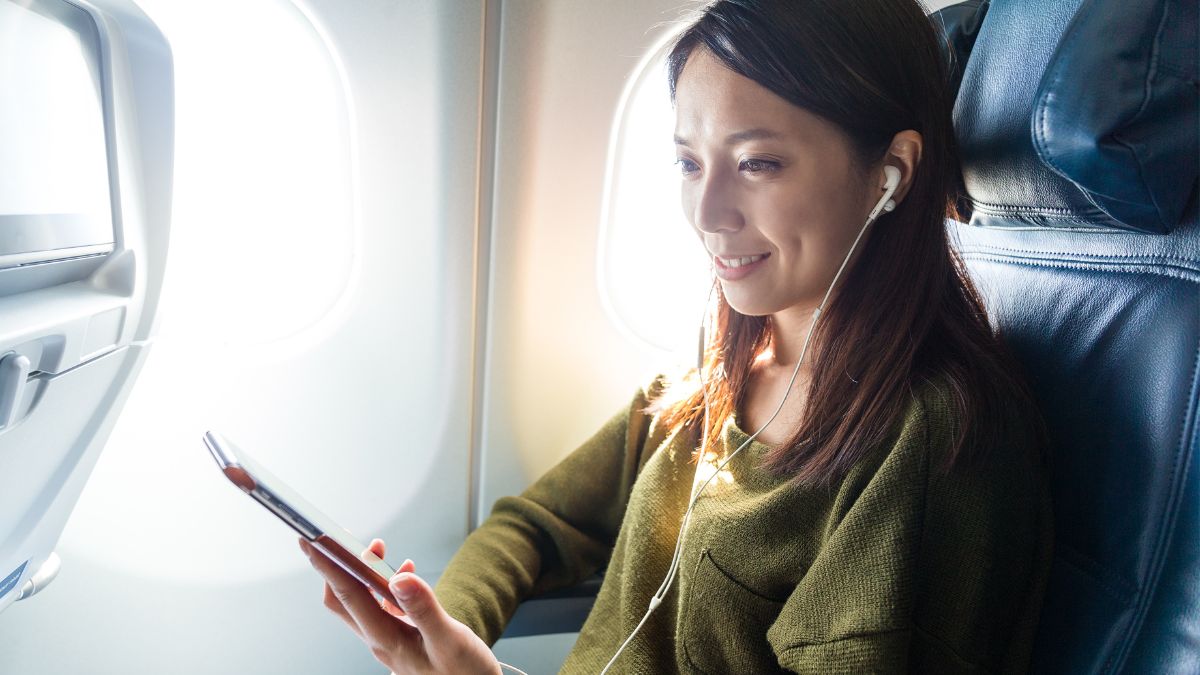
For many travelers, the request to switch their devices to airplane mode before takeoff feels like little more than an inconvenience, typically met with sighs from younger passengers and exasperated looks from their parents. But as it turns out, there is a genuine and important safety reason behind that familiar cabin announcement. Mandy Smith, a former Virgin Atlantic flight attendant, has shed light on exactly why this rule exists and why crew members take it so seriously. Her explanation cuts through years of vague assumptions and gets to the heart of what is actually at stake when a phone stays connected at 35,000 feet.
Airplane mode works by shutting off all wireless transmissions on a device at once, which means cellular signals, Wi-Fi, and GPS all go dark the moment it is activated. Smith emphasizes that the primary concern is not about passengers losing focus or cabin crew wanting a quieter flight. The real issue is interference with the navigational equipment that pilots depend on to know exactly where they are and how high they are flying. Ground-based radio navigation beacons, known as radio beacons or radiobeacons, send out precise signals that aircraft instruments receive and use to establish position and altitude, particularly during the critical phases of takeoff and landing.
Smith broke the issue down in straightforward terms, explaining what happens when outside signals compete with those navigational transmissions. “Let’s say there is a radio beacon near the runway while the plane is taking off or landing,” she said. “It helps determine the position and altitude of the aircraft, and the plane follows that signal.” The aircraft’s instruments are designed to lock onto that beacon’s frequency and use it as a reference point, which means any competing signal in the same or adjacent frequency range has the potential to create confusion in the system. Even a small amount of interference during a landing approach could theoretically cause instruments to display slightly incorrect altitude or position data.
What surprises many people is just how broadly Smith defines the category of problematic devices. “All other radio signals, such as those from mobile phones, and even a Furby toy, which was once banned, are not allowed because they could interfere with that signal,” she noted. The Furby reference is not a joke. The interactive toy was indeed prohibited on certain military and government aircraft in the late 1990s due to concerns about its ability to transmit radio frequencies, and the story became something of an aviation urban legend that turned out to have a real basis. The point Smith is making is that the rule is not about phones specifically but about any device capable of broadcasting a wireless signal in an environment where navigational precision is paramount.
The rule around airplane mode has been in place for decades, though airlines and aviation authorities have updated their guidance over the years as technology evolved. The Federal Aviation Administration and its international counterparts have consistently maintained that while modern aircraft are built with shielding designed to reduce the risk of interference, the potential consequences of a navigational error during landing are serious enough to warrant caution. Flight crews are trained to enforce the policy not out of habit but because the stakes during takeoff and landing, when aircraft are closest to the ground and operating with the least margin for error, are simply too high to treat lightly. Smith’s message to passengers is clear and direct: “If you know that airplane mode must be on, please do so.”
Understanding the reasoning behind in-flight rules tends to change how passengers feel about following them. Most travelers assume the announcement is a precaution with little real-world relevance, but the connection between cellular transmissions and ground-based navigation systems is a legitimate engineering concern that has been studied extensively. Airlines are not asking passengers to inconvenience themselves for no reason. The few minutes of disconnection during takeoff and landing represent a small ask in exchange for ensuring that the instruments guiding the aircraft are receiving clean, uninterrupted signals.
Airplane mode was first introduced as a standard feature on mobile devices in the early 2000s, specifically in response to aviation concerns, which means the feature itself exists largely because of rules like the one Smith is describing. The International Air Transport Association has documented cases where passenger electronic devices caused audible interference in cockpit headsets, described by pilots as a rapid clicking or buzzing sound that could mask important communications. Radio beacons used in aviation, particularly instrument landing systems, operate on frequencies between 108 and 112 MHz, which overlaps with ranges that older cellular technologies were known to affect.
Share your thoughts on in-flight electronics rules in the comments.