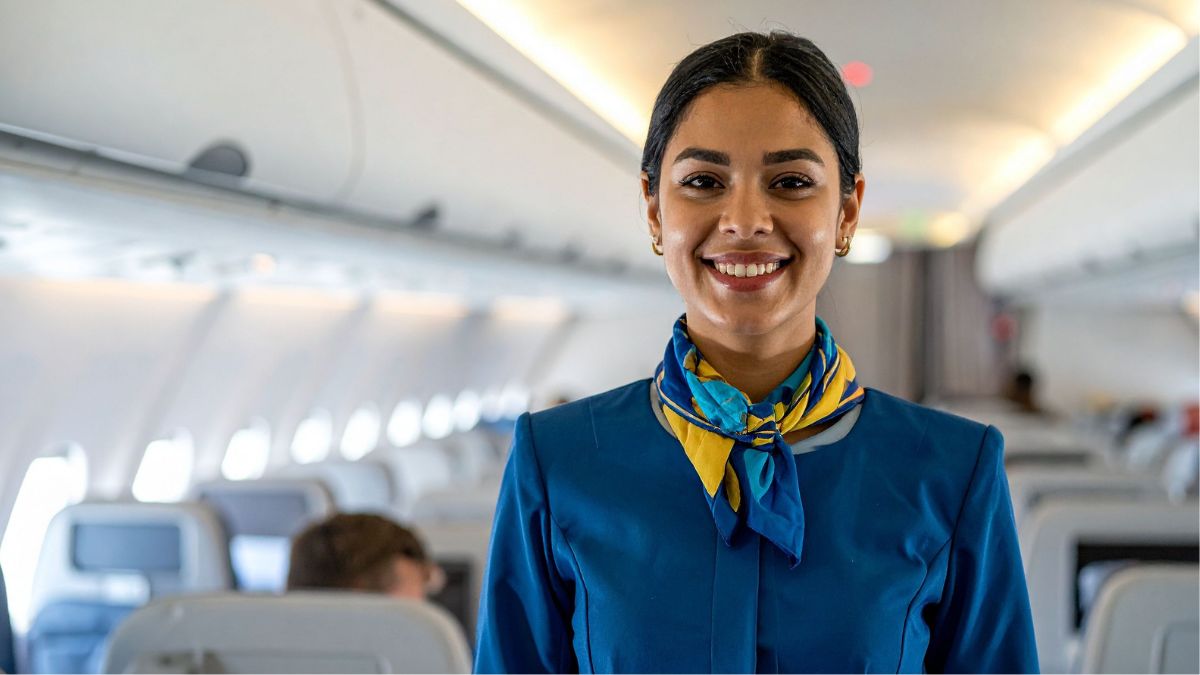
The idea of joining the Mile High Club has long held a certain mystique in travel culture. Long-haul flights, darkened cabins, and the thrill of being thousands of feet in the air have made it a staple of adult fantasy and lighthearted jokes alike. But according to those who actually work at 35,000 feet, the reality is far less cinematic than people imagine.
Flight attendant and author Mandy Smith, known for her memoir ‘Cabin Fever: The Sizzling Secrets of a Virgin Air Hostess,’ has spoken candidly about what actually happens when passengers attempt intimate encounters mid-flight. Her book draws on years of firsthand experience working in the cabin, offering an unfiltered look at the less glamorous side of air travel. And when it comes to the Mile High Club, her verdict is clear: it happens, but not nearly as often as the legend suggests.
“I’d say it happens on one in every twenty or thirty flights,” Smith shared. “It’s not really that frequent.” That might come as a surprise to those who assume airplane bathrooms are a hotbed of clandestine activity, but Smith’s account suggests the fantasy rarely survives contact with reality.
For starters, the physical conditions inside an airplane lavatory make the whole endeavor far less appealing upon closer inspection. The space is extraordinarily cramped, barely large enough for one person to move around comfortably. The smell is typically a combination of strong industrial cleaning chemicals and recycled air, and the surfaces leave much to be desired. It is, by any reasonable standard, one of the least romantic environments imaginable. One person turning around in there is an achievement; two people attempting anything more intimate is a logistical puzzle with no elegant solution.
Beyond the physical awkwardness, there is the rather significant matter of discretion, which is nearly impossible to maintain. When two passengers exit an airplane bathroom in close succession, it tends not to go unnoticed. Passengers seated nearby have a front-row view of the comings and goings in the aisle, and flight attendants, who have seen virtually everything over the course of their careers, are not easily fooled. Smith notes that crew members approach these situations with a matter-of-fact directness, knocking on the lavatory door and firmly requesting that passengers return to their seats. The goal is to resolve the situation quickly and quietly, without drawing any more attention than necessary.
The context of the flight does factor into how cabin crew responds, however. Smith acknowledged that night flights are sometimes handled differently than daytime or family-oriented routes. “If it’s a night flight and they’re being discreet, honestly, I probably wouldn’t disturb them,” she admitted. The calculus changes considerably when children are aboard or when passengers are being disruptive rather than quiet.
Smith also recounted a story from a colleague that illustrated just how far some passengers are willing to push things. On one particular flight, an 18-year-old passenger made her intentions extremely clear from the moment the plane was airborne. “A friend of mine had a situation with a young 18-year-old who was so determined to join the Mile High Club that she basically grabbed the first man she could find,” Smith recalled. Cabin crew intervened and asked her to return to her seat, which she did. But roughly half an hour later, she was back in the aisle with a different passenger, attempting the same thing again.
At that point, the crew decided a different approach was needed. Smith’s colleague went and spoke directly with the young woman’s parents, who were also on the flight, and that conversation put an end to the attempts entirely. “She was only 18,” Smith noted. “She didn’t try it again.” The remainder of that flight was reportedly very uncomfortable for everyone involved, and the car ride home presumably even more so.
The broader picture Smith paints is one where the Mile High Club exists more as cultural mythology than as any kind of widespread phenomenon. Cabin crew are trained to handle all manner of unexpected situations, and this particular one barely registers as remarkable anymore. What once might have seemed daring is, from the perspective of experienced flight attendants, simply another Tuesday at cruising altitude.
The term “Mile High Club” was reportedly first coined in 1916, when aviator Lawrence Sperry allegedly engaged in an amorous encounter that caused his plane to go into an uncontrolled dive over Long Island, drawing the attention of a very bewildered duck hunter below. Airplane lavatories, despite their tiny footprint, actually contain some of the most sophisticated water recycling and waste management systems of any vehicle ever built, processing everything in a vacuum-sealed system that operates in pressure conditions most people never think about. Some airlines have quietly installed motion sensors and weight detectors inside lavatories over the years, though carriers rarely advertise this particular feature of their facilities.
Have you ever wondered what really goes on behind the scenes at 35,000 feet? Share your thoughts and travel stories in the comments.