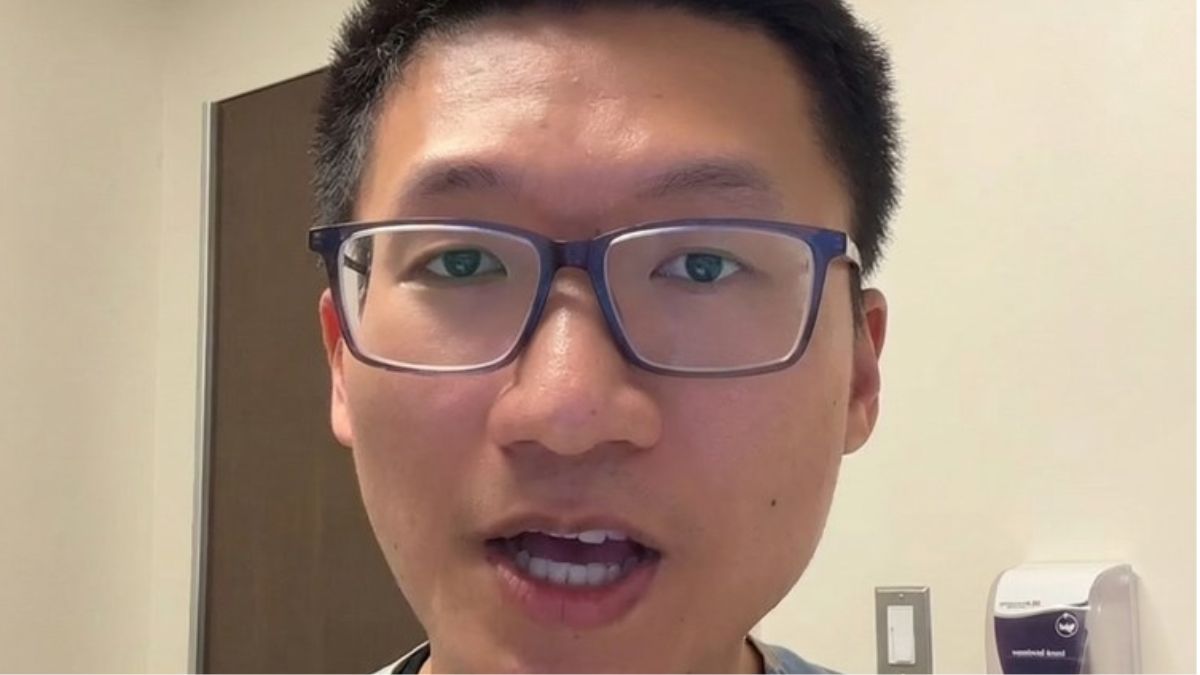
Most people know the usual stroke risk factors — high blood pressure, elevated cholesterol, smoking. But a neurologist who goes by Dr. Bing online recently stepped forward with a different kind of warning, one rooted not in textbook risk factors but in cases he has personally witnessed throughout his career. Dr. Baibing Chen, known on TikTok as Dr. Bing, shared three specific habits he refuses to practice himself, all of which carry a rare but real potential to trigger a stroke. His message was straightforward: “As a neurologist, I have seen rare cases of stroke caused by these things, so I personally avoid them. Here is what I mean.”
The first habit on his list involves massage guns used on the neck. While these handheld percussion devices have become wildly popular for post-workout muscle recovery, Dr. Chen draws a firm line when it comes to applying them to the neck area. “I can use a massage gun on other parts of my body, but never on my neck,” he explained. The reason comes down to anatomy. The carotid and vertebral arteries, which run along the sides and back of the neck and are responsible for supplying blood to the brain, can be vulnerable to forceful or sustained pressure. In rare cases, that kind of impact can create a small tear in the arterial wall, a condition known as dissection, which can then become a site where a blood clot forms. If that clot travels to the brain, a stroke can follow. Dr. Chen also pointed out that people with unstable arterial plaque buildups — often without knowing it — face an added risk, since strong percussive force could potentially dislodge those deposits.
The second habit he avoids is holding the head in prolonged hyperextension, meaning tilted sharply backward for an extended period. This position, which many people encounter during a routine shampoo at the hair salon, can compress or fold the vertebral arteries. “This can reduce blood flow through the vertebral arteries, which may lead to dizziness, vision problems, and even stroke,” Dr. Chen said. He noted that there is even a recognized medical phenomenon called “beauty parlor stroke syndrome,” which occurs when people hold their heads back over a salon basin for too long. His advice is clear: if you ever find yourself in that position and begin experiencing symptoms, you need to act immediately.
The third item on his list is one that might genuinely catch people off guard. Dr. Chen warns against popping pimples, particularly those located in an area of the face he refers to as the “triangle of death.” This zone runs roughly from the bridge of the nose down to the corners of the mouth. “The veins in that area are connected to deeper veins that lead to the cavernous sinus near the brain,” he explained. A serious infection in that region can spread inward, potentially causing blood clots, a brain infection, or in extreme cases, a stroke. He was careful to emphasize that these outcomes are rare, but added, “As a neurologist, I have seen them, and once you see them, you do not forget them.”
@doctor.bing 3 things I don’t do as a neurologist #TikTokLearningCampaign #learnontiktok #BrainHealth #neurology #brain ♬ original sound – Dr. Bing, MD MPH
Beyond these three specific habits, Dr. Chen’s video serves as a reminder that strokes can sometimes be triggered in ways that seem completely disconnected from the brain. A stroke occurs when blood supply to the brain is either blocked or when a blood vessel ruptures, causing brain cells to begin dying within minutes. It is one of the most time-sensitive medical emergencies that exists.
Knowing how to recognize a stroke quickly can make a significant difference in outcomes. The most common warning signs include facial drooping where one side of the face appears to sag and a person cannot produce a normal smile, sudden arm weakness where one arm cannot be raised or held up due to numbness, and difficulty speaking clearly or coherently. Other symptoms can include sudden blurred or lost vision, confusion, severe and unexplained headache, dizziness, and nausea. Any of these signs should prompt an immediate call to emergency services, because every minute without treatment matters.
The cavernous sinus, located at the base of the skull, is one of the most protected and consequential structures in the human body, and it sits closer to the surface of the mid-face than most people realize — which is exactly why dermatologists have warned about the danger zone for decades. Vertebral artery dissection, the injury Dr. Chen describes from neck percussion, accounts for a disproportionately high percentage of strokes in people under 45, making it far more relevant to younger, otherwise healthy individuals than most would assume. The term “beauty parlor stroke syndrome” has been documented in medical literature since the 1990s, with reports noting that even a few minutes of sustained neck hyperextension over a hard salon sink rim can be enough to compress the vertebral artery in susceptible individuals.
Have you ever heard of these lesser-known stroke triggers before, and did any of them surprise you? Share your thoughts in the comments.