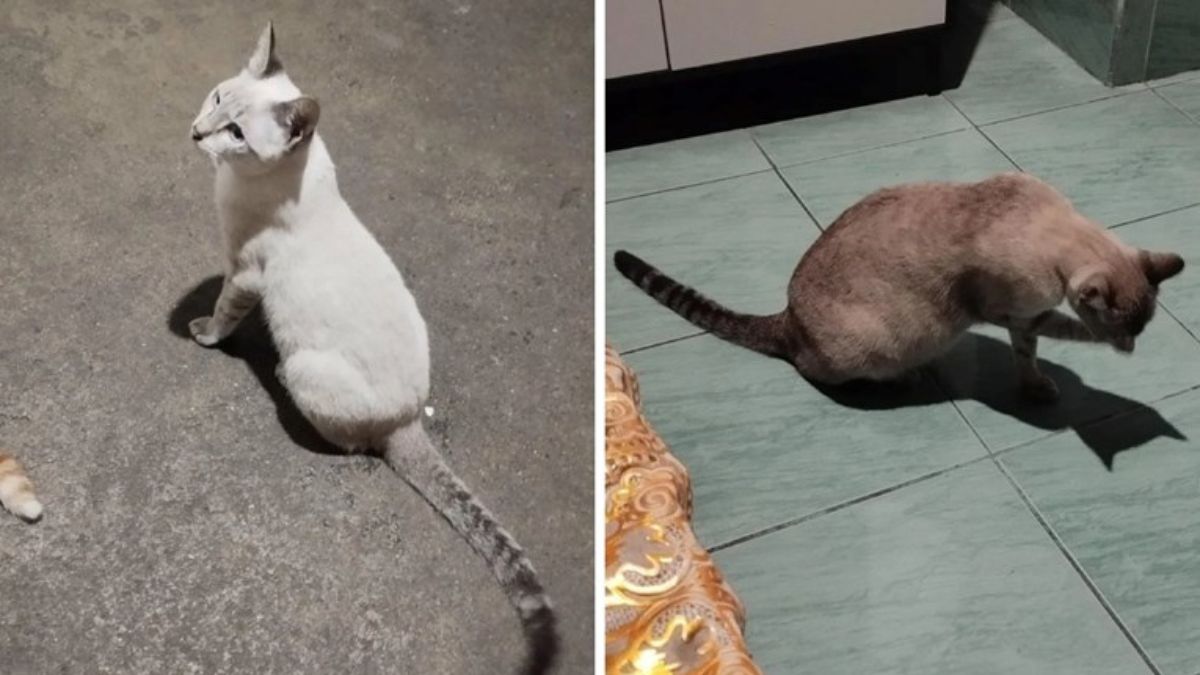
When a Reddit user known as u/K1raVee rescued a tiny white kitten from the street on a rainy night in 2022, she had no reason to think the cat would look any different a few years down the road. White cats are white cats. But flipping through her photo gallery in 2025, she stumbled on an old picture of her cat as a kitten and noticed something that stopped her mid-scroll. The animal that had been almost entirely white, with just a faint dusting of gray on the tip of her tail, had grown into a cat whose coat was now predominantly gray across most of her body. She posted the before-and-after photographs on Reddit with a caption that summed up her feelings perfectly: “I adopted a white cat… she has different color settings now.”
The post gathered more than 7,600 upvotes and 240 comments, with the response falling into two broad categories: people who had experienced exactly the same thing with their own cats, and people who wanted to explain what was actually happening. Both groups showed up in considerable numbers. One commenter shared a particularly charming example from her own household. “The same thing happened with my cat! Her name is Elsa because she was white, and now my mom calls her Pepelsa because she looks like she’s been dusted with ash,” she wrote, with Pepelsa being a playful twist on the word for ash. The detail of a cat named after a princess who has essentially become the opposite of her original color attracted some especially enthusiastic agreement in the thread.
On the explanatory side, several commenters offered terminology that pointed toward what may be happening. “I believe this is called ‘toasting,’” one person noted, while another added: “This happens with colorpoint cats. They get darker with age.” The colorpoint connection is biologically significant. Breeds like Siamese and Burmese cats carry a temperature-sensitive enzyme that affects how pigment is produced in the fur. Cooler areas of the body, typically the extremities, develop darker coloring, while warmer central areas remain lighter. As a cat ages and changes in body temperature or environment shift, those patterns can evolve and become more pronounced over time, which can produce exactly the kind of gradual whole-coat darkening that the Reddit user observed in her cat.
adopted a white cat… now she’s on a different color setting
by u/K1raVee in cats
According to Newsweek, there are several other reasons a cat’s coat color can shift over the course of its life, and not all of them are cause for concern. Aging itself plays a role, as the pigment-producing cells responsible for coat color gradually weaken over time, sometimes causing dark fur to lighten or produce gray tones, typically appearing first around the muzzle. Nutritional deficiencies can also affect coat color, particularly a lack of certain amino acids and minerals, which can cause dark fur to develop a reddish or lighter tone. Prolonged sun exposure has a bleaching effect on fur as well, though that tends to lighten rather than darken a coat. On the health side, conditions such as autoimmune disorders affecting pigmentation, or hyperthyroidism, can also produce noticeable changes in coat quality and color, which is why any sudden or dramatic shift is worth discussing with a veterinarian even when a more benign explanation seems likely.
The “toasting” phenomenon that commenters referenced has its own devoted corner of the internet, with cat owners regularly posting side-by-side comparisons of their formerly pale pets who have developed rich tan, gray, or brown tones with age. It turns out that a cat who seems to have changed color is not nearly as unusual as it might appear at first, though the degree of transformation in this particular case was dramatic enough to catch even her own owner off guard.
Has your cat or pet ever changed appearance in a surprising way over the years? Share your stories in the comments.