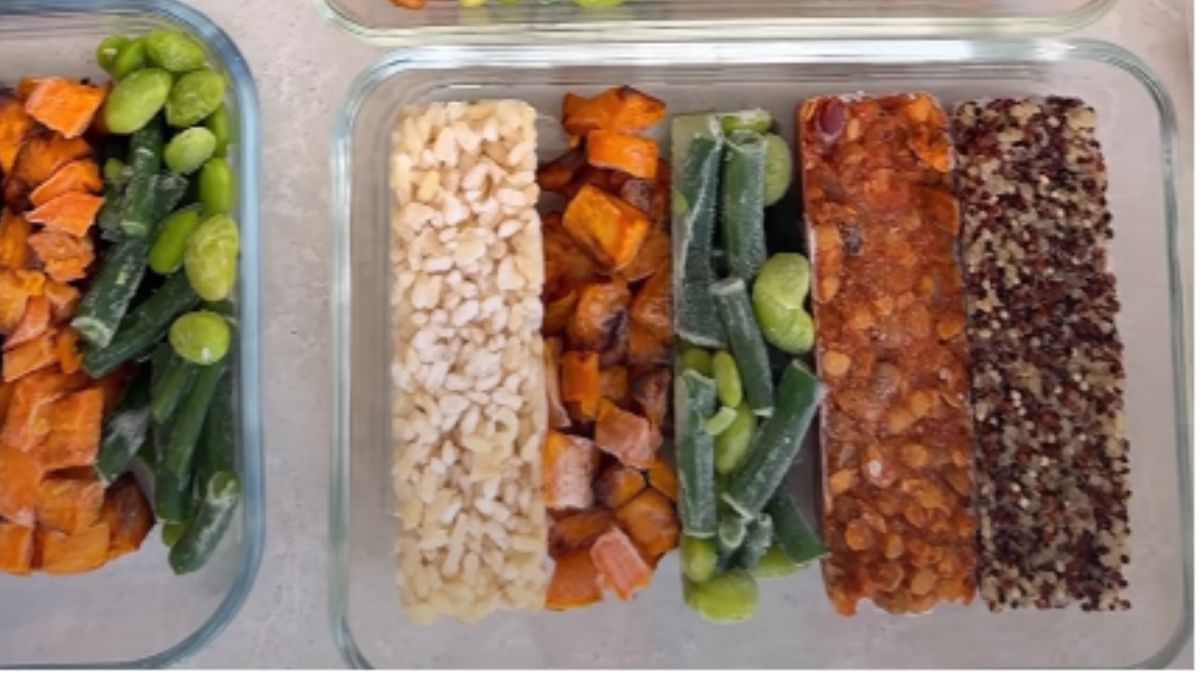
Social media has never run short of clever kitchen hacks, but every once in a while, one comes along that genuinely changes the way people think about cooking. That is exactly what happened when an Instagram user shared her approach to meal prep and freezing, a system she refers to as the “Lego Method.” The concept is as satisfying as it sounds, and it has been making the rounds online for good reason.
Instead of preparing and freezing complete, ready-to-eat meals, this home cook advocates for freezing individual components separately. Think cooked grains, sauces, proteins, and vegetables, each stored on their own in small containers. The idea is that when dinnertime rolls around, you simply pull out whichever building blocks appeal to you and combine them into a fresh meal on the spot.
“Recently I came across the idea of ‘Lego lunches’ which completely changed the way I prepare and freeze meals,” she wrote in her Instagram post. “Instead of freezing one finished dish, prepare and freeze each component separately: grains, sauces, proteins, and vegetables, like Lego bricks.” The analogy is immediately intuitive, and it is hard not to see the appeal once you picture it.
What makes this method especially practical is that it does not require any extra cooking sessions. Most of the components in her freezer are simply leftovers from larger batches she already made throughout the month. A pot of quinoa that yielded more than she needed, a tray of roasted vegetables from Sunday dinner, some chili con carne she had simmering on the stove anyway. Over time, the freezer fills up naturally, almost without trying. “When you need a quick meal, you can mix and match different combinations and create endless healthy and varied lunches or dinners,” she explained.
The flexibility this creates is one of its biggest selling points, particularly for families with picky eaters. Rather than serving everyone the same dish and negotiating around what a child refuses to touch, parents can let kids pick their own combination of blocks. “Children can choose what they want to eat, and it comes in handy when they don’t like what’s on the menu that day,” she noted. “It’s like having your own little Lego set for adults in the freezer.”
Portioning is built into the method as well. She uses small containers as her individual “blocks,” then assembles them into a full meal as needed. For her four-year-old, a typical dinner involves around three blocks, covering a protein, a grain, and a vegetable base. Adults tend to need five or six. Everything gets transferred from the freezer to the refrigerator the night before to thaw, then reheated however works best, and the meal is ready with minimal effort.
The variety of components she demonstrated in her video gives a good sense of just how versatile the system can be. Items like chili con carne, roasted sweet potato, cooked leafy greens, roasted chickpeas, quinoa, and brown rice can all be mixed and matched across multiple meals without any combination feeling repetitive. The same batch of chickpeas might end up alongside brown rice and roasted sweet potato one night, then tucked into a bowl with greens and chili the next.
Beyond just saving time, the Lego Method addresses one of the more frustrating aspects of traditional meal prep: the monotony. When you freeze an entire dish, you are committing to eating that exact meal every time you pull it out. With modular freezing, no two dinners have to look the same, even when you are working with the same ingredients.
The oldest known method of food preservation by freezing dates back to ancient China, where packed ice was used to keep food cold as far back as 1000 BC. The average American household throws away roughly 32 percent of the food it buys, which makes modular freezing not just convenient but genuinely impactful on reducing waste. Quinoa, one of the staples in this method, is technically a seed rather than a grain, which is why it contains all nine essential amino acids and cooks in under 15 minutes.
Have you ever tried modular meal prepping, and would the Lego Method work for your household? Share your thoughts in the comments.