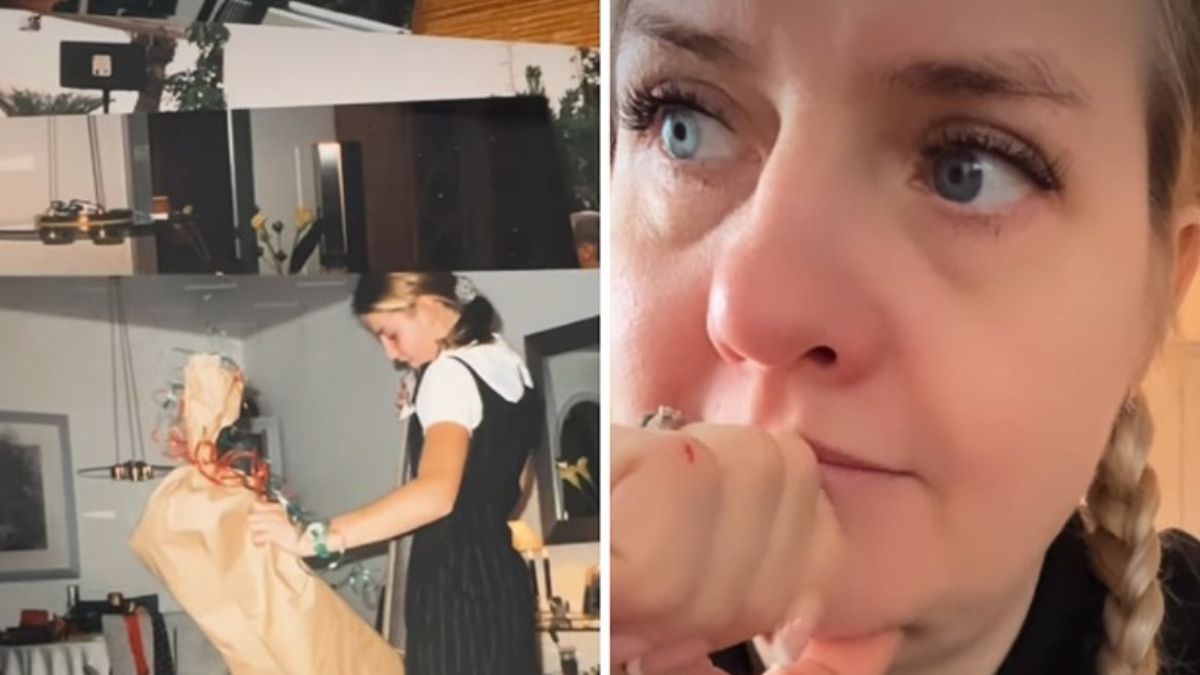
A video posted by content creator Kiki, known on Instagram as @kiki_cooks_fit, has gone viral after she shared a deeply personal realization that left millions of viewers stunned. While flipping through old childhood photographs, Kiki discovered that the story she had always believed about her own body simply did not match reality. The clip racked up four million views and sparked an outpouring of similar confessions from women around the world. What started as a quiet personal moment quickly turned into a broader conversation about the lasting damage that weight-related comments can leave on a child.
In the video, Kiki described a painfully familiar scenario for many millennials, writing in the caption: “Scenario: as a child and teenager they kept telling you that you were already ‘too fat’.” She explained that after stumbling across old photos of herself, she was genuinely taken aback by what she saw. “I found my old childhood photos… and I’m honestly in shock,” she wrote. “I was never the ‘fat girl’ they considered me to be.” She acknowledged that her body changed as she grew up, as it does for every child, but emphasized that she was never the size or shape she had been made to believe she was.
The emotional weight of her post came through clearly in her follow-up reflection. “I grew up thinking something was wrong with my body, even when the photos prove otherwise,” Kiki shared. “That kind of story stays with you. In your body. In your mind. Forever.” She described how repeated messaging, even when completely untrue, can become deeply embedded as personal truth. Her words resonated with an enormous number of people who recognized their own experiences in her story.
According to Daily Dot, psychologists have established that parents who directly comment on, criticize, or compare a child’s weight significantly raise the likelihood of that child developing an eating disorder or a poor relationship with their body, particularly among daughters. Research indicates that the harmful effects of such comments can begin showing up as early as age five or six. The damage, experts note, can be far-reaching and long-lasting, shaping the way a person sees themselves well into adulthood.
The comments section beneath Kiki’s post quickly filled with women who felt seen by her message. One person wrote, “I hate looking at my old photos because I now realize I was so much prettier than I thought. I feel so sorry for that girl who hated her body.” Another added, “Others commented on my ‘little belly’ when I was 15. Looking at those photos today, I can see I had visible abs. And even if I hadn’t, nobody had any right to comment on my body at that age. It’s so damaging.” One particularly heartbreaking account came from a woman who recalled visiting her father, a professional bodybuilder, for her 11th birthday, only to be told: “Who are you? You’re too fat to be related to me. Get out of my house.” Others chimed in with equally painful memories, with comments ranging from “I want to hug that little girl every time I look at old photos” to “I weighed 88 pounds and they still called me fat.”
Negative body image rooted in childhood is a well-documented psychological issue. Research in the field of developmental psychology shows that children as young as three years old can begin internalizing messages about body size and attractiveness. The way caregivers and family members talk about weight, both directly to a child and in general conversation within the home, plays a significant role in shaping self-perception. Studies have consistently linked early exposure to weight-based criticism with higher rates of anxiety, depression, and disordered eating behaviors later in life. Body dysmorphia, a condition where a person becomes obsessed with perceived flaws in their appearance that others cannot see or consider minor, is also closely associated with early negative body messaging. Mental health professionals widely agree that fostering a neutral or positive body environment during childhood is one of the most protective factors against these outcomes.
If Kiki’s story resonated with you or brought up memories of your own, share your thoughts in the comments.