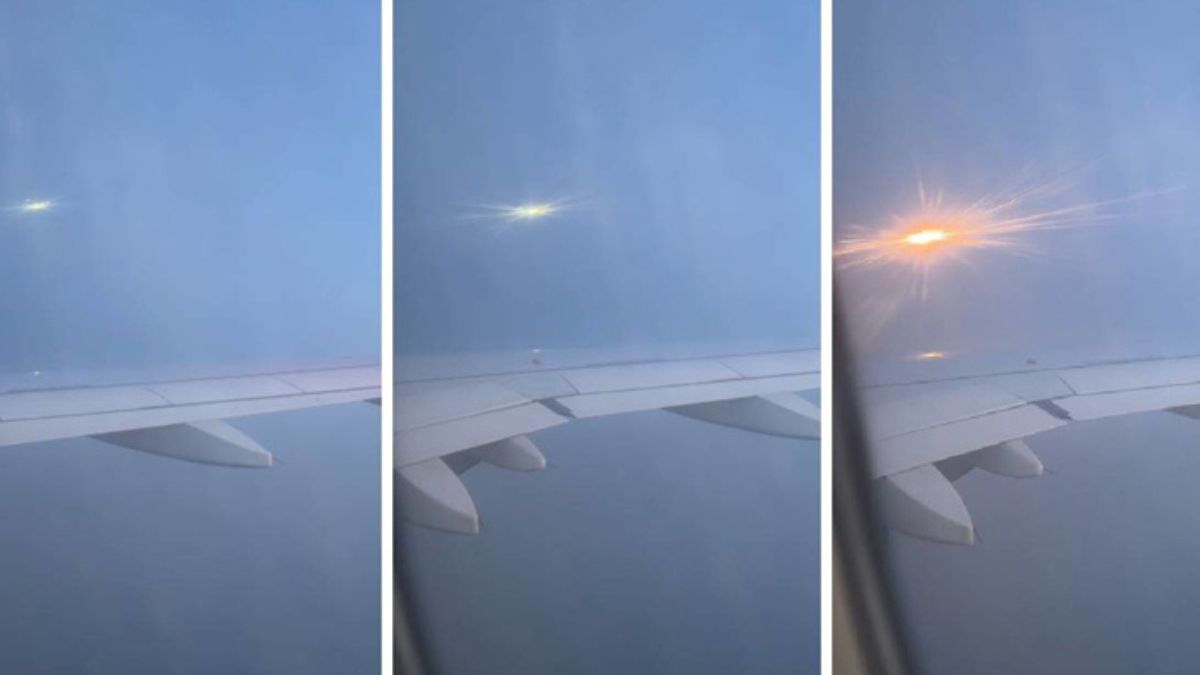
A routine flight out of Brussels turned into an unforgettable brush with the cosmos for one traveler in early March. Denis Maltyzov, a Berlin-based passenger aboard Brussels Airlines flight SN2589, was quietly recording a timelapse through his window during takeoff when the sky suddenly erupted in a blinding burst of light. What he captured on camera turned out to be a fireball meteor visible across multiple European countries, and the footage quickly spread far beyond anything he had anticipated.
Maltyzov described the moment to Newsweek in vivid detail. “Everything happened around 6:53 PM, during takeoff. I was filming a timelapse through the airplane window when suddenly a very bright object appeared, and then it flashed powerfully, almost like an explosion of light,” he said. For a few terrifying seconds, he was convinced something had gone wrong close to the plane. “I genuinely thought something had exploded near our aircraft, which was pretty frightening,” he added. The shock of the moment lingered well after the light faded.
When Maltyzov shared the video on social media, he was still visibly shaken. “I’m still a little rattled as I’m writing this,” he wrote in his post, describing what he had witnessed as an “intense burst of light.” He noted that despite being a frequent flyer, the experience was unlike anything he had encountered in the air before. “This is the first time in my life I was genuinely scared on a plane,” he wrote. Reflecting on the cosmic scale of the event, he added: “A rock that traveled billions of kilometers through space and burned up right before my eyes.”
The fireball was not just a private spectacle for one startled passenger. Sightings poured in from across Belgium, Germany, France, Luxembourg, and the Netherlands, initially sparking confusion and alarm among those on the ground before scientists stepped in to explain what had happened. Many witnesses reported the same dramatic details, including a long glowing tail and a series of loud sonic booms as the object broke apart while entering the atmosphere. The scale of the event made it one of the more widely observed meteor sightings over Western Europe in recent memory.
The European Space Agency confirmed the event in an official statement, noting that the fireball was detected at approximately 6:55 PM Central European Time on March 8th, traveling in a southwest-to-northeast direction across Western Europe. According to the ESA, the object remained visible for several seconds before disintegrating, and was captured both by dedicated meteor-monitoring cameras and by ordinary mobile phones. The ESA’s Planetary Defence team estimated the object measured several feet in diameter and stressed that objects of this size enter Earth’s atmosphere with relative frequency and typically pose minimal risk.
After learning that his footage was just one piece of a much larger puzzle, Maltyzov updated his original post to reflect the broader scope of the sighting. He noted that numerous people had “reported a massive fireball with a long glowing tail, accompanied by a strong flash and even loud bangs as it broke apart in the atmosphere.” The confirmation from scientists transformed his moment of fear into something far more extraordinary and grounding.
The video’s spread exceeded anything Maltyzov had expected when he first hit share. The clip racked up more than a million views on Instagram alone. “I shared the video simply because it was such an extraordinary moment and I realized I had accidentally captured it,” he said. “I wasn’t expecting this kind of reaction. It’s quite surreal to see so many people interested in something that happened entirely by chance.” What began as a casual timelapse became one of the most-watched accidental astronomical recordings of the year.
Fireballs, technically known as bolides when they explode in the atmosphere, are defined as meteors that shine brighter than the planet Venus, and scientists estimate that Earth is pelted by roughly 100 tons of cosmic debris every single day, most of it burning up long before it reaches the ground. The specific orbit of the March 8th object was traced back toward the asteroid belt, which sits between Mars and Jupiter, meaning that piece of rock had been traveling through the solar system for billions of years before its 26-mile-per-second finale over Belgium. The sonic booms Maltyzov and others heard were not from an explosion but from the meteor pushing through the atmosphere faster than the speed of sound, creating a shockwave that can sometimes rattle windows miles below.
Have you ever witnessed a meteor or fireball in person? Share your experience in the comments.