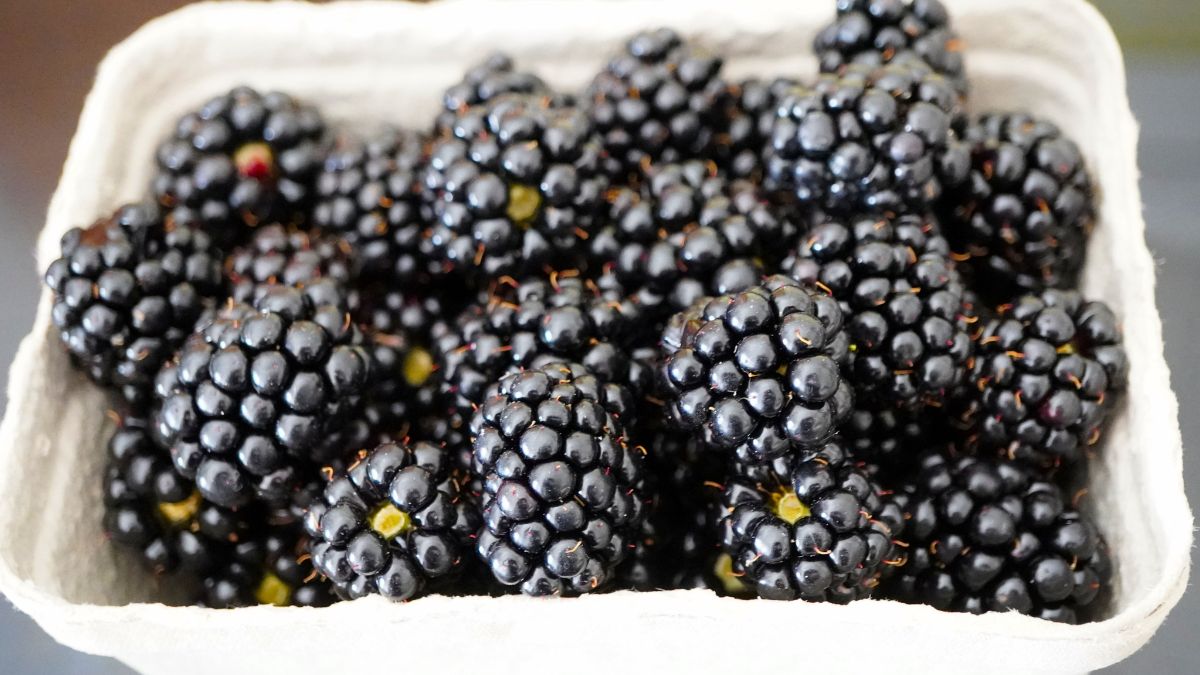
Most people who reach for a handful of blackberries or add kale to their lunch are thinking about vitamins, maybe antioxidants, possibly just trying to be a little healthier. What they are almost certainly not thinking about is that the puckering sensation those foods create in their mouth might be sending a signal to their brain that resembles the one triggered by a workout. A new study suggests that is exactly what may be happening, and the implications are genuinely surprising.
Researchers at the Shibaura Institute of Technology published a study in the journal Current Research in Food Science in late 2025, looking specifically at the effects of consuming astringent foods on brain activity and behavior. The team, led by Dr. Yasuyuki Fujii and Professor Naomi Osakabe, focused on flavanols, a type of polyphenol found in plant-based foods that produces that characteristic dry, slightly rough, puckering feeling in the mouth. Foods like blackberries, kale, dark chocolate, and red wine all contain high levels of these compounds, and most people have experienced that sensation without giving it much thought.
The central question the researchers wanted to answer was how flavanols actually influence the nervous system, given that only very small amounts of them are absorbed into the bloodstream. The prevailing assumption had been that their health benefits came primarily from what the body absorbed and processed internally. But the Shibaura team proposed a different mechanism entirely. “Flavanols have an astringent taste,” said Fujii. “Our hypothesis was that this taste acts as a stimulus that sends signals directly to the central nervous system. We believe that flavanol stimulation is transmitted through sensory nerves, activates the brain, and then triggers physiological responses in the rest of the body through the sympathetic nervous system.” In simpler terms, the taste itself may be the messenger, not just what survives digestion.
To test this, the researchers gave one group of mice oral doses of flavanols while a control group received only distilled water. The results were notable. The mice that consumed flavanols showed measurably higher levels of physical activity, more exploratory behavior, and better performance on learning and memory tasks compared to the control group. These were not subtle differences but consistent patterns that suggested a real and measurable physiological response was taking place.
What made the findings particularly interesting was the nature of that response. The team observed that the flavanol-consuming mice appeared to experience something functioning like a mild stressor, and the body’s reaction to that stressor closely resembled what happens during physical exercise. The brain’s response to the astringent taste, mediated through the sympathetic nervous system, seemed to prime the body for increased activity and alertness. “Responses to stress induced by flavanols in this study are similar to those prompted by physical activity,” Fujii noted, adding that even moderate flavanol consumption, despite limited absorption, may support overall health and quality of life.
Part of what makes this finding so compelling is the specific chemicals involved. The researchers found that flavanol consumption elevated levels of dopamine and its precursor levodopa, along with norepinephrine and its metabolite normetanephrine. These are not minor players in the body’s chemistry. They are directly tied to motivation, attention, alertness, and stress regulation, which are the same systems that exercise is well known to activate. The idea that eating a handful of blackberries could nudge those same systems, even modestly, is a genuinely intriguing possibility.
Before anyone cancels their gym membership, the researchers themselves are careful to keep expectations grounded. This was a study conducted on mice, and the outcomes were described as mild. The finding is not a claim that eating astringent foods replaces exercise but rather that it might complement or support it in ways that were not previously understood. At minimum, it adds another layer of scientific rationale for including flavanol-rich foods in a regular diet, beyond the already well-established links between polyphenols and reduced cardiovascular disease risk and improved memory.
The broader implication, if the mechanism holds in humans, is that the act of tasting certain foods may be doing more work than we ever gave it credit for. The mouth is not just a gate for nutrients to pass through on their way to digestion. It is also a sensory interface that communicates constantly with the brain, and the signals it sends may have downstream effects that extend well beyond flavor perception.
Flavanols were first identified as a distinct subclass of polyphenols in the mid-twentieth century, but it was not until the 1990s that researchers began seriously investigating their cardiovascular benefits, partly sparked by studies into why certain populations with high cocoa consumption showed surprisingly low rates of heart disease. The sympathetic nervous system, which the Shibaura team identified as the likely pathway for flavanol-triggered responses, is the same system responsible for the body’s fight-or-flight response, which is why the parallels to exercise-induced stress are so structurally interesting. Kale, one of the most flavanol-dense vegetables commonly available, also happens to be one of the most nutrient-dense foods per calorie on the planet by almost any metric used, which at this point feels almost unfair.
Have you ever noticed a shift in your energy or mood after eating particularly bitter or astringent foods? Share what you’ve experienced in the comments.