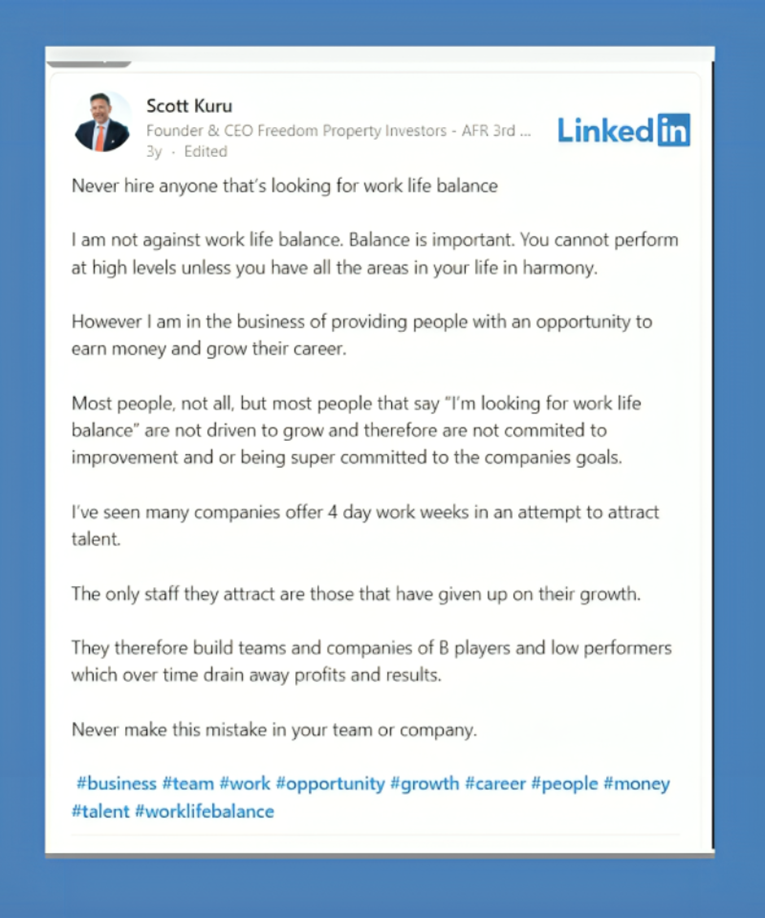
A prominent business leader has ignited a heated discussion online by suggesting employers should pass on job applicants who highlight a specific priority during interviews. Scott Kuru, the founder and director of Freedom Property Investors, made this claim in a LinkedIn post that quickly drew widespread attention. He argued that candidates focused on this element often lack the drive for career advancement. That element turns out to be work-life balance.
Kuru explained his position clearly in the post. “Never hire someone who is looking for work-life balance.” He clarified that he does not oppose the idea completely but views those who emphasize it as uninterested in professional growth. In his experience, initiatives like four-day work weeks tend to draw workers who have stopped pursuing personal development.
The statement provoked strong backlash from other professionals on the platform. Many accused Kuru of being out of touch with modern workplace realities. One woman highlighted the serious health implications involved. “Burnout now has an ICD-10 code, a confirmed disease state with enormous costs to the healthcare system. It’s time to change how we treat employees.”
Evidence from various studies challenges Kuru’s perspective on employee well-being. Research from December 2020 revealed that 76 percent of workers in the United States had faced burnout due to overwhelming workloads. During the period known as the Great Resignation, 41 percent of employees quit their positions seeking more flexible arrangements. Maintaining a proper balance between work and personal life boosts engagement levels and cuts healthcare expenses for companies.
Employees with healthy boundaries also show greater productivity. Data indicates they perform 21 percent better than those without such equilibrium. While shorter work weeks can pose logistical difficulties for businesses, the long-term advantages frequently surpass the dangers of widespread exhaustion. These findings underscore the value many workers place on sustainable career paths over relentless ambition.
Kuru’s company, Freedom Property Investors, operates in the property investment sector where high-pressure environments are common. His views reflect a traditional mindset that prioritizes hustle above all else. Yet the responses to his post illustrate shifting attitudes among today’s workforce. Professionals increasingly demand roles that respect their time outside the office.
The debate highlights broader tensions in employment dynamics. Employers grapple with retaining talent amid rising awareness of mental health issues. Candidates, in turn, feel empowered to voice expectations early in the hiring process. Kuru’s advice, while provocative, has prompted many to reconsider what qualities truly signal a strong hire.
Work-life balance generally describes the effort to divide time and energy effectively between professional responsibilities and personal activities. It includes family commitments, hobbies, rest, and self-care to prevent overload. Poor management of this balance often leads to stress, reduced job satisfaction, and higher turnover rates. Companies promoting it typically see improved morale and lower absenteeism.
Burnout represents a syndrome resulting from chronic workplace stress that has not been successfully managed. It involves emotional depletion, detachment from work, and a sense of reduced accomplishment. International health organizations recognize it as a significant occupational concern with real impacts on physical and mental well-being. Addressing it requires systemic changes rather than individual resilience alone.
The Great Resignation marked a massive wave of voluntary job departures starting around 2021. Millions of workers reassessed their priorities following pandemic disruptions. Many sought better pay, remote options, or environments valuing their overall health. This shift forced numerous organizations to adapt recruitment and retention strategies.
Experiments with reduced work weeks have gained traction in various countries. Some trials report maintained or increased output despite fewer hours. Participants often cite higher job satisfaction and creativity. Outcomes vary by industry, but the model continues to challenge conventional full-time norms.
What do you think about prioritizing work-life balance when applying for jobs – share your experiences in the comments.