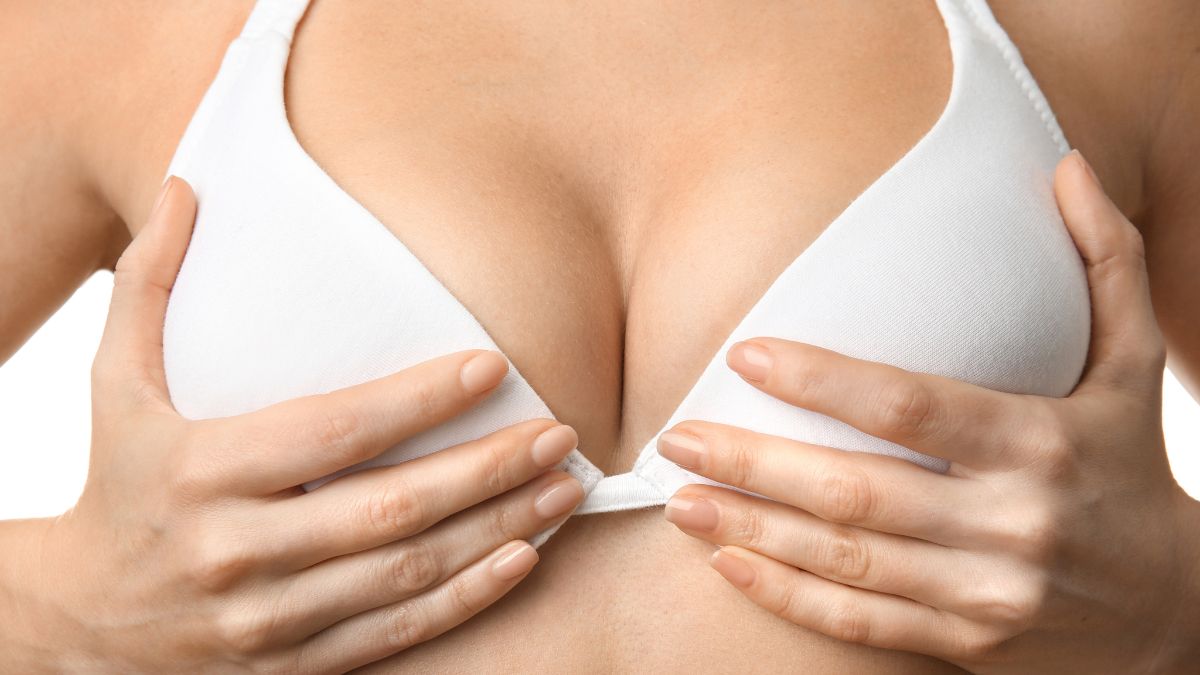
Buying a bra should be a straightforward task, but for countless women it turns into a frustrating ordeal involving sizes that don’t seem to exist, wires that shift after a few wears, and endless strap adjustments in dressing rooms. The reality is that a surprisingly large number of women go through their daily lives wearing the wrong bra size without even realizing it. A professional bra fitter on TikTok recently broke down four telltale signs that your bra simply does not fit properly, and the comment section filled up almost instantly with women who recognized themselves in every single point. The video resonated so widely because these are not rare or unusual problems — they are everyday discomforts that many women have quietly accepted as normal.
The first and most obvious sign is that the band rides up toward your shoulder blades throughout the day. The underband, which is the horizontal strip of fabric sitting below the cups, is actually responsible for the vast majority of the bra’s support — not the straps. When the band creeps up your back and you find yourself reaching halfway up your spine to unhook it at the end of the day, that is a strong signal the band is too loose and therefore failing to stay anchored in place. A properly fitted band should sit horizontally and firmly across your back, parallel to the floor, without shifting at all.
The second sign is that you are constantly tugging your straps tighter because the front of the bra feels like it is drooping or not providing enough lift. Many women instinctively compensate for poor fit by shortening the straps, believing that the straps are what hold everything up. The fitter points out, however, that in a correctly sized bra the straps should not need to be shortened repeatedly — if you find yourself doing this on a near-daily basis, the band and cups are likely not doing their job, and the straps are being overworked as a result.
The third sign is that the underwire or the edge of the cup is digging into breast tissue or leaving deep marks in the wrong places. The wire is designed to sit neatly around the base of the breast, completely encircling the breast tissue without pressing into it. When the wire pokes, pinches, or cuts into the breast itself, it almost always means the cup is too small, or alternatively that the band is too wide and pulling everything out of alignment. Either way, discomfort from an underwire is never something you simply have to put up with — it is a clear fitting problem worth addressing.
The fourth sign is chafing, particularly under the breasts or along the edges of the cups. This happens when the bra is not stable enough on the body and moves around with every step or movement, causing the fabric to repeatedly rub against the skin. A common reason for this kind of movement is a band that is too large, which means the bra has too much room to shift around rather than staying firmly in position. Persistent redness or irritation in these areas is a reliable indicator that your current size is not the right match for your body.
@gia_costella You guys ask me at least once a week ♥️✨ #plussize #plussizebra #woolies #fashionplug #wooliesbra ♬ original sound – Gia Costella | PlusSizeFashion
It is worth understanding that bra sizing is far more complex than it might appear on a label. The number in a bra size refers to the band measurement in inches around the ribcage, while the letter indicates the cup size, which is determined by the difference between the bust measurement and the band measurement. Cup size is not an absolute measurement — it is relative to the band, which means a 34C and a 36B actually hold a similar volume of breast tissue, a concept known in the fitting world as sister sizing. This is one of the reasons so many women end up in the wrong size: they assume their cup size is fixed across all band sizes, when in reality switching to a smaller band might require going up a cup letter to maintain the same actual fit. Most lingerie experts and professional bra fitters recommend getting measured every year or whenever your body changes significantly, since weight fluctuations, pregnancy, nursing, and even changes in muscle tone can all affect the ideal bra size. Studies and surveys conducted by lingerie brands and fitting specialists over the years have consistently found that the majority of women are wearing the wrong size, with the most common errors being a band that is too large and a cup that is too small.
If any of these four signs sound familiar, share your own bra-fitting experiences and thoughts in the comments.