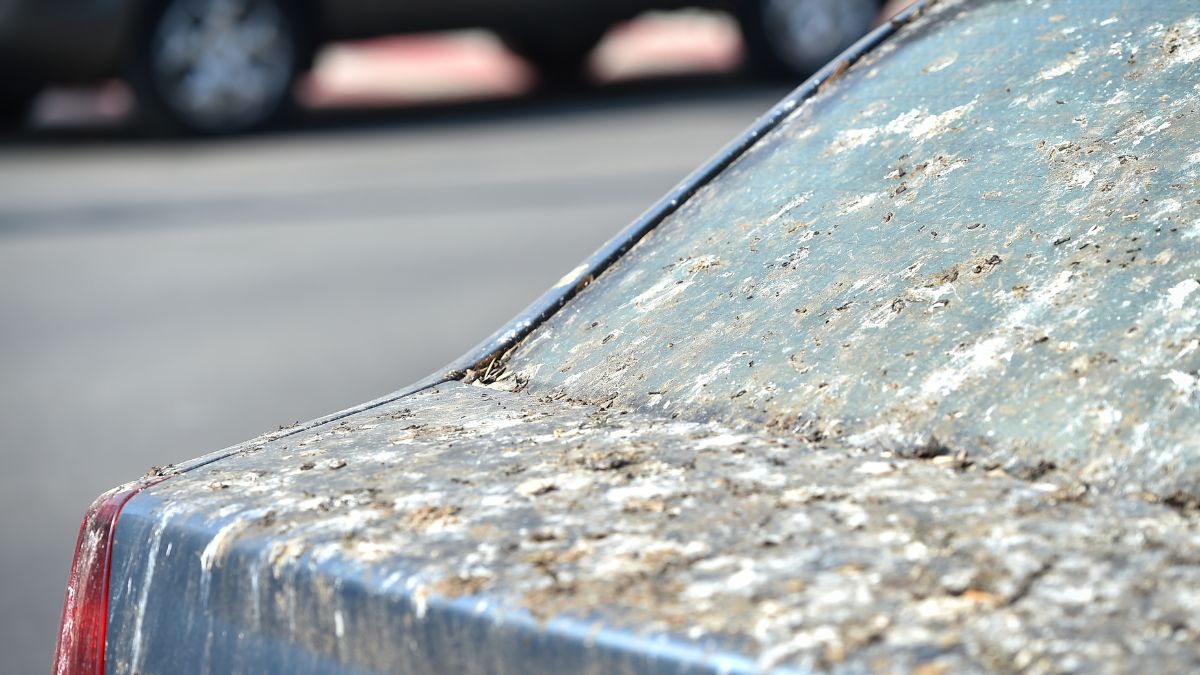
Birds are truly remarkable creatures that, according to scientific understanding, descended directly from dinosaurs millions of years ago. But as awe-inspiring as they are, the little “gifts” they leave on your car can turn into a genuine headache for any vehicle owner. Bird droppings are capable of causing serious and permanent damage to your car’s paint, which is why acting fast after a splattering is absolutely essential. Automotive outlet Jalopnik has taken a deep dive into just how damaging these droppings can be and what you should do about it.
The problem is taken so seriously by automakers that they actually develop synthetic bird droppings in their laboratories. Engineers spray these artificial samples onto test panels and then bake them under simulated sunlight to mimic real-world conditions. This process creates what researchers describe as a kind of droppings “cement” that replicates the genuine article. Car paint naturally expands in the heat and contracts when temperatures drop, and any contamination sitting on the surface gets literally pressed into the clear coat with each cycle, making bird droppings particularly destructive in this regard.
The core of the issue lies in acidity. Bird droppings carry a pH level somewhere between 3 and 4.5, which is acidic enough to eat through your vehicle’s clear coat and underlying paint. For context, pure water sits at a neutral pH of 7, meaning droppings are dramatically more corrosive by comparison. On top of that, birds do not excrete urine and solid waste separately the way most other animals do. Their combined waste contains both solid particles and uric acid, which is that white, sticky residue that, unlike urea found in human urine, simply does not dissolve in water. The result is something that is acidic, water-resistant, and exceptionally difficult to remove.
Even a fresh dropping should never be wiped away carelessly. The waste often contains hard particles like seeds, which can scratch the paint surface if dragged across it. The correct approach is to dab and lift rather than wipe. Grab a damp microfiber cloth and gently tap the affected area to pull the material away from the surface. After several rounds of this, rinse the spot with water and dry it with a clean cloth before applying a detailing spray and a layer of wax to restore the protective barrier.
If the dropping has already dried and hardened, your first step is to soften it. Lay a cloth soaked in warm water over the spot and let it sit for a few minutes. You can also use a mixture of water, a small amount of baking soda, and a couple of drops of dish soap to help neutralize the acid. Once the material has softened, treat it the same way you would a fresh dropping by dabbing and lifting rather than rubbing. After rinsing, inspect the paint carefully. Minor surface damage might be buffed out with a polishing compound, but if the clear coat has been significantly compromised, a visit to a professional detailer or body shop will likely be necessary.
When it comes to prevention, avoiding the problem entirely is not always realistic, but smart parking choices go a long way. Steering clear of trees, street lamps, and overhead power lines, which are favorite resting spots for birds, will dramatically reduce your exposure. It is also worth keeping in mind that parking under trees brings the additional hazard of tree sap, which is equally stubborn and damaging to automotive finishes. Frequent washing is not necessarily the answer, as over-washing can introduce its own set of paint problems. Instead, maintaining a solid layer of quality wax creates a protective shield between your paint and the environment.
For those wanting more advanced protection, paint protection film and ceramic coatings are two strong options worth exploring. Ceramic coatings are even used on aircraft due to their resistance to extreme environmental conditions. Professional application can be costly, but more budget-friendly do-it-yourself ceramic coating kits are widely available at auto parts stores. As with any such product, carefully reading and following the instructions is critical to avoid accidentally making things worse.
Car paint is generally made up of several layers, including a primer, a base coat for color, and a transparent clear coat on top that provides gloss and protection. The clear coat is the layer most vulnerable to bird droppings, UV rays, and environmental contaminants. Paint protection film, sometimes called PPF, is a thermoplastic urethane film that is applied directly to painted surfaces and can even self-heal minor scratches when exposed to heat. Ceramic coatings, meanwhile, form a chemically bonded layer on top of the paint that is hydrophobic, meaning water and many contaminants bead up and slide off rather than sticking. Both technologies have become increasingly popular among car enthusiasts and everyday drivers looking to preserve their vehicle’s value and appearance over the long term.
If you have ever dealt with bird dropping damage on your car or have a go-to cleaning method that actually works, share your experience in the comments.