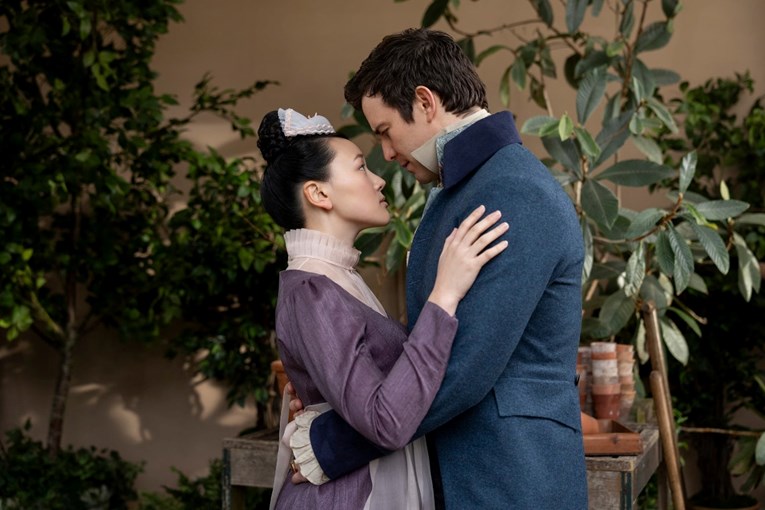
Sensitive men have always existed, but popular culture spent decades treating them like a footnote. Throughout the 2000s and 2010s, romance narratives were frequently built around emotional unavailability dressed up as mystery. The man who replied in one-word texts was coded as intriguing. The one who kept you guessing was framed as deep. Women were handed the bulk of the emotional labor in these dynamics and told, more or less, that this was just how things worked.
The shorthand became painfully familiar. “He’s complicated” was supposed to signal depth. “He’s like that with everyone” was offered as a kind of absolution. Emotional distance was confused with complexity, and a generation of romantic storylines reinforced the idea that yearning without reciprocation was somehow more compelling than actual tenderness. And then ‘Bridgerton’ arrived and quietly started resetting expectations.
The male leads in ‘Bridgerton’ are far from perfect. They hesitate, they misjudge, they get in their own way. But they also look at the women they love like those feelings are nothing to be ashamed of. They pine openly. They apologize without being backed into a corner. And according to Newsweek, this has struck a nerve with audiences in a way that is hard to overstate. Lori Bindig Yousman, a communications professor at Sacred Heart University, told Newsweek that the show puts forward male leads who are “emotionally expressive, attentive, and engaged in their partners’ inner lives.” By most standards, that description sounds less like a revolutionary archetype and more like a baseline. Yet for a long time, that kind of man was considered sweet but a little dull.
Part of what makes the ‘Bridgerton’ effect so striking is how much it reflects a broader cultural shift in what people actually want from a romantic partner. Clinical psychologist Sabrina Romanoff, affiliated with Harvard University, explained that the emotionally withholding male lead has started to feel less exciting and more draining. People are already stretched thin by work, by the relentless scroll of dating apps, by general uncertainty about the state of the world. The last thing anyone wants is a love interest who functions like a puzzle with no solution.
The data seems to back this up. Dating.com analyzed Google Trends and found that searches for phrases like “my boyfriend isn’t romantic” and “my man isn’t romantic” spiked noticeably in the period following the return of ‘Bridgerton.’ The same analysis found that 36 percent of American women said they would prefer to date someone from a culture that encourages open emotional expression. These are not small numbers, and they point to something real shifting in how people understand what they want and what they are willing to settle for.
Journalist Katherine Brodsky framed ‘Bridgerton’ as something like a recalibration of what masculinity looks like in romantic storytelling. She described the show’s central appeal with clarity, telling Newsweek: “The fantasy is that he openly yearns for her. That’s something to aspire to.” It is a deceptively simple observation, but it captures why the show has resonated so widely. Longing that is expressed rather than suppressed, attention that is given rather than withheld, these things have always been appealing. What changed is that a wildly popular show decided to put them front and center without treating them as weaknesses.
None of this means that gentle, emotionally present men are a new invention. They have always been out there. What is new is the cultural permission to find them attractive without qualification, to watch a man say what he feels on screen and think yes, finally, rather than nice but where is the drama. The ‘Bridgerton’ effect is less about creating a new standard and more about recovering one that got buried under years of narratives that confused coldness with intrigue.
The result is a strange and somewhat overdue moment. Viewers are rewinding scenes set to string arrangements of pop songs, watching men admit to their feelings on screen, and feeling something click into place. Someone, it turns out, finally understood what a lot of people had been hoping for all along.
The original ‘Bridgerton’ book series by Julia Quinn sat on shelves for over a decade before the Netflix adaptation turned it into a global phenomenon, which says something about how quickly the right cultural moment can change a story’s reach. Regency-era England, which serves as the show’s backdrop, actually had a word for the kind of brooding, performatively distant man the show pushes back against, they called him a rake, and the genre has been trying to rehabilitate or retire that figure ever since. Research published in the journal Evolutionary Psychology found that women consistently rate emotional responsiveness as one of the most attractive long-term partner traits, which means ‘Bridgerton’ is not inventing a fantasy so much as finally matching one that already existed.
If the ‘Bridgerton’ effect has you rethinking what you actually want in a partner, or you have thoughts on why it took this long for emotionally available men to have their pop culture moment, share them in the comments.