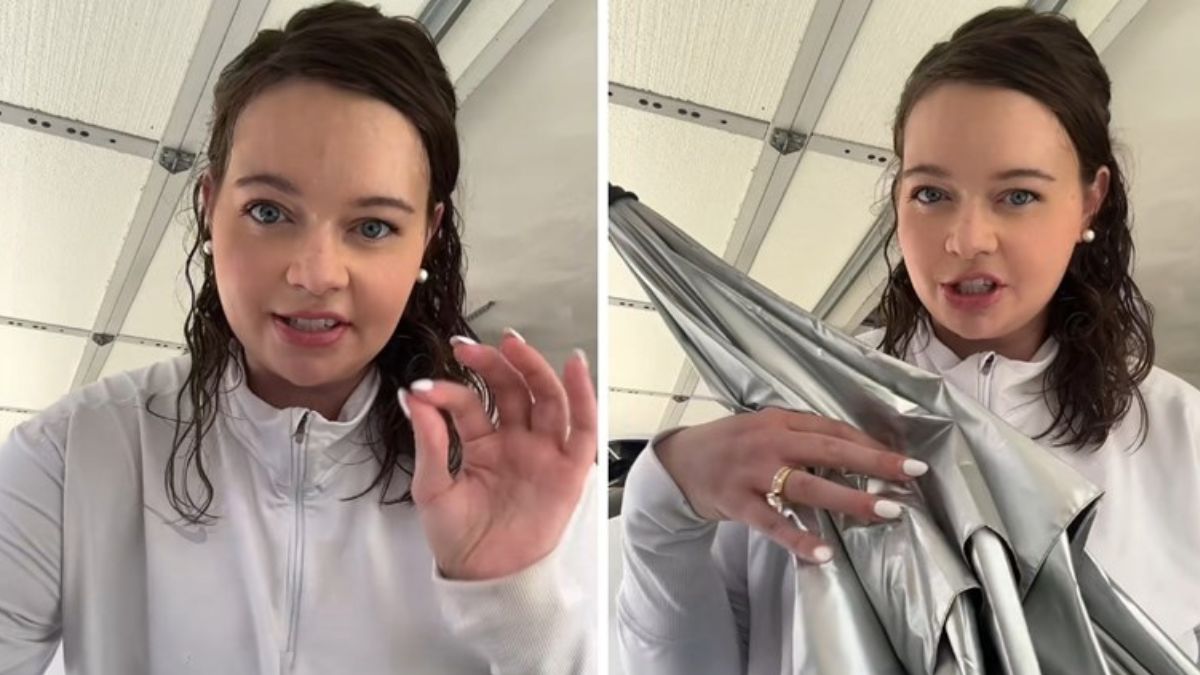
Most people think of allergies as a manageable inconvenience, something dealt with by popping an antihistamine or avoiding a specific food. But for a TikToker known as Jennin, simply stepping outside on a sunny day is a carefully orchestrated mission involving specialized clothing, medical documentation, and an arsenal of SPF. Her condition is a sun allergy, and it developed not on its own but as a side effect of an autoimmune disease she was diagnosed with four years ago. “God, I miss being outdoors so much,” she wrote in her video, which has since gone viral with nearly 8 million views in just three days.
Jennin described herself as “deathly allergic to the sun,” and what followed in the clip was a detailed walkthrough of everything she has to do and wear before she can walk out the front door. The preparation is extensive and leaves very little room for error. As spring arrives and UV levels rise, even brief, unprotected skin exposure can result in burns. The routine she has built around this reality is nothing short of a full-time job.
The first thing she addressed was her car. Because sunlight once hit one side of her face through the window while she was driving and caused burns, she had her vehicle fitted with fully tinted windows. This was not a cosmetic choice but a medical necessity, and she obtained official documentation to back it up. The medical clearance is noted on her driver’s license, and she also carries a separate doctor’s letter in case she is pulled over by police.
Clothing comes next, and it is equally non-negotiable. Every item she puts on must have UV protection built into the fabric. In her video, she showed a long-sleeved UV-protective top with a high collar that shields her neck entirely, UV-protective leggings, UV-protective socks, and UV-protective sneakers. She even lets her hair down deliberately to provide an extra layer of coverage for the back of her neck. Nothing is left unguarded.
Before leaving home, Jennin applies sunscreen with a high protection factor from head to toe, and she always carries more with her to reapply throughout the day. The application process is thorough to a degree most people would never consider. “On the middle parts of the outer ear, under the nails, everywhere,” she explained. She has learned this level of precision the hard way. “I’ve already had it happen that I skipped some of those spots and got burns,” she said. “It’s so uncomfortable.”
Even with all of that in place, stepping out of the car presents its own challenge. Whenever she has to go from her vehicle into a store or any other space, she uses a UV-protective umbrella to shield herself during those few exposed moments. She showed it on camera, acknowledging that it is not exactly compact. “It’s massive,” she said, holding it up. “But anything is better than getting burned.”
@jenninprogress 4 years ago I developed my sun allergy as a side effect of my autoimmune disease and omg I miss the outdoors ….. 😭😭😭 #autoimmunedisease #fyp #howto #uvindex #tips ♬ original sound – jenninprogress
There is one more layer of difficulty that comes with all of this protection: heat. The UV-protective clothing traps warmth, and during summer months in Virginia, where Jennin lives, temperatures can climb to around 95 degrees Fahrenheit. “It’s horrible, so I don’t spend too much time outside,” she admitted. To finish off her routine, she always wears polarized sunglasses that she described as practically living on her face. She puts them on even indoors when she is sitting near a window. “Once I didn’t do that and my eyelids almost completely burned,” she said.
The reaction to her video has been enormous, with viewers expressing both shock and admiration for the level of discipline her daily life requires. Her story has opened up a wider conversation about how invisible and misunderstood conditions can completely reshape a person’s relationship with something as ordinary as daylight.
Solar urticaria, one of the rarest forms of sun allergy, can cause hives within minutes of sun exposure and affects only about one in 100,000 people globally. UV-protective fabrics were originally developed for fishermen and outdoor workers in Australia, where skin cancer rates have historically been among the highest in the world. Polarized lenses do not just reduce glare but actually block specific wavelengths of light from penetrating the eye, which is why they can make a meaningful difference for people with light-sensitive conditions.
If you or someone you know has dealt with a rare or unusual allergy, share your experience in the comments.