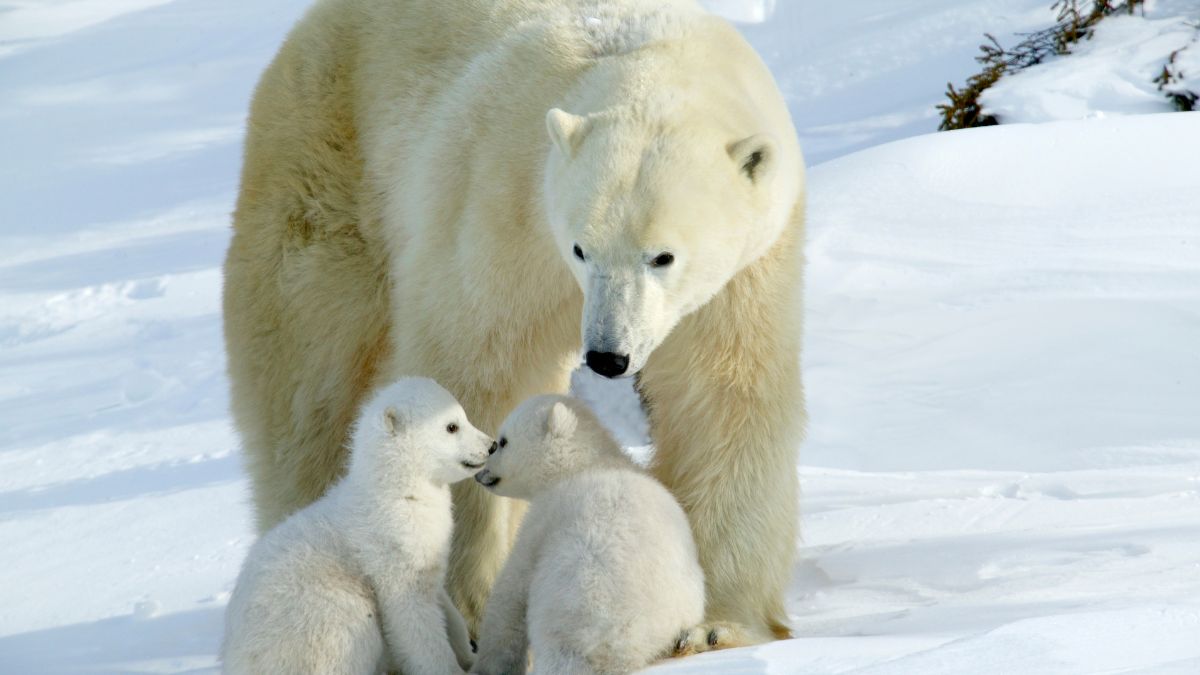
There are moments in nature so tender and fleeting that they feel almost too private to witness, and a recent BBC Earth footage capturing two polar bear cubs stumbling into the light for the very first time is exactly that kind of moment. Filmed in March, when daylight finally returns to the High Arctic after four months of complete darkness, the clip has traveled across the internet with remarkable speed, leaving viewers across the world quietly emotional. The footage was narrated by the legendary Sir David Attenborough, whose voice has long become synonymous with the most intimate and awe-inspiring stories the natural world has to offer. Together, the images and narration create something that feels less like a wildlife documentary and more like a small miracle caught on camera.
In the opening moments of the footage, the mother bear is the first to emerge from the den, stepping out as a signal that spring has finally arrived. Attenborough describes what follows with characteristic calm and wonder: “After months of confinement underground, she makes her way down the slope. Perhaps to clean her fur, perhaps out of sheer joy.” It is a quiet but loaded detail, the idea that even a polar bear might tumble down a snowy hillside simply because it feels good to be alive after months in the dark. The cubs appear shortly after, blinking into what Attenborough calls “their bright, new world” for the very first time.
What makes the footage so affecting is just how unsteady the little ones are. The steep slope, as Attenborough gently observes, “is not the easiest place for first steps,” and the cubs prove this in the most charming way possible, scrambling and sliding as they try to catch up with their mother below. She calls out to them from the base of the hill, patient and encouraging, as the two small bears work their way down with all the grace of someone learning to walk in oversized boots. The cubs had apparently been kept waiting all morning, as their mother had, according to Attenborough, “delayed their feeding for this special day.”
The footage struck a deep nerve online, drawing an outpouring of affection from viewers who were clearly moved by the simplicity and beauty of what they were seeing. Comments flooded in describing the bears as “beautiful” and “magnificent,” with many people expressing that the clip had genuinely brightened their day. “There is still so much beauty in the world,” one viewer wrote, capturing the sentiment felt by many who watched. Another person put their feelings a little more bluntly: “I know they could tear me apart, but they are so damn cute.” It is the kind of reaction that says everything about what footage like this does to people when it reaches them at the right moment.
@bbcearth Polar bear cubs take their very first steps 🐻❄️🐾 After spending months inside her den without food, a mother polar bear finally emerges into the Arctic spring. Her cubs, born blind and deaf in the darkness, are stepping out into the world for the very first time. Celebrate 20 years of Planet Earth with us. Find out where to watch the full episode via the link in our bio 💚 #PlanetEarth #DavidAttenborough #PE20 ♬ original sound – bbcearth
Among the responses, several viewers used the clip as a jumping-off point to advocate for environmental protection. “We must protect our environment for them!” one commenter urged, a reminder that behind the warmth of the video lies a species facing very real and mounting pressures. Polar bears are classified as vulnerable, with their survival deeply tied to sea ice conditions that continue to shift year after year. BBC Earth has long used moments like this not just to entertain but to quietly remind audiences what is at stake when the natural world is left unprotected.
Attenborough’s narration, as always, does something that few voices in wildlife filmmaking manage: it adds weight without heaviness, turning a simple video of two stumbling cubs into a meditation on resilience, instinct, and the quiet courage of new life. The mother bear’s patience, the cubs’ determined little legs, the vast white silence surrounding them all of it arrives in under a few minutes, yet leaves the kind of impression that stays with you long after the screen goes dark.
Polar bear cubs are actually born during the winter denning period, typically between November and January, which means by the time they take those famous first outdoor steps in March, they are already two to three months old and have spent their entire lives in complete darkness. Female polar bears fast for the entirety of their denning period, going without food for up to eight months while nursing their cubs, which makes them one of the longest-fasting mammals on Earth. And despite their reputation as fierce predators, polar bear mothers are extraordinarily attentive parents, sometimes spending up to two and a half years raising their cubs before sending them out on their own.
What did you think when you saw those wobbly first steps? Share your thoughts in the comments.