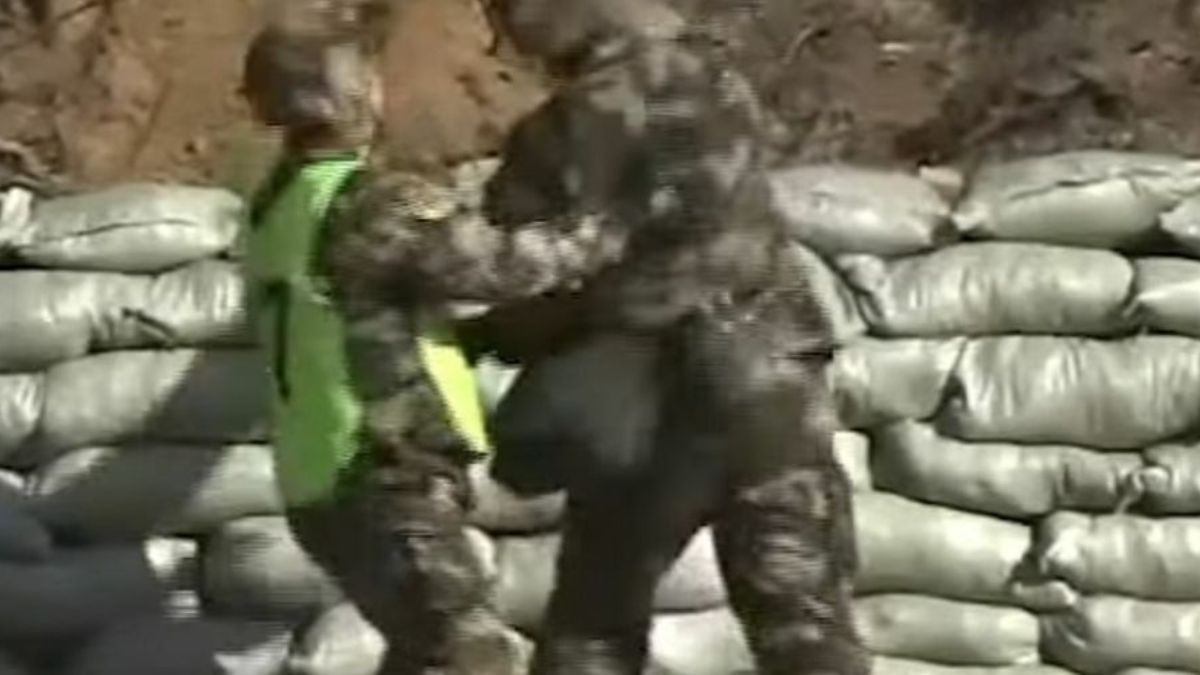
A viral video compilation making the rounds on social media has captured the attention of millions, and it is not hard to see why. The footage brings together a collection of ordinary people who, in a split second, managed to prevent disasters that could have turned deadly. From parents snatching children out of harm’s way to complete strangers rushing in to catch a falling person, the clip has been celebrated across platforms as proof that human instinct, at its finest, is a remarkable thing. Viewers around the world have reacted with awe, with many describing the individuals featured as nothing short of heroic.
What makes these moments so universally captivating is the sheer speed at which they unfold. There is no time to think, no moment to deliberate — the body simply reacts before the conscious mind has a chance to catch up. Scientists describe this as a reflex arc, a process in which sensory information bypasses the brain’s higher reasoning centers and triggers an almost automatic motor response. In high-stakes situations, this biological shortcut can mean the difference between a close call and a catastrophe. The people in the compilation did not choose to be heroes in any planned sense; their bodies simply did what human bodies are built to do under pressure.
The compilation has drawn particularly strong reactions for the moments involving parents and young children. In several clips, adults move with astonishing speed to grab toddlers teetering on edges or to intercept objects falling toward them. Psychologists have long noted that parental protective instinct can temporarily unlock physical capabilities that would otherwise seem impossible, sometimes referred to informally as “hysterical strength.” This phenomenon has been documented in numerous real-world cases where parents have lifted vehicles or broken through barriers to protect their children. The footage circulating online offers a vivid, real-time illustration of that instinct in action.
Equally striking are the moments involving strangers helping other strangers. In one segment of the compilation, a bystander lunges to catch a person who loses their footing on a staircase, making contact in what appears to be less than a second. Behavioral researchers studying prosocial behavior have found that bystander intervention is far more common in one-on-one situations than in large crowds, a phenomenon explained partly by diffusion of responsibility. When only one person is nearby, that individual is far more likely to act, and act fast. These clips serve as a powerful visual counterpoint to the more cynical notion that people are less inclined to help strangers in the modern world.
The compilation first gained traction on Facebook before spreading across other platforms, accumulating thousands of comments and shares within days of being posted. Social media users have been quick to label the participants as everyday heroes, and the term seems entirely fitting. There are no capes, no dramatic music swelling in the background — just regular people, caught on camera, doing something extraordinary in an utterly ordinary moment. For many viewers, that relatable quality is precisely what makes the footage so powerful and so easy to share.
From a physiological standpoint, human reflexes are divided into two broad categories: spinal reflexes, which are processed entirely within the spinal cord without involving the brain, and brainstem reflexes, which are governed by the lower brain. The classic example of a spinal reflex is the knee-jerk response triggered by a doctor’s rubber hammer, while the startle response to a sudden loud noise is a brainstem reflex. In everyday life, however, the most impressive reflex-like behaviors — such as catching a falling object or swerving to avoid a collision — are actually a blend of learned motor skills, attention, and rapid subconscious processing rather than pure reflexes in the strict neurological sense. Athletes and trained professionals often spend years honing these responses, but as the viral compilation demonstrates, untrained individuals can perform them just as impressively when the stakes are high enough.
Research into reaction time has shown that the average human responds to a visual stimulus in roughly 250 milliseconds, or about a quarter of a second. Sound-based stimuli are processed even faster, at around 170 milliseconds. These numbers can be significantly improved through training, focus, and physical conditioning, which is why athletes, firefighters, military personnel, and emergency responders invest so heavily in drills and simulations. But biology also plays a role — younger individuals tend to have faster reaction times, which peak in the mid-twenties and gradually slow with age. Despite this, the viral footage features people of varying ages, a reminder that motivation and circumstance can override whatever biological limitations might otherwise apply.
The popularity of reflex and rescue compilations on social media speaks to something deeper than a fascination with close calls. They offer viewers a dose of genuine optimism, a reminder that people are capable of remarkable things even without preparation or fanfare. In an era when much of what circulates online tends toward the divisive or the distressing, a video of a stranger catching a child mid-fall has a quietly powerful effect on the collective mood. Share your thoughts in the comments and let us know which moment from a viral rescue compilation has left the biggest impression on you.