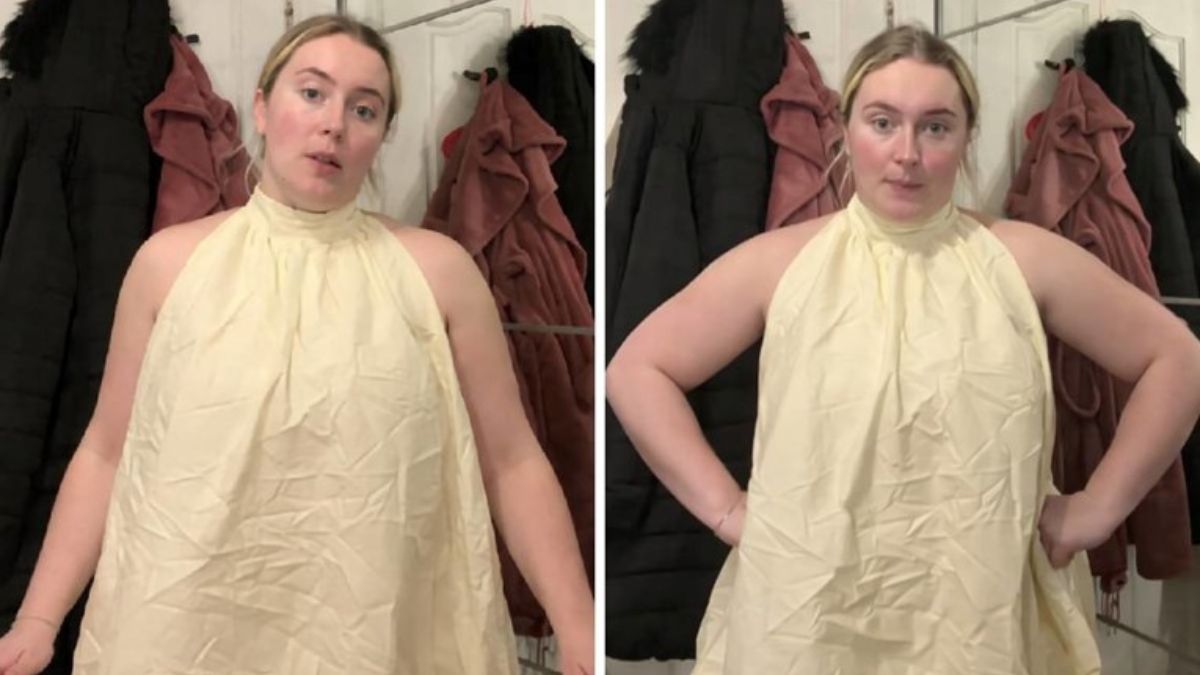
Online fashion shopping has produced millions of disappointments, but few people document them with quite the same comic flair as Emma Mather, a TikTok creator who recently bought a dress from PrettyLittleThing and then showed her followers exactly what arrived. What she had been hoping to receive was a butter-yellow puff-sleeve mini dress with a neck tie, the kind of going-out piece that looks flattering and fun in product photos. What she actually received, as she put it with perfect comic timing, was something rather different. The video has since surpassed 214,000 views, and the comment section reads like a group therapy session for anyone who has ever made a similar mistake.
Mather opened the video with a question that doubled as a confession: “Can someone please explain to me why I keep ordering from PLT?” The dress in question had originally been listed at around $42 but was available for approximately $29 on markdown at the time she purchased it, which perhaps explains the stubborn optimism that led her to click buy despite what she implied was a history of similar outcomes with the same retailer. When she put the dress on and turned to face the camera, the result was not the figure-flattering mini the product listing had suggested. The puffed fabric had puffed in all the wrong directions. The tie at the neck, rather than creating an elegant gathered effect, was doing something more structural and less glamorous. “I look like a potato sack with arms,” she said, equal parts defeated and amused, and then repeated the line as if it needed saying twice to be properly believed.
The follow-up commentary was equally sharp. “It’s terrible, it’s really bad,” she added, noting that on top of the styling failure, the dress had arrived in a state of significant crumpling, as though it had been folded into the smallest possible configuration and then left to contemplate its own inadequacy in a warehouse somewhere. She suggested it would need a thorough ironing before anyone could even make a fair assessment of it, though based on the overall evidence, a thorough ironing was unlikely to fully resolve the situation.
@emma.mather Could do with an iron tbh #plt #fashionfail ♬ original sound – Emma Mather
The comment section that assembled beneath the video demonstrated the particular TikTok talent for collective mockery that is warm rather than cruel. One viewer wrote that the exact same dress had been sitting in her own online shopping cart and thanked Mather sincerely for the intervention. Another described the result as looking like a latex glove turned inside out, which is a comparison that is both unkind to the dress and extremely accurate. Others contributed additional analogies of escalating creativity: a misplaced pillowcase, a decorating bag for icing cakes, a piece of shower curtain that had escaped from its rings and decided to pursue a life in fashion. The consensus was clear, and it was enthusiastic.
The broader phenomenon at play here is something that anyone who has shopped on fast fashion platforms will recognize immediately. Product photography is an art form specifically designed to make cheap fabric look desirable, and the gap between what a dress looks like on a model under studio lighting and what it looks like in real life can be genuinely staggering. The model in the PrettyLittleThing listing presumably did not look like a potato sack with arms. The lighting was soft. The fit had likely been clipped or pinned into submission at the back. Whatever fabric was used had been chosen with the photography rather than the customer in mind. None of this is disclosed anywhere on the product page. The $29 price tag is the only warning, and most people who have been shopping long enough know to interpret it accordingly, and then order anyway, because hope is remarkably durable.
PrettyLittleThing, the British fast fashion brand founded in 2012 and owned by the Boohoo Group, has built its entire identity around exactly this kind of accessible, trend-driven impulse purchase, marketing its clothes aggressively through influencer partnerships and social media campaigns that create an aspirational image while the actual products are produced at a price point that makes quality a secondary consideration. The irony is that TikTok, the platform through which PLT does a great deal of its marketing, has become simultaneously the most effective vehicle for calling out the gap between the promise and the reality. Emma Mather’s video is not unusual: there is an entire genre of fast fashion disappointment content on the platform, and it reliably outperforms the sponsored posts trying to sell the same products.
PrettyLittleThing was founded by Umar Kamani, the son of Boohoo co-founder Mahmud Kamani, and originally sold only accessories before expanding into clothing in 2013, growing so rapidly that it reached a $1 billion valuation within a decade despite never having had a physical retail presence. The fast fashion industry as a whole produces an estimated 92 million tons of textile waste per year globally, a figure that becomes genuinely disorienting when you consider that most of those discarded garments were purchased because someone saw a flattering product photo and thought, reasonably enough, that $29 seemed like a good deal. And there is actually documented research showing that the color butter yellow, which was the shade Mather ordered, photographs particularly warmly under studio lighting conditions, appearing richer and more luxurious than it tends to look in natural light, which helps explain why it appears constantly in fast fashion marketing and constantly disappoints in real life.
Have you had a similar online shopping disaster, and did you laugh about it or send it straight back? Share your experience in the comments.