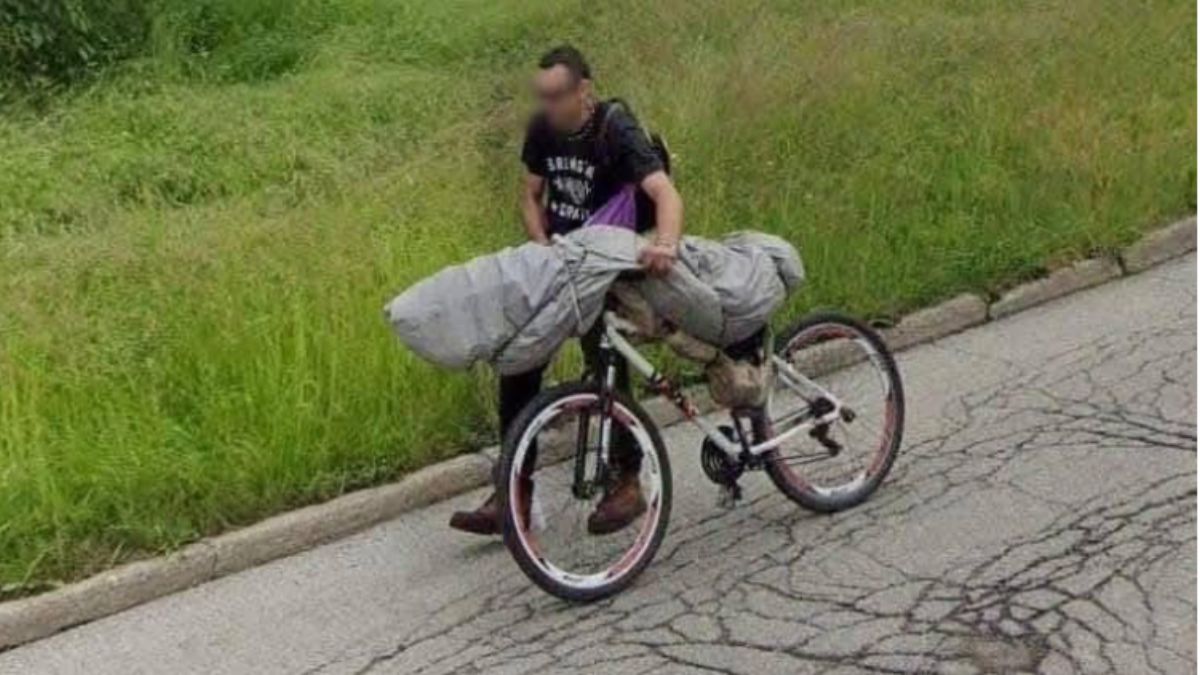
A peculiar image captured on Google Earth has ignited a fierce debate across social media, with people sharply divided over what is actually visible in the frame. The photograph shows a figure pushing a bicycle with a large, elongated bag draped over it, and the blurred quality of the surrounding image only added to the unsettling atmosphere. The post spread rapidly after it was shared on Threads by user @themrs_shari on February 27, quickly racking up over 1.5 million views as people scrambled to look up the location for themselves. The instructions she shared pointed viewers to Kent St. 44305 in Street View mode, where the mysterious scene can still be found.
In her original post, @themrs_shari urged followers to check the spot out personally. “Google Earth blurred the image, but you can still look it up,” she wrote. “Open Google Earth, search for the address Kent St. 44305, and turn on Street View. You’ll notice this guy in the middle of… who knows what.” The ambiguous shape of the object slung over the bicycle was enough to send imaginations running wild, and the comment sections filled up almost immediately with theories ranging from the mundane to the genuinely unsettling.
The darker interpretations centered on the long bag’s resemblance to a body bag, and the jokes came quickly. “That’s why I’m overweight. So no one can just dispose of my body on a bicycle,” one commenter quipped. Another user leaned further into the dark humor, writing “What bad luck. The camera hadn’t passed through that area in 15 years and they just happened to be getting rid of a body the day it came through. Hilarious how they got caught.” These kinds of comments, while clearly made in a tongue-in-cheek spirit, were precisely what turned the post into a viral sensation, as people debated and joked in equal measure.
However, not everyone was convinced by the more dramatic readings of the image. User @eastendlass shared a screenshot taken from a different angle of the same location and offered a strikingly different perspective. “From another angle it really doesn’t look like a body, does it?” she wrote alongside the image, prompting a wave of reconsideration among those who had been quick to assume the worst. The new vantage point revealed a far less sinister shape, and many viewers changed their minds after seeing it.
Several commenters also jumped in with straightforward explanations rooted in everyday reality rather than true crime speculation. “I’m sorry, but that is definitely not a body. It’s probably a homeless person carrying their sleeping bag,” one person wrote. Another agreed, saying “Yeah, it looks like a sleeping bag they’re using as a bag for all their belongings.” These interpretations were widely supported, with many pointing out that people who are unhoused often transport rolled-up sleeping bags and bundled belongings across bicycle frames in exactly this manner, creating a shape that can look alarming when captured in a blurry, low-resolution still image.
The incident fits neatly into a long tradition of Google Earth and Street View discoveries that capture accidental or coincidental moments frozen in time and stripped of all context. Without knowing the circumstances of a photograph, even the most ordinary scene can appear suspicious or strange, especially when combined with image blur that conceals identifying details. It is a reminder of how powerfully context shapes the way we interpret visual information and how quickly online crowds can construct narratives around an ambiguous image.
Google has addressed questions about how its imagery is collected and displayed on multiple occasions. The company notes that the photos shown in Google Earth and Street View are gathered over extended periods of time from a variety of providers and imaging platforms. “The images are not real-time, so you cannot track live changes,” Google explains. The company also clarifies that “the satellite and aerial images in Google Earth are captured by cameras on satellites and aircraft, with each photo taken on a specific date and at a specific time.” In some cases, imagery captured across multiple days or even months is stitched together into a composite mosaic and displayed as a single continuous view, which can occasionally produce visual inconsistencies or jarring transitions between frames.
Google Earth was first launched in 2001 under the name EarthViewer 3D by a company called Keyhole Inc., which was later acquired by Google in 2004. The platform was relaunched under its current name in 2005 and has since become one of the most widely used geographic tools in the world, offering satellite imagery, aerial photography, 3D terrain rendering, and the Street View feature that uses ground-level photography captured by specially equipped vehicles. Street View alone covers millions of miles of roads across more than 100 countries. The platform has been the subject of numerous viral moments over the years as users stumble upon unusual, funny, or eerie frames captured entirely by chance during routine data collection drives.
Have you ever spotted something strange or unexpected while browsing Google Earth or Street View? Share your stories in the comments.