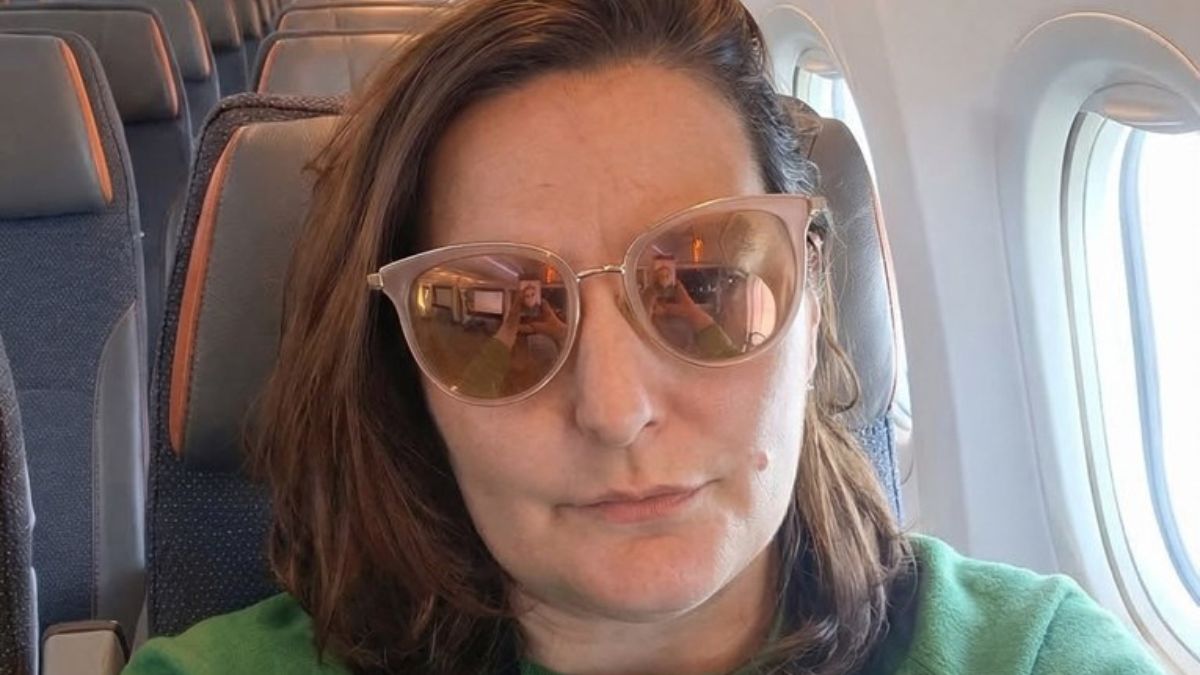
While most travelers were fleeing Dubai amid rising tensions across the Middle East, one woman decided to board a nearly empty plane headed straight for the United Arab Emirates. Marina Gilla, an English language teacher from Latvia, found herself as the sole passenger on a Flydubai flight departing from Riga. She documented the entire surreal experience on Instagram, where the video quickly went viral and left thousands of followers both stunned and deeply curious. Her story became one of the more unusual travel moments to capture the internet’s attention in early 2026.
Gilla posted a short clip showing rows upon rows of completely empty seats, captioning it simply with “When you’re the only passenger on a plane to Dubai, March 8, 2026.” The post spread rapidly across social media, with people flooding the comments section to ask the obvious question: why on earth was she flying there at all? It didn’t take long for Gilla to offer an explanation, and her answer surprised many who assumed the trip must have been some kind of personal adventure or impulse decision. In reality, the motivation was far more grounded and professional.
In her comments, Gilla revealed that a business opportunity she simply couldn’t pass up was the driving force behind the trip. “It was an unusual flight from Riga to Dubai. I was shocked that they didn’t cancel it and that I was able to go to the UAE because I received a good business offer,” she explained. Some commenters were critical, suggesting she should have turned down the offer given the circumstances, while others responded with envy, wishing they could have an entire aircraft to themselves. The divide in reactions reflected just how differently people assess risk when professional stakes are involved.
Despite being the only ticketed passenger aboard, Gilla was far from alone on the plane. Four flight attendants were on duty for the entire flight, and with no one else to attend to, they made the most of the unusual situation. “One of the flight attendants can be seen in another clip, and there were four of them total! And guess what they were doing? They sat in different parts of the aircraft to relax, eat, and enjoy their meals. Just like me,” she noted. The image of a handful of crew members scattered throughout an empty cabin, eating and unwinding mid-flight, struck many viewers as almost comically absurd given the circumstances.
The highlight of the experience, however, came from an unexpected personal gesture by the flight’s captain. Gilla shared that the pilot personally walked over to her seat, extended a warm welcome, and apologized for a delay of six hours before departure. “On top of everything, the pilot came over to me, welcomed me, and apologized for the six-hour delay,” she concluded. It was a small but memorable moment that underscored just how different the dynamic of a one-passenger flight truly is, with the usual anonymity of commercial aviation replaced by something almost intimate.
The backdrop to this story is the broader regional instability that had gripped the Middle East in the weeks prior. Following American and Israeli strikes on Iran on February 28, 2026, Iran responded with missile and drone attacks targeting US allies in the region, including the UAE and Saudi Arabia. Dubai, one of the world’s busiest travel and transit hubs, was placed on heightened alert as a result. Expats and tourists began leaving in large numbers, and airlines across the region canceled or suspended numerous routes due to airspace restrictions and safety concerns. Dubai International Airport, one of the busiest airports on the planet by international passenger volume, saw significant disruptions during this period.
The Flydubai airline, which operated Gilla’s flight, is a low-cost carrier based in Dubai and majority-owned by the government of Dubai. It operates scheduled passenger services to over 100 destinations across the Middle East, Africa, Europe, and Asia. Low-cost carriers often face difficult decisions during geopolitical crises, balancing the commercial pressure to keep routes open against passenger demand that can collapse overnight. The fact that this particular flight was not canceled, despite having only one confirmed passenger, speaks to the complex calculations airlines make when assessing route viability during uncertain times.
Dubai itself is a city-state within the UAE known for its rapid development over the past few decades, transforming from a modest pearl-diving and trading port into a global financial, tourism, and aviation powerhouse. The UAE has historically positioned itself as a neutral diplomatic player in the region, which has made cities like Dubai attractive destinations for international business professionals like Gilla. The city hosts hundreds of thousands of expatriates from across Europe, South Asia, and beyond, many of whom live and work there long-term while maintaining ties to their home countries. Events that destabilize the broader region therefore tend to have an outsized effect on Dubai, given how interconnected it is with global travel and commerce.
Would you fly to a destination in the middle of a regional crisis if a good business offer was on the table? Share your thoughts in the comments.