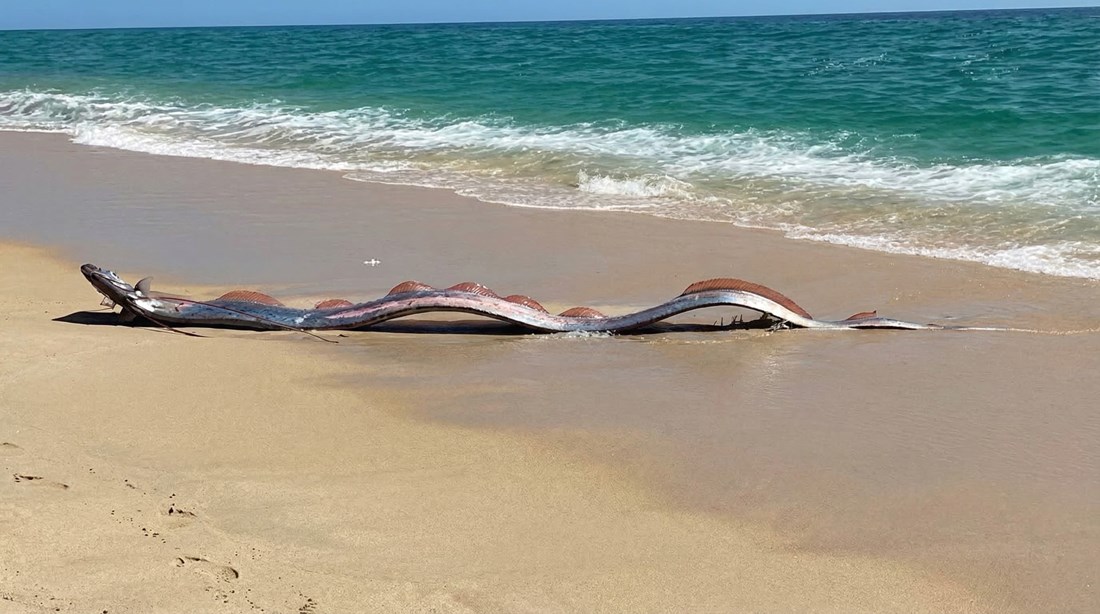
A bizarre and captivating scene recently unfolded on the shores of Cabo San Lucas, Mexico, where two extremely rare deep-sea creatures were spotted struggling in the shallow waters near the beach. The animals in question were oarfish, a species so seldom seen near the surface that their sudden appearance drew massive attention online. According to an ancient folk belief, spotting these fish is considered a bad omen foreshadowing natural disasters, though no scientific evidence supports that claim. The footage of the encounter was published on the YouTube channel We Love Animals and quickly spread across the internet.
The whole story began when two sisters noticed an unusual glimmer in the distance while walking near the water. At first, the sight seemed so strange that they could not believe what they were seeing. As they moved closer, the mystery was solved in the most unexpected way possible. According to the video’s description, “when they got closer, they realized the creatures struggling in shallow water were actually oarfish, a rare deep-sea species almost never seen near the surface.”
One of the sisters waded into the water and, along with the help of other beachgoers, attempted to guide one of the fish safely back toward open ocean. Just when everyone thought the excitement was over, a second creature appeared nearby. “As soon as they finished helping the first one, they spotted another oarfish near the shore,” the video description noted. The chances of such an event happening are extraordinarily slim, as the description pointed out: “Seeing even one is extremely rare. Seeing two in the same place is almost unheard of.”
The clip accumulated more than 1.6 million views, with comment sections flooded by people who were moved by what they witnessed. Many viewers directed their praise toward the woman who stepped in without hesitation to help the stranded animals. “What a fantastic person, without hesitation she jumped in to help this endangered fish! You’ve restored my faith in people!” one commenter wrote. Another added, “She tried to return it to the ocean and save its life. These fish live very deep and she showed great compassion and respect by returning it to the sea.”
One viewer described the rarity and sheer awe of the moment in detail: “Oarfish are creatures that have inspired myths and legends for centuries. It’s incredibly rare to see them alive. I’ve never seen footage like this. I hope these people save them. This is an incredible experience, one that most people only get once in a lifetime.” Not everyone was swept up in pure wonder, however. A more cautious commenter urged people not to rush into physical contact with unknown sea creatures, writing: “Her colors would make me think she’s venomous. She was lucky. Please be careful and watch what you touch before you do it. This could have really ended differently.”
The oarfish earned its eerie nickname through centuries of Japanese maritime folklore, which holds that these creatures are messengers sent by the gods of the sea to warn people of coming catastrophes such as earthquakes or tsunamis. That reputation turned the Cabo San Lucas sighting into fuel for plenty of dark humor on social media. One user on X wrote: “The ocean throws two literal harbingers of doom onto a beach in Cabo. Is it time to rethink my trip or do I just pack my apocalypse gear and pretend everything is fine?” Another quipped: “They say something bad happens after their appearance. Let’s hope they’re just late and all the bad stuff already happened.”
Despite how compelling the legend may seem, scientists are clear that there is no verified connection between oarfish sightings and seismic or other natural disasters. The folklore, while culturally fascinating, has not been backed by any peer-reviewed research or reliable data. The fish’s deep-sea habitat simply makes them a very unusual sight at the surface, which is likely what sparked the mythology in the first place.
The oarfish, known scientifically as Regalecus glesne, holds the distinction of being the longest bony fish in the world. It can reach lengths of up to roughly 30 feet, though some unconfirmed reports suggest even greater sizes. These fish are believed to live at depths of around 650 to 3,300 feet below the ocean’s surface, which explains why they are so rarely seen alive. Their long, ribbon-like silver bodies and distinctive red dorsal fin are thought to be the origin of many historical sea monster legends, including those involving massive serpents described by sailors throughout history. Because they live so far below the surface and are so seldom encountered, much of their biology and behavior remains poorly understood by researchers.
If you’ve ever had a close encounter with a rare or unexpected ocean creature, or if you have thoughts on the “doomsday fish” legend and the science behind it, share them in the comments.