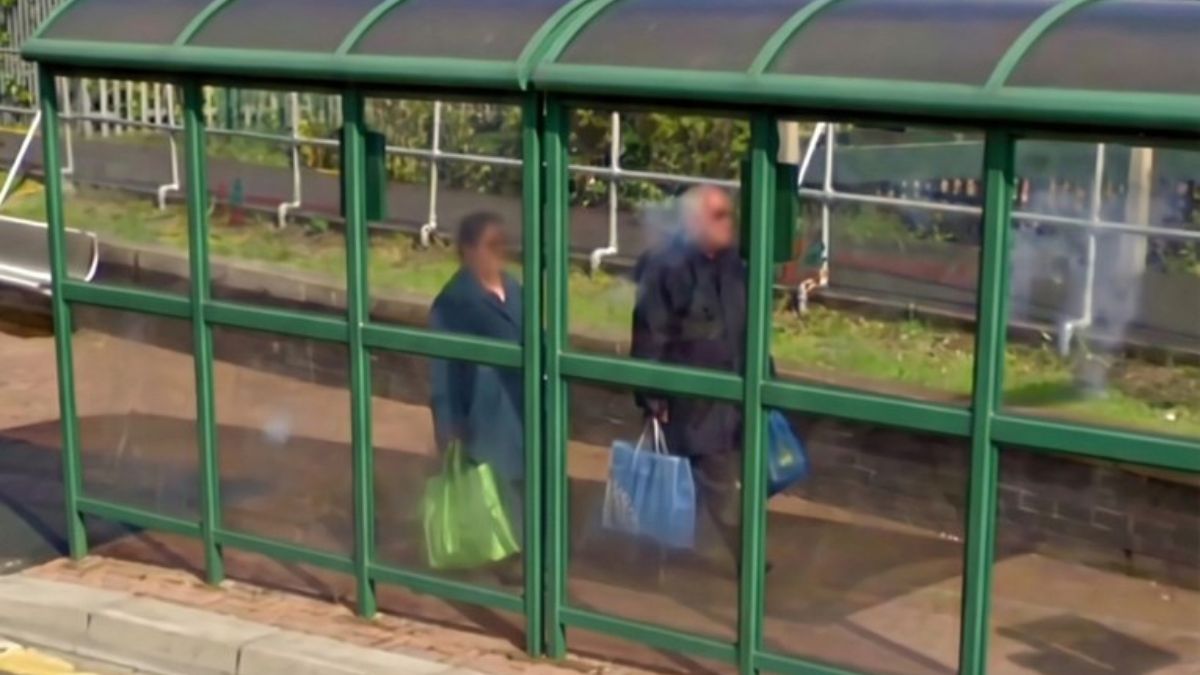
Sometimes the internet delivers moments no one could ever anticipate, and for one woman, a casual scroll through Google Maps turned into an unexpectedly emotional experience. Laura Jane had lost both her grandmother and her uncle, and while browsing the map service out of sheer curiosity, she stumbled upon something that stopped her in her tracks. In the small Welsh town of Mountain Ash, located in the Cynon Valley, she found a Street View image capturing her two beloved family members going about their everyday routine as if time had never moved on. The discovery was both heartwarming and heartbreaking in equal measure, and Laura Jane felt compelled to share it with the world.
She posted the find on her TikTok account, @janelaur15, along with a caption that resonated with countless people who have also lost someone dear to them. “My grandmother and uncle are still here, frozen in time, doing their everyday shopping together,” she wrote, describing the surreal feeling of seeing them preserved in an ordinary, peaceful moment. She added, “It’s crazy to have found this today. I miss them both every day.” The raw simplicity of those words struck a chord with viewers, and the post quickly gained widespread attention across social media platforms.
The response from other users was nothing short of overwhelming, with many coming forward to share their own similar discoveries on Google Maps and Street View. One commenter described finding their grandparents standing in front of their old family home, noting that their grandfather had since passed away and that they revisit the image from time to time just to feel close to him. Another person shared that their mother is still visible on Google Earth, parked in the driveway after returning home, having passed away in 2020. These moments, captured unintentionally by a mapping vehicle passing through an ordinary neighborhood on an ordinary day, have taken on enormous emotional weight for the families involved.
@janelaur15 crazy feeling finding this today 🥺 miss them both everyday🤍 #nan #loss #grandparentsoftiktok #fyp ♬ childhood – daniel.mp3 & Zamaro
What makes these discoveries so particularly poignant is the complete ordinariness of the scenes. There are no staged photos, no special occasions being documented, just people going about their daily lives without any idea that the image would one day serve as a kind of digital memorial. For many grieving families, these accidental snapshots offer something photographs and videos cannot always provide, which is the quiet, unguarded version of a person simply existing in the world. Grief researchers have long noted that unexpected reminders of loved ones can trigger what is known as a grief burst, a sudden wave of emotion that arrives without warning but can also bring genuine comfort alongside the sadness.
Google Maps was officially launched on February 8, 2005, initially as a desktop-only service, before expanding to become one of the most widely used navigation tools in the world. The Street View feature, which allows users to explore locations at ground level through 360-degree panoramic images, was introduced in 2007 and has since expanded to cover millions of miles of roads across more than 100 countries. Google typically updates Street View imagery every one to three years, though there is no fixed schedule, and the frequency varies considerably depending on the region. The platform also offers a historical imagery feature that allows users to scroll back through older versions of the same street, which is precisely what makes emotionally charged rediscoveries like Laura Jane’s possible.
The Street View imagery is collected by specially equipped vehicles, known as Street View cars, which are fitted with cameras mounted on top to capture continuous panoramic footage as they drive. In some areas, Google also uses trikes, snowmobiles, and even backpack-mounted camera systems called Trekkers to access locations where vehicles cannot go. Once captured, the imagery goes through a process that automatically blurs faces and license plates to protect individual privacy before being published to the platform. Despite these privacy measures, the technology has inadvertently created a kind of living archive of everyday life, one that families and researchers alike are only beginning to fully appreciate.
If you have ever come across a meaningful or unexpected moment while browsing Google Maps or Street View, share your experience in the comments.