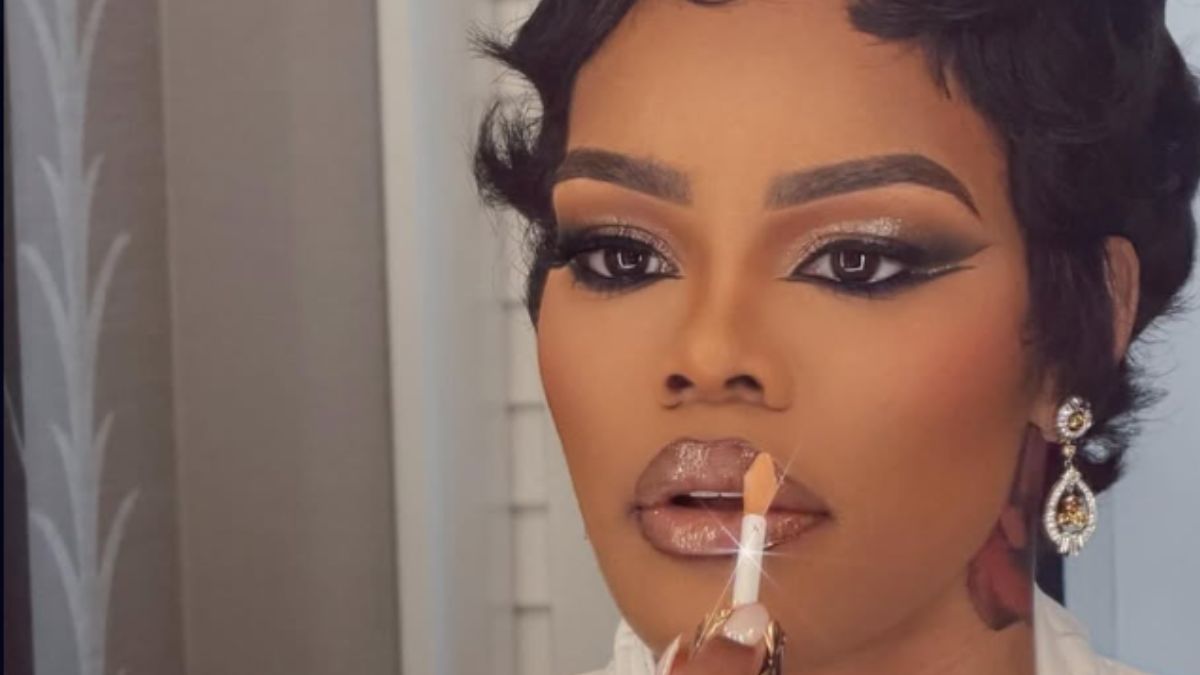
Lifestyle content creator Caroline Ricke wanted to put the widely discussed concept of “beauty privilege” to a real-world test, and she chose one of America’s most iconic retail destinations to do it. She dolled herself up in a form-fitting black dress and strappy heels, then headed to her local Home Depot expecting to turn heads and attract helpful strangers eager to assist her. What happened instead left her genuinely stunned and sparked a conversation that quickly spread across social media. Rather than receiving the warm reception she anticipated, she found herself sitting largely ignored by both shoppers and store employees.
In a video that went viral among her 3.2 million followers on TikTok, Ricke shared her frustration after the first visit. “Due to my eye-catching outfit, I experienced more restraint than flirting,” she explained to her audience, clearly surprised by the reaction. She sat in the store for roughly ten minutes, fully styled, and not a single person came over to offer assistance. “Nobody helps me. I’ve been sitting here for about ten minutes, and I dressed up head to toe, and nobody offered help,” she said, visibly disappointed.
Determined to understand what was really going on, Ricke returned to the same Home Depot location a short time later, this time wearing a relaxed sweatsuit and joggers with no effort put into her appearance. The shift in how people responded to her was immediate and dramatic. A female store employee approached her almost right away and showered her with compliments, calling her “beautiful,” “gorgeous,” and “cute.” Shortly after, a male employee handed her a valuable discount coupon, and in what felt like the universe playing along, she stumbled upon $60 lying on the floor.
The contrast between the two visits could not have been more striking, and Ricke made sure her followers knew about every detail. “This is literally my lucky day,” she said during her second visit, her mood a complete reversal from the first. She offered her own interpretation of the results, saying “I think they treat me better because I don’t scare them with my appearance,” suggesting that approachability played a much bigger role than traditional notions of attractiveness. The clip sparked immediate engagement, with thousands of viewers weighing in on their own similar experiences.
@richcaroline DOES PRETTY PRIVILEGE APPLY AT THE HARDWARE STORE?
♬ runway minimalist house music(1369360) – KAKKY
The comment section became a fascinating forum for debating how appearance and perceived approachability influence everyday social interactions. “In that outfit you seem more approachable!” wrote one viewer, validating Ricke’s own theory. Another offered a more detailed take, writing: “You’re already beautiful, so dressing more casually doesn’t change that, your beauty comes through even more because it’s carried by your face and confidence. In formal clothes people are simply intimidated.” The responses painted a picture of a deeply held collective belief that polished, dressed-up appearances can actually create emotional distance between people.
Several commenters shared their own parallel experiences from everyday life. One female Home Depot shopper chimed in with “When I go dressed casually, men approach me in almost every other aisle,” reinforcing the idea that this phenomenon extends well beyond Ricke’s experiment. Another tied it to a broader cultural trend, comparing it to the growing popularity of wearing comfortable, casual clothing in social settings like bars and clubs. “Men told me it’s intimidating to approach me when I’m all dressed up. It’s all about that girl-next-door vibe,” one user noted. A particularly sharp commenter summed up the whole experiment simply, declaring that in the contest between “approachable” and “unapproachable” clothing, approachable wins every time.
The experiment also reignited debate around the idea of “beauty privilege,” a term used to describe the social and professional advantages that conventionally attractive people are often said to receive in everyday life. Research in social psychology has long suggested that physically attractive individuals tend to be perceived as more competent, trustworthy, and likable, a phenomenon sometimes called the “halo effect.” However, Ricke’s experience points to a more nuanced reality, one where the way attractiveness is presented and packaged matters just as much as attractiveness itself. Studies have also found that people tend to approach and engage more freely with individuals who appear relaxed and non-threatening, regardless of their physical appearance.
Home Depot, founded in 1978 and headquartered in Atlanta, Georgia, is the largest home improvement retailer in the United States, with over 2,300 stores across North America. It serves both everyday consumers and professional contractors, making it a uniquely diverse social environment where all kinds of people cross paths on a daily basis. TikTok, the platform where Ricke shared her experiment, has become one of the most influential spaces for social commentary, with videos about beauty standards, dating dynamics, and human behavior regularly racking up millions of views. The platform’s short-form video format makes it particularly well-suited for real-world social experiments that invite immediate viewer reactions.
What do you think about Caroline Ricke’s experiment and the idea that casual clothing makes people more approachable? Share your thoughts in the comments.